


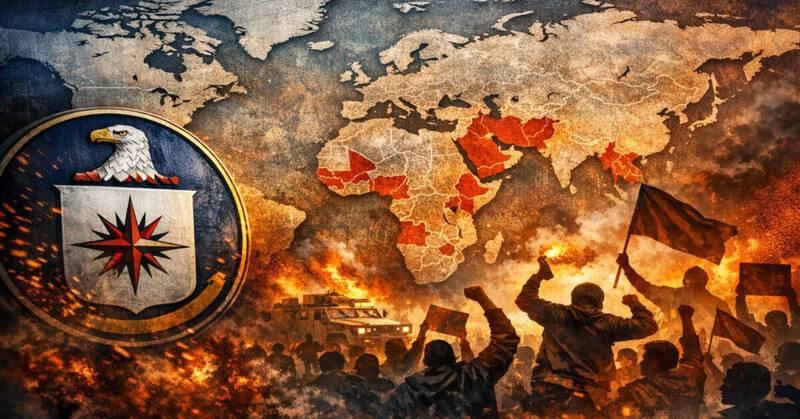
15 Times The U.S. Ruthlessly Deposed International Leaders

0
35

15 Times The U.S. Ruthlessly Deposed International Leaders

5. João Goulart, Brazil (1964)

15 Times The U.S. Ruthlessly Deposed International Leaders
U.S. intervention in 1964 Brazil facilitated a military coup against President Goulart, shaping Cold War dynamics.

In 1964, the United States covertly supported Brazilian military leaders who deposed President João Goulart. Goulart’s leftist policies and perceived alignment with communism raised concerns in Washington. The U.S. provided financial and logistical assistance to the coup plotters, facilitating the establishment of a military dictatorship that lasted two decades. This intervention aimed to curb leftist influence in Latin America and prevent the spread of communism during the Cold War. (wilsoncenter.org)

6. Sukarno, Indonesia (1965-1967)

15 Times The U.S. Ruthlessly Deposed International Leaders
U.S. support for Indonesia’s 1965 coup led to widespread violence and mass killings.

In 1965, the United States provided support and intelligence to Indonesian generals who ousted President Sukarno, fearing his leftist policies and ties to the Communist Party of Indonesia (PKI). Following the coup, the Indonesian military, under General Suharto, initiated mass killings of suspected communists, resulting in an estimated 500,000 to one million deaths. Declassified U.S. documents reveal that American officials had detailed knowledge of the massacres and actively encouraged the military’s actions to eliminate the PKI and secure a pro-Western regime. (theguardian.com)

7. Salvador Allende, Chile (1973)

15 Times The U.S. Ruthlessly Deposed International Leaders
Salvador Allende’s presidency marked a pivotal moment in Chilean history, ending with a military coup.

In 1970, Salvador Allende became Chile’s first democratically elected socialist president. Concerned about his leftist policies, the U.S. initiated Project FUBELT to prevent his rise to power. Despite these efforts, Allende was inaugurated. Over the next three years, the U.S. continued covert operations, including funding opposition media and strikes to destabilize his government. On September 11, 1973, a military coup led by General Augusto Pinochet overthrew Allende, leading to a 17-year dictatorship marked by human rights abuses. (npr.org)

8. Isabel Perón, Argentina (1976)

15 Times The U.S. Ruthlessly Deposed International Leaders
U.S. support for Argentina’s 1976 military junta enabled human rights abuses during the “Dirty War.

In 1976, the United States provided indirect support to the Argentine military junta that overthrew President Isabel Perón. This assistance included military aid and training, which facilitated the junta’s operations during the “Dirty War,” a period marked by widespread human rights abuses. Declassified U.S. documents reveal that American officials, including Secretary of State Henry Kissinger, encouraged the junta’s actions against leftist opponents. (britannica.com)

9. Jean-Bertrand Aristide, Haiti (1991, 2004)

15 Times The U.S. Ruthlessly Deposed International Leaders
Jean-Bertrand Aristide’s tumultuous presidency reflects U.S. influence in Haitian politics.

Jean-Bertrand Aristide, Haiti’s first democratically elected president, was ousted from office twice with U.S. involvement. In 1991, a military coup led by General Raoul Cédras deposed Aristide, prompting U.S. intervention under Operation Uphold Democracy to restore him in 1994. In 2004, amid political unrest and armed insurgency, Aristide resigned and was flown into exile, with the U.S. facilitating his departure. Aristide later claimed he was forced out, describing the event as a “political kidnapping.” (en.wikipedia.org)

10. Manuel Noriega, Panama (1989)

15 Times The U.S. Ruthlessly Deposed International Leaders
Operation Just Cause: A pivotal U.S. intervention in Panama, reshaping governance and influence.

In 1989, the United States launched Operation Just Cause to depose Panamanian leader General Manuel Noriega, who had fallen out of favor with Washington due to his involvement in drug trafficking and the annulment of democratic elections. The invasion resulted in the capture of Noriega, the restoration of democratic governance, and the reassertion of U.S. influence in Panama. However, the operation was controversial, leading to civilian casualties and raising questions about U.S. interventionism. (bbc.com)

11. Slobodan Milošević, Serbia (2000)

15 Times The U.S. Ruthlessly Deposed International Leaders
Belgrade 2000: Citizens unite in protest against Milosevic’s regime, demanding democratic change.

In 2000, the United States provided substantial support to Serbian opposition groups aiming to oust President Slobodan Milošević. This assistance included funding for the Otpor! movement, a student-led organization that played a pivotal role in mobilizing public dissent against Milošević’s regime. The U.S. also offered training, resources, and strategic advice to opposition parties and civil society organizations. These efforts contributed to the peaceful overthrow of Milošević following the 2000 Yugoslavian general election. (en.wikipedia.org)

12. Saddam Hussein, Iraq (2003)

15 Times The U.S. Ruthlessly Deposed International Leaders
The 2003 Iraq invasion: a turning point marked by regime change and lasting turmoil.

In 2003, the United States led a coalition that invaded Iraq, toppling President Saddam Hussein’s regime. The invasion was justified by claims that Iraq possessed weapons of mass destruction (WMDs) and had ties to terrorist organizations. Despite extensive searches, no WMDs were found. The conflict led to prolonged instability, sectarian violence, and the emergence of extremist groups. Hussein was captured in December 2003, tried for crimes against humanity, and executed in December 2006. (britannica.com)

13. Muammar Gaddafi, Libya (2011)

15 Times The U.S. Ruthlessly Deposed International Leaders
NATO’s 2011 intervention in Libya aimed to protect civilians amidst civil conflict.

In 2011, NATO, under strong U.S. leadership, intervened in Libya’s civil conflict to enforce United Nations Security Council Resolution 1973, which aimed to protect civilians from Muammar Gaddafi’s forces. The intervention began on March 19, 2011, with airstrikes targeting Gaddafi’s military assets. By October 31, 2011, NATO concluded its operations after Gaddafi’s death. The aftermath was marked by political instability, ongoing violence, and the emergence of armed militias, leading to a protracted period of chaos in Libya. (bbc.com)

14. Viktor Yanukovych, Ukraine (2014)

15 Times The U.S. Ruthlessly Deposed International Leaders
U.S. support for Ukraine’s 2014 Euromaidan movement reshaped regional dynamics and international relations.

In 2014, during Ukraine’s Euromaidan movement, the United States provided support to protesters advocating for closer ties with the European Union. This assistance included diplomatic backing and, reportedly, non-lethal aid. The movement led to President Viktor Yanukovych’s ouster in February 2014. His removal significantly strained U.S.-Russia relations, contributing to Russia’s annexation of Crimea and the onset of the conflict in Eastern Ukraine. (reuters.com)

15. Evo Morales, Bolivia (2019)

15 Times The U.S. Ruthlessly Deposed International Leaders
Evo Morales resigns amid election irregularities and military pressure, igniting political turmoil in Bolivia.

In 2019, following disputed elections, Bolivian President Evo Morales resigned under military pressure. The Organization of American States (OAS) reported irregularities in the election, leading to widespread protests. Amid escalating unrest, Morales stepped down, and the U.S. swiftly recognized the interim leadership, a move that some critics labeled a coup. Morales sought asylum in Mexico, and Bolivia faced political turmoil and uncertainty. (theguardian.com)

Aftershocks and Legacy of U.S. Interventions

15 Times The U.S. Ruthlessly Deposed International Leaders
U.S.-backed regime changes have fostered instability and ethical debates in foreign policy.

The history of U.S.-backed regime changes has left a legacy of political instability, economic decline, and social upheaval in many affected nations. Interventions often led to unintended consequences, including civil wars, human rights abuses, and the rise of extremist groups. These outcomes have sparked ongoing debates over the ethics and effectiveness of democracy promotion through foreign intervention. Calls for accountability in U.S. foreign policy have intensified, emphasizing the need for strategies that prioritize long-term stability and respect for national sovereignty. (cato.org)

Search
Categories
Read More
Games
Fresh Arc Raiders roadmap promises new high-level matchmaking soon, followed by a major threat and some love for Scrappy
Fresh Arc Raiders roadmap promises new high-level matchmaking soon, followed by a major threat...
By Test Blogger6 2026-01-24 11:02:14 0 1K
Games
In a familiar twist of fate, Cyberpunk 2077's TCG adaptation needs a lot more time in the oven
In a familiar twist of fate, Cyberpunk 2077's TCG adaptation needs a lot more time in the oven...
By Test Blogger6 2026-02-06 18:00:38 0 787
Music
Sharon Osbourne’s Wild Tactics to Keep Ozzy From Drugs + Alcohol
‘This Will Stop Him’ - Sharon Osbourne’s Wild Tactics to Keep Ozzy From Drugs + AlcoholYouTube -...
By Test Blogger4 2026-02-24 17:00:08 0 213
Games
How to get forklift key in Resident Evil Requiem
How to get forklift key in Resident Evil Requiem Where do you get the forklift key in...
By Test Blogger6 2026-02-26 13:01:24 0 132
Food
7 Grocery Store Items That May Be Harder To Find In 2026
7 Grocery Store Items That May Be Harder To Find In 2026...
By Test Blogger1 2026-02-01 22:00:08 0 972