


Global Market Expansion with Strong Regional Demand
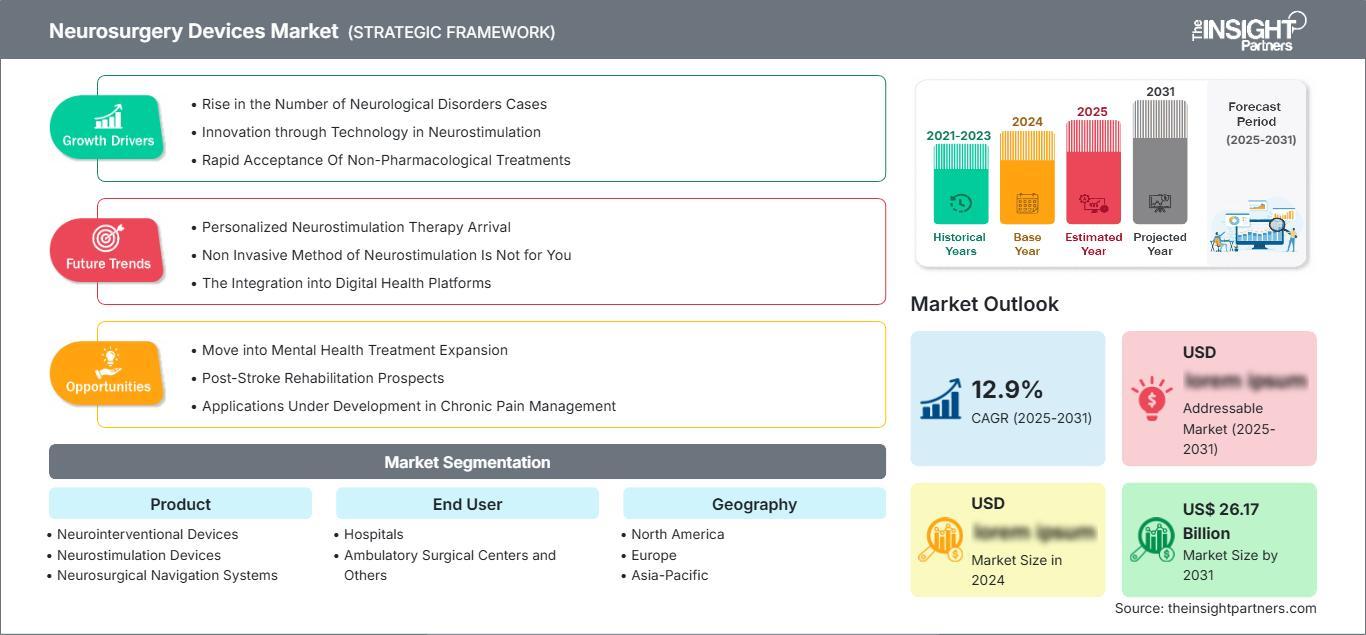
North America remains a leading region in the neurosurgery devices market due to advanced healthcare infrastructure and high adoption of cutting-edge technologies. At the same time, Asia-Pacific is emerging as a high-growth region driven by improving healthcare access and rising awareness of neurological treatments. This global demand is expected to sustain long-term market growth.
Accelerated Market Growth and Future Forecasts
The global neurosurgery devices market was valued at several billion USD in 2024 and is anticipated to reach approximately USD 26.17 billion by 2031, growing at a CAGR of around 12.9% from 2025 to 2031. This growth trajectory reflects strong demand across hospitals and ambulatory surgical centers, driven by the increasing prevalence of neurological disorders and enhanced focus on advanced surgical technologies.
Key Device Segments Driving Innovation
Neurosurgery devices encompass a wide range of technologies, each serving critical clinical needs:
- Neurointerventional devices — for treating vascular conditions such as aneurysms.
- Neurostimulation systems — increasingly used for chronic pain, movement disorders, and mental health applications.
- Neurosurgical navigation tools — improving surgical precision with real-time guidance.
- Neurosurgical power tools and CSF management devices — essential for complex brain and spinal procedures.
Technological advancements — from AI-enhanced navigation to smaller, more efficient implantable stimulators — are reshaping procedural outcomes and encouraging broader adoption.
Rising Prevalence of Neurological Disorders
One of the central drivers of market expansion is the growing incidence of neurological conditions like Parkinson’s disease, epilepsy, traumatic brain injury, and stroke. These disorders often require complex surgical intervention; therefore, demand for precise and effective neurosurgery tools continues to rise. The increasing aging population worldwide further exacerbates this trend, as neurological conditions tend to be more prevalent in older adults.
Technological Breakthroughs Enhancing Surgical Precision
Innovation in neurosurgery devices is transforming how surgeons plan and execute procedures. Modern neurosurgical navigation systems integrate advanced imaging modalities such as intraoperative MRI and CT to guide surgeries with enhanced accuracy. At the same time, AI and machine learning are being integrated to assist with procedural planning and real-time decision support, improving outcomes and reducing surgical risks.
Robotic-assisted devices and minimally invasive tools are also gaining traction, enabling complex interventions with smaller incisions, quicker recovery times, and reduced patient morbidity. These technological leaps are fostering greater confidence among clinicians and patients alike.
Hospitals and Ambulatory Centers: End Users Shaping Demand
Hospitals remain the primary end users of neurosurgery devices due to their capacity to perform a broad spectrum of surgical interventions and their access to specialized neurosurgical teams. However, ambulatory surgical centers are emerging as high-growth settings as minimally invasive procedures become more feasible outside traditional hospital environments. These facilities offer shorter patient stays, lower procedural costs, and improved operational efficiency, driving greater adoption of advanced neurosurgical technologies.
Regional Insights: North America Leads the Charge
North America dominates the neurosurgery devices market — supported by robust healthcare infrastructure, deep technological integration, strong R&D funding, and accessible reimbursement pathways. The United States particularly stands out as the largest national contributor due to significant investment in medical technology and high procedural volumes. Meanwhile, regions such as Asia-Pacific are expected to grow rapidly as healthcare access expands and awareness of neurosurgical solutions increases.
Challenges and Growth Opportunities
Despite the positive outlook, the market faces challenges including high equipment costs, stringent regulatory pathways, and disparities in healthcare access across emerging regions. However, these barriers also create opportunities for innovation — particularly in cost-effective device design, telemedicine integration, and training-focused tools. Personalized neurostimulation therapies and AI-supported surgical systems are among the most promising areas for future growth, with potential applications expanding into mental health, stroke rehabilitation, and chronic pain management.
Conclusion: A Dynamic Landscape for Neurosurgical Advancement
The neurosurgery devices market is poised for substantial growth as healthcare systems embrace new technologies and respond to the global rise in neurological disorders. From enhanced surgical precision and minimally invasive platforms to expanding treatment applications, the market’s evolution promises to improve surgical outcomes and patient quality of life. Continued investment in R&D, coupled with strategic adoption of next-generation technologies, will be key to unlocking the full potential of neurosurgical care in the years ahead.
Related Reports @
Adult Neurosurgery Devices Market Size and Forecasts (2021 - 2031)
Neurosurgery Market Size and Forecasts (2021 - 2034)
About Us -
The Insight Partners provides comprehensive syndicated and tailored market research services in the healthcare, technology, and industrial domains. Renowned for delivering strategic intelligence and practical insights, the firm empowers businesses to remain competitive in ever-evolving global markets.
Contact Information
Email: sales@theinsightpartners.com
Also Available in : Korean German Japanese French Chinese Italian Spanish

 English
 Arabic
 French
 Spanish
 Deutsch
 Turkish
 Dutch
Dutch
 Italiano
 Russian
 Romaian
 Portuguese (Brazil)
 Greek
Greek