Automotive fabric Market Overview
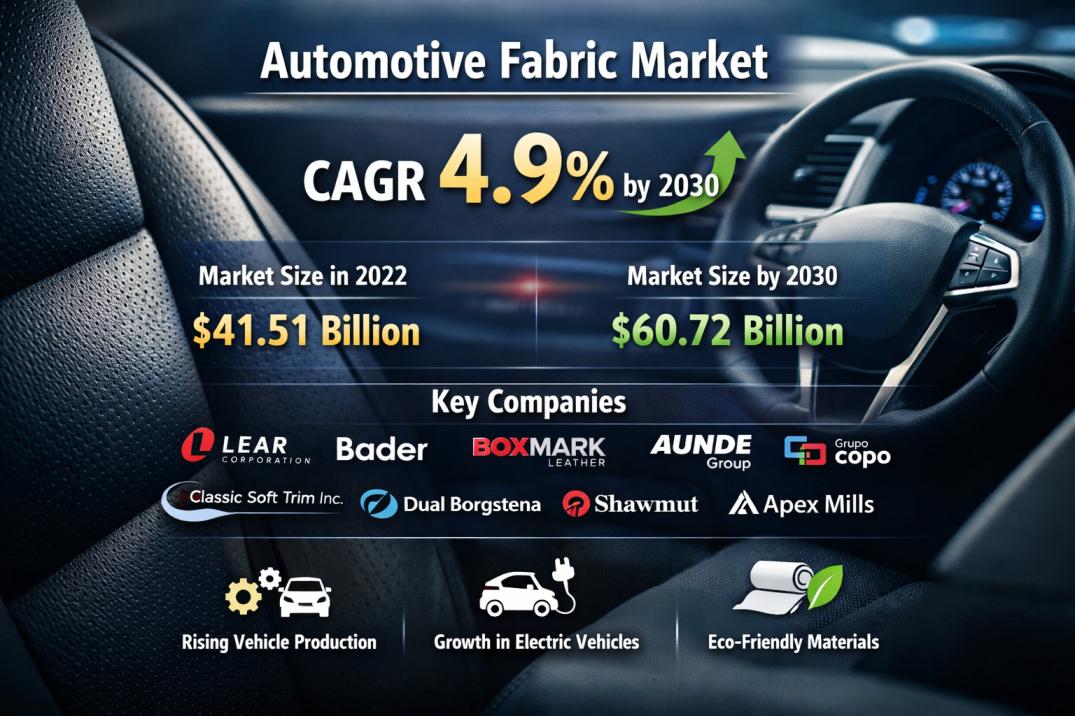
The Automotive Fabric Market was valued at US$ 41,513.83 million in 2022 and is projected to reach US$ 60,722.34 million by 2030, registering a CAGR of 4.9% from 2022 to 2030. The market growth is strongly linked to increasing vehicle production, growing electric vehicle adoption, and rising consumer preference for premium and comfortable interiors.
Automotive manufacturers are continuously investing in advanced textile technologies to enhance durability, safety, and environmental sustainability. With the automotive industry focusing on innovation and lightweight solutions, demand for high performance fabrics is steadily increasing.
Automotive fabric Market Growth Drivers
Rising Vehicle Production
Global vehicle manufacturing continues to expand, especially in Asia Pacific and Europe. Growing demand for passenger cars and commercial vehicles directly increases the consumption of automotive interior materials.
Growing Electric Vehicle Demand
Electric vehicles require lightweight materials to improve battery efficiency and driving range. Automotive fabrics contribute significantly to weight reduction compared to traditional materials, supporting EV adoption.
Focus on Comfort and Aesthetics
Consumers increasingly prioritize luxury, comfort, and advanced interior styling. Premium seat coverings, artificial suede, and advanced textiles enhance the overall driving experience.
Stringent Safety Regulations
Government regulations mandate safety features such as airbags, seat belts, and proper insulation systems. High performance automotive fabrics are essential in manufacturing these safety components.
Sample PDF:- https://www.theinsightpartners.com/sample/TIPRE00006211
Automotive fabric Market Challenges
Despite steady growth, the market faces certain restraints. Synthetic leather production using PVC and PU involves energy intensive processes and environmental concerns. Additionally, genuine leather is costly, and some synthetic alternatives offer limited durability compared to natural materials. Sustainability regulations are pushing manufacturers to adopt eco friendly production methods, which may increase operational costs.
Automotive fabric Market Segmental Analysis
By Component
-
Carpet
-
Headliner
-
Hood Liner
-
Insulation
-
Seat Covering Material
-
Others
Carpet and seat covering materials account for a significant market share due to their extensive application in vehicle interiors. Insulation fabrics are also gaining importance due to rising focus on noise reduction and thermal management.
By Material
-
Textiles
-
Artificial Leather
-
Genuine Leather
-
Artificial Suede
The textiles segment held a dominant position in 2022 due to versatility and cost effectiveness. Artificial suede is witnessing rising demand in luxury vehicle segments.
Regional Analysis
Asia Pacific leads the market, supported by large scale automotive production in China, Japan, and India. Europe represents a significant share owing to strong automotive manufacturing capabilities in Germany, the UK, and Italy. North America is projected to experience steady growth driven by technological advancements and increasing EV production.
Competitive Landscape
The Automotive Fabric Market is highly competitive with the presence of major global players focusing on acquisitions, expansion, and innovation. Companies are strengthening their portfolios through smart manufacturing technologies and sustainable fabric solutions to gain a competitive edge.
What factors are driving the Automotive Fabric Market growth?
The key drivers include increasing vehicle production, growing electric vehicle demand, rising preference for premium interiors, and stringent automotive safety regulations.
Which material segment dominates the market?
Textiles dominate the market due to their wide application, durability, lightweight nature, and cost effectiveness.
Why is Asia Pacific the leading region in the Automotive Fabric Market?
Asia Pacific leads due to high automotive production volumes, presence of major manufacturers, and growing domestic vehicle demand.
Future Outlook
The Automotive Fabric Market is expected to witness sustained growth through 2030. Increasing adoption of sustainable textiles, advancements in lightweight materials, and integration of smart interior technologies will shape future demand. As electric vehicles and premium mobility solutions gain traction, automotive fabric manufacturers focusing on innovation and eco friendly production processes are likely to capture significant long term growth opportunities.




 English
 Arabic
 French
 Spanish
 Portuguese
 Deutsch
 Turkish
 Dutch
Dutch
 Italiano
 Romaian
 Portuguese (Brazil)
 Greek
Greek