


9 of the Worst Trees to Plant in Your Yard (and What to Plant Instead)
9 Trees to Never Plant in Your Yard (and What to Plant Instead)
Key Takeaways
- Bradford pear trees are invasive, have a weak limb structure, and their blooms emit an unpleasant aroma.
- Norway spruce and Norway maples are both considered invasive and can cause ecological disruption.
- River birches are preferable alternatives to paper birches due to their resilience to pests and suitability in warmer climates.
Trees can provide a multitude of benefits to your garden and the planet, but the worst trees to plant in your yard cause more headaches than they're worth. These are the varieties that grow too large, produce tons of debris from falling twigs and leaves, or clog drains and break sewage pipes with their aggressive roots. Throw in invasive species, and your choice of tree could create problems for you and the local ecosystem. Here are 9 trees to avoid, and what to plant instead.
Bradford Pear
Susan A. Roth
Bradford pear (Pyrus calleryana) blooms are a sign of spring in many areas. Their pretty white flowers are spectacular, but many homeowners have come to regret planting them. The flowers have a sickeningly sweet aroma (and that's being kind), the tree is exceedingly invasive, and the tree's limb structure is weak and prone to storm damage.
What to Plant Instead
Native serviceberries (Amelanchier spp.) are beautiful small trees or shrubs that offer all-season interest. Serviceberries bloom early in spring with white, pink, or yellow blossoms, providing ample sources of nectar for pollinators. Small, edible berries form in summer, and the green foliage turns fiery red and orange colors in fall. In winter, the plant displays stunning silver bark.
Norway Spruce
Hailing from central and northern Europe, the Norway spruce (Picea abies) has been planted in gardens throughout North America for many years due to its large, yet manageable, size, dark green color, and drooping side branches that sway back and forth in the wind. They’re also fast-growing evergreen trees, giving them a leg up on many other spruces.
While they might be beautiful trees that grow quickly in the colder parts of their range, they tend to reseed and have become invasive in parts of the northern U.S. and Canada, making them an unsustainable choice in those areas.
What to Plant Instead
Denny Schrock
Skip the Norway spruce, and choose the similar-in-appearance Engelmann spruce (Picea engelmannii). This native of North America has graceful sweeping branches and is only slightly less hardy than the Norway spruce in Zones 3-8, but it presents less risk of introducing an invasive species into your local ecosystem.
Norway Maple
Kritsada Panichgul
Another native of Europe, the Norway maple (Acer platanoides) and its numerous cultivars have grown in parks and gardens for many years owing to their large leaves and beautiful fall colors. They come in the typical green leaf forms and variegated and purple varieties.
Their beauty aside, Norway maples are exceedingly messy trees and produce what must be millions of seeds each year. From these seeds come thousands of seedlings, and in certain parts of the U.S., they’ve become yet another invasive species, blocking out native plants and disrupting ecosystems.
What to Plant Instead
If you’re looking for a maple tree, go with a red maple (Acer rubrum). Native to North America and capable of surviving in several soil types and environments, these popular trees come in lots of varieties that showcase their amazing fall colors.
Black, White, and Green Ash
Denny Schrock
Black, white, and green ash trees (Fraxinus spp.) are known for their quick growth, clean, rounded shape, and buttery yellow to vibrant red and orange fall colors. They were heavily planted in the U.S. during the 1960s and 1970s due to these characteristics and were touted as ideal street trees.
Unfortunately, with the arrival of the emerald ash borer from Asia, entire cities have had to cut down thousands of dead ash trees. Even with regular (and somewhat expensive) treatment, ashes tend to succumb to these destructive insects eventually.
What to Plant Instead
Until plant breeders can introduce ash borer-resistant trees, the Kentucky coffee tree (Gymnocladus dioicus) is a great alternative. A member of the legume family, this tree produces large compound leaves that turn bright yellow in the fall.
Weeping Willow
Dean Schoeppner
Weeping willows (Salix babylonica) are beautiful trees when planted in an open landscape next to a pond or small lake. Their swaying branches and bright fall color look amazing in the right location. However, outside of a spacious location, they quickly become overcrowded.
These large trees prefer moist to wet soils, which is great for planting near water bodies, but when planted near homes, they tend to invade and destroy water pipes and sewer systems. Plus, as they age, weeping willows become brittle and drop large branches.
What to Plant Instead
Wirestock / Getty Images
Swamp white oak (Quercus bicolor) is an excellent alternative to weeping willow. A native of much of the eastern half of the U.S., this oak tolerates a wide variety of environments and has beautiful large leaves. It prefers to grow in lowlands and otherwise wet areas in much the same way as weeping willows. Topping out at around 80 feet tall, these trees live for hundreds of years and are exceedingly durable.
Paper Birch
Janet Loughrey
Birches are beautiful specimen trees that have long been used in landscapes for their rustic yet elegant look. Often planted in groups of three or four, their appeal is obvious, and they grow throughout the United States (Hardiness Zones 2-7), far outside of their natural range in the far north.
Unfortunately, paper birch trees (Betula papyrifera) have drawbacks that make them poor choices for the modern landscape. Like all other birches, they drop vast quantities of leaves, branches, catkins, and seeds, making them one of the worst trees to plant near pools or high-traffic areas. These messy trees prefer cold climates but are often planted in much hotter, drier climates than they can handle, leaving them looking sickly. On top of that, paper birches are prone to attack by bronze birch borers, insects that tunnel through the tree, eventually killing it.
What to Plant Instead
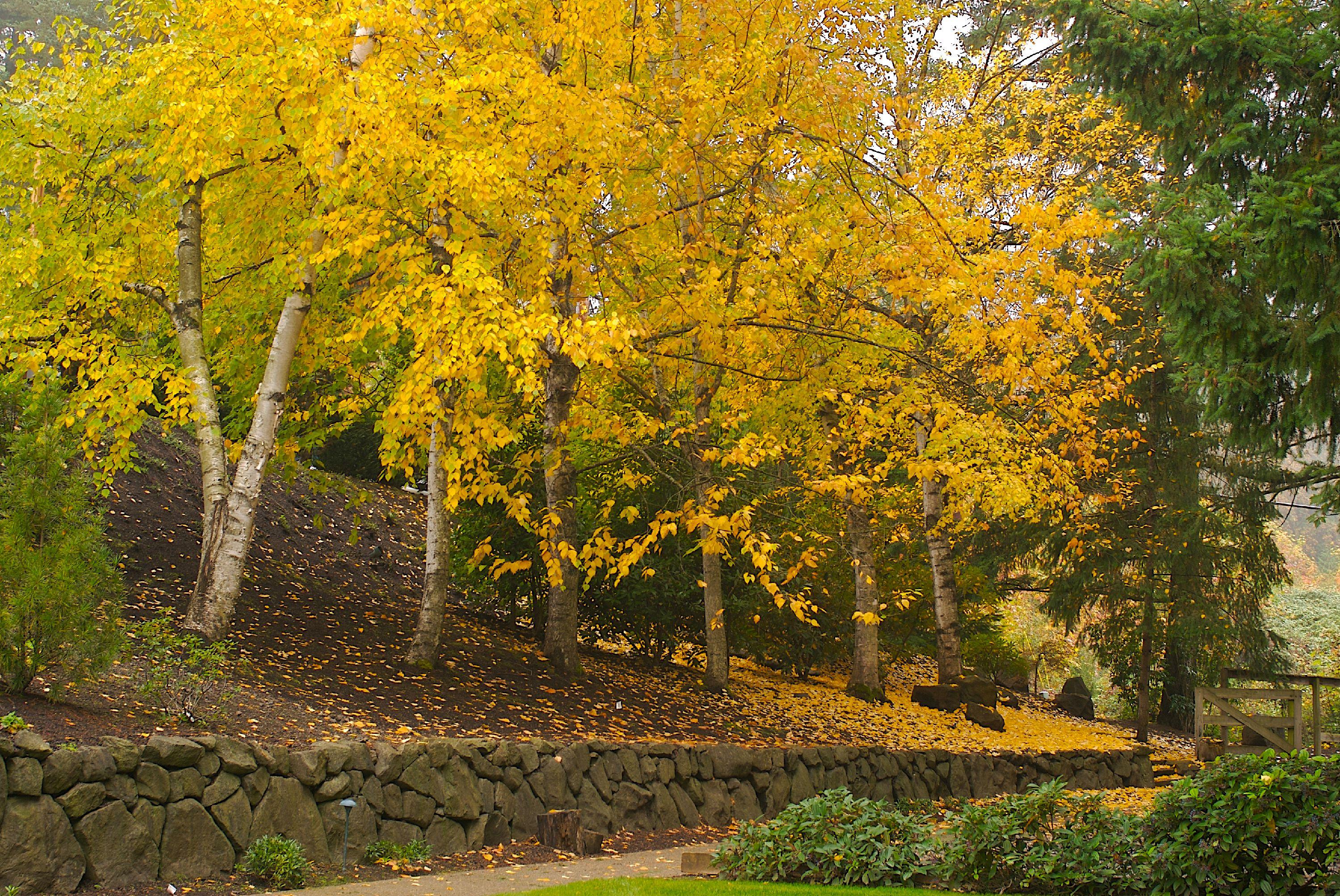
If you love the graceful look of a birch tree, try planting river birches (Betula nigra) instead of paper birches. River birches grow in warmer climates and are less susceptible to bronze birch borers. They still drop leaf litter, but with proper placement, these trees can be viewed from afar without the hassle of cleanup.
Fruitless Mulberry
Marty Baldwin
Originally introduced into the United States as food for a silkworm industry that never took off, the fruitless white mulberry (Morus alba) quickly became popular as a shade tree for home landscapes. Being incredibly cold hardy and resistant to drought, and reaching upward of 60 feet, they were an obvious choice for landscapers and homeowners alike. There are also smaller weeping forms of fruitless mulberry, as shown here, that get about 20 feet tall.
While they’re an improvement on the standard fruiting white mulberry due to their lack of fruit and being excellent shade trees, the benefits of fruitless mulberries pretty much stop there. Like all mulberries, fruitless mulberries produce ample pollen, drop their sterile flowers by the truckload, and quickly destroy lawns and underground pipes in their search for water. What’s more, because of their extensive root system, they’re capable of damaging nearby concrete and foundations.
What to Plant Instead
Enter the white basswood (Tilia americana), also known as American linden. As the scientific name suggests, white basswood is a North American native. With large, shiny, round leaves and a height of around 100 feet in cultivation, they make excellent, long-lived shade trees. In spring, their fragrant flowers support pollinators, and the seeds are eaten by a variety of wildlife, making them much better additions to the landscape than fruitless mulberry.
Lombardy Poplar
Kindra Clineff
Growing quickly, with an appealingly slim and upright profile, the Lombardy poplar (Populus nigra 'Italica') sounds like a perfect screening tree for a fence line. The catch? It's very susceptible to canker disease, which can cut the tree's lifespan down to 10 or 15 years (leaving you with the hassle of removing a big tree from your yard). Its roots are also considered invasive in some parts of the country.
What to Plant Instead
Matthew Benson
Unlike Lombardy poplar, 'Fastigiata' English hornbeams (Carpinus betulus) are not prone to diseases or pest problems, so they're with you for the long haul. They have a stately columnar shape when young that looks fantastic in a row along a driveway or fence. The trees can be kept in check with pruning to create a privacy screen or, if you are looking for a larger tree, allowed to mature to their full 40-foot height.
Eastern Cottonwood
Brie Williams
A North American native, Eastern cottonwood (Populus deltoides) can provide a large, enticing amount of shade. But the tree's massive size—it grows quickly and can reach up to 100 feet tall—makes it unsuitable for the average-sized urban or suburban yard. Even on a large property, it can be a nuisance, due to its tendency to drop branches. It also has weak wood that can be susceptible to wood-boring pests.
What to Plant Instead
Denny Schrock
Katsura trees (Cercidiphyllum japonicum) provide a generous amount of shade, while remaining at a more manageable size of around 40 to 60 feet tall. As a bonus, this Japanese native has heart-shaped leaves that put on a show throughout the year, going from reddish-purple in spring to blue-green in summer to golden in the fall.

 English
 Arabic
 French
 Spanish
 Deutsch
 Turkish
 Dutch
Dutch
 Italiano
 Russian
 Romaian
 Portuguese (Brazil)
 Greek
Greek