




Anton Dobrea/Getty Images
Rose-tinted beer goggles can distract you from brewery red flags that can result in a subpar experience. Quite often, it's not the beer itself that's at fault. You wouldn't expect America's oldest brewery, D.G. Yuengling and Son, which is still going strong, to not get its brew right. However, it's in the details, like how it's poured, that a great beer can go wrong. "Beer deserves respect from keg to glass," says Stephen Alexander, Sales & Marketing Director for Tall City Brewing Company in Midland, Texas. While many people won't know what to look for, there are signs that indicate whether a beer has been poured the right way or not. "If someone jams the tap into the beer while pouring, and it's touching the liquid, that's a no go. The faucet should never sit in the beer. That's how contamination happens," explains Alexander, who is also part of the Public Relations & Marketing Committee for the Texas Craft Brewers Guild.
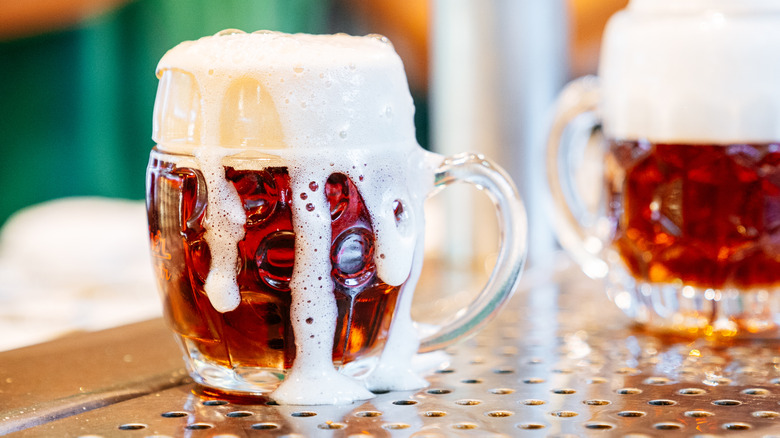
Beer foam is an incredible indicator of how competently your drink has been transferred from keg to glass. For starters, make sure that there is sufficient head and that the beer isn't all the way to the rim. No head means the beer is still full of gas that should, ideally, be released during the pour. "When the beer hits your stomach, that's where the carbonation escapes," Alexander states. However, too much foam can be a bad thing. "Half pulls create turbulence and excess foam. You should always open the faucet all the way." The pour aside, "aggressive over foaming" can be a sign that the glass is improperly rinsed.
What to look for when served a beer and the important distinction between foam and bubbles
Andrey Danilovich/Getty Images
The yeast that gives beer its rich flavor is also conducive to bacterial formation. A brewery that's not stringently managed can become a hotbed of unwanted microorganisms. So, look out for funky smells in your beer and other signs of unclean brewery tap lines, such as sour flavors. And then, there's the glass. Even when poured correctly, a dirty glass can instantly subdue beer. "If the glass isn't clean, you'll see bubbles clinging to the sides, or the head will collapse immediately. That's a sign of poor glass prep," Stephen Alexander says. Any grease or residue on the inside of the glass will collapse the head right away. However, a small amount of foamy spillover is harmless and can be taken off with a foam scraper.
Large bubbles are also a clear warning of an unclean glass. In general, homogenous foam consisting of tightly packed small bubbles is a good sign. Random particles on a dirty glass form nucleation points, resulting in random uneven, large bubbles. This should compel you to ask for a fresh glass. Conversely, residual rings of fine foam (lacing) that remain stuck to the inside as you drink signals a perfectly clean glass.
Alexander also draws attention to how the beer glass is served. A server holding it by the rim and placing (or worse, sliding) the glass to you is a red flag. "Serving beer isn't just handing someone a drink; it's the final step of the brewing process," he adds.

 English
 Arabic
 French
 Spanish
 Portuguese
 Deutsch
 Turkish
 Dutch
Dutch
 Russian
 Romaian
 Portuguese (Brazil)
 Greek
Greek