


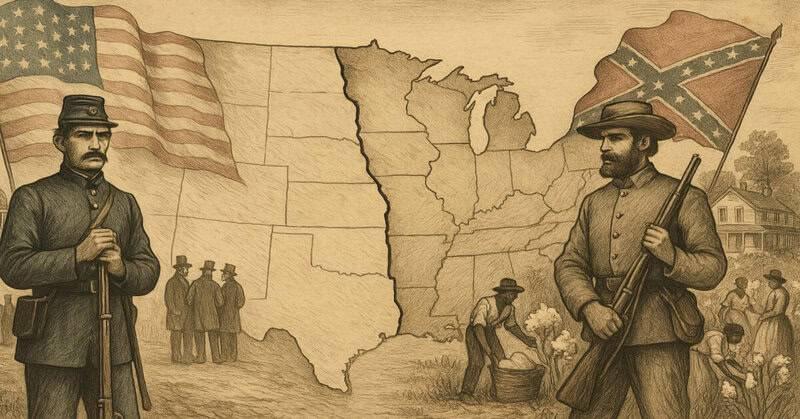
Not Just Slavery: 15 Events That Led To The U.S. Civil War

0
37

Not Just Slavery: 15 Events That Led To The U.S. Civil War

1. The Northwest Ordinance of 1787

Not Just Slavery: 15 Events That Led To The U.S. Civil War
The Northwest Ordinance of 1787 established governance and limited slavery in new territories.

The Northwest Ordinance of 1787 established governance for the Northwest Territory, encompassing present-day Ohio, Indiana, Illinois, Michigan, Wisconsin, and parts of Minnesota. Article VI of the ordinance prohibited slavery and involuntary servitude, except as punishment for crimes (archives.gov). This prohibition set a precedent for limiting slavery’s expansion into new territories, creating a geographical boundary between free and slave regions. However, the ordinance did not address the status of enslaved individuals already present in the territory, leading to legal ambiguities and future conflicts over slavery’s expansion.

2. The Missouri Compromise (1820)

Not Just Slavery: 15 Events That Led To The U.S. Civil War
Missouri Compromise of 1820: a pivotal agreement balancing slave and free states.

The Missouri Compromise of 1820 admitted Missouri as a slave state and Maine as a free state, maintaining the balance between free and slave states in the Senate. Additionally, it established the 36°30′ parallel as the dividing line, prohibiting slavery in territories north of this latitude, except within Missouri. While this compromise temporarily alleviated sectional tensions, it ultimately delayed, rather than resolved, the conflict over slavery’s expansion (history.com).

3. Nat Turner’s Rebellion (1831)

Not Just Slavery: 15 Events That Led To The U.S. Civil War
Nat Turner’s 1831 revolt ignited fear in the South, leading to stricter slave codes.

In August 1831, Nat Turner, an enslaved preacher in Virginia, led a revolt that resulted in the deaths of 55 to 65 white individuals. The uprising intensified Southern fears, prompting stricter slave codes and harsher penalties for enslaved people (nmaahc.si.edu). This event paralleled other slave revolts, such as the 1822 Denmark Vesey plot, highlighting the persistent resistance to enslavement.

4. The Nullification Crisis (1832-1833)

Not Just Slavery: 15 Events That Led To The U.S. Civil War
South Carolina’s 1832 nullification challenged federal authority, igniting tensions and presidential response.

In 1832, South Carolina declared the federal Tariffs of 1828 and 1832 unconstitutional and therefore null and void within the state. This assertion of states’ rights challenged federal authority and heightened tensions between state and federal governments. President Andrew Jackson responded by issuing a proclamation against South Carolina and seeking congressional approval for the Force Bill, which authorized the use of military force to enforce federal laws (britannica.com).

5. The Annexation of Texas (1845)

Not Just Slavery: 15 Events That Led To The U.S. Civil War
Texas’s 1845 annexation intensified sectional tensions, foreshadowing conflicts over slavery and territorial expansion.

The annexation of Texas in 1845 added a vast slave-holding region to the United States, intensifying sectional tensions. The heated debates over its admission as a slave state highlighted the nation’s deepening divisions over slavery’s expansion (history.state.gov). This event set the stage for broader conflicts, including the Mexican-American War, further polarizing the nation.

6. The Mexican-American War and Treaty of Guadalupe Hidalgo

Not Just Slavery: 15 Events That Led To The U.S. Civil War
The Treaty of Guadalupe Hidalgo reshaped U.S. territory and fueled slavery debates, intensifying sectional tensions.

The Mexican-American War (1846-1848) concluded with the Treaty of Guadalupe Hidalgo, which added approximately 525,000 square miles to the United States, including present-day California, Nevada, Utah, Arizona, and parts of Colorado and New Mexico. This acquisition reignited debates over the expansion of slavery into new territories, leading to significant political compromises and intensifying sectional tensions that contributed to the onset of the Civil War (history.com).

7. The Wilmot Proviso (1846)

Not Just Slavery: 15 Events That Led To The U.S. Civil War
Wilmot’s 1846 amendment highlights early tensions over slavery in American territorial expansion.

In August 1846, Representative David Wilmot of Pennsylvania introduced an amendment to a war appropriations bill, aiming to prohibit slavery in any territory acquired from Mexico during the Mexican-American War. The amendment passed the House of Representatives but failed in the Senate, where Southern opposition was stronger. This unsuccessful proposal intensified sectional tensions and foreshadowed the deepening divisions over slavery that would lead to the Civil War (history.com).

8. The Compromise of 1850

Not Just Slavery: 15 Events That Led To The U.S. Civil War
Legislative measures of 1850 aimed to resolve slavery disputes but deepened national divisions.

The Compromise of 1850 was a series of legislative measures aimed at resolving disputes over slavery in territories acquired from Mexico (britannica.com). Key provisions included admitting California as a free state, establishing the territories of New Mexico and Utah with the question of slavery to be decided by popular sovereignty, and enacting a stricter Fugitive Slave Act. While intended to ease tensions, the compromise further polarized the nation, setting the stage for future conflicts.

9. Fugitive Slave Act (1850)

Not Just Slavery: 15 Events That Led To The U.S. Civil War
The Fugitive Slave Act of 1850 heightened regional tensions and sparked Northern resistance.

The Fugitive Slave Act of 1850 mandated that citizens assist in the capture and return of escaped slaves, imposing fines and imprisonment for non-compliance. This law intensified Northern resistance and Southern distrust, escalating tensions across state lines (history.com).

10. Uncle Tom’s Cabin (1852)

Not Just Slavery: 15 Events That Led To The U.S. Civil War
Harriet Beecher Stowe’s ‘Uncle Tom’s Cabin’ ignited anti-slavery sentiment and reshaped public discourse.

Harriet Beecher Stowe’s 1852 novel, “Uncle Tom’s Cabin,” profoundly influenced public opinion by exposing the brutal realities of slavery. ts widespread popularity galvanized anti-slavery sentiment in the North and angered the South, demonstrating the power of literature as a political tool (britannica.com).

11. The Kansas-Nebraska Act (1854)

Not Just Slavery: 15 Events That Led To The U.S. Civil War
The Kansas-Nebraska Act ignited violent conflicts over slavery in newly established territories.

The Kansas-Nebraska Act of 1854, introduced by Senator Stephen A. Douglas, established the territories of Kansas and Nebraska and allowed settlers to decide on the legality of slavery through popular sovereignty. This effectively repealed the Missouri Compromise, which had prohibited slavery in these regions. The act led to violent conflicts between pro-slavery and anti-slavery factions, known as “Bleeding Kansas,” as both sides rushed to influence the outcome (kansashistory.gov).

12. Bleeding Kansas (1854-1859)

Not Just Slavery: 15 Events That Led To The U.S. Civil War
Violent clashes in Kansas foreshadowed the impending national conflict over slavery.

Between 1854 and 1859, the Kansas Territory was engulfed in violent confrontations between pro-slavery and anti-slavery settlers, collectively known as “Bleeding Kansas.” This turmoil was ignited by the Kansas-Nebraska Act, which allowed settlers to decide the slavery issue through popular sovereignty (nps.gov). The ensuing violence, including events like the Pottawatomie Massacre, served as a grim preview of the national conflict that would erupt into the Civil War.

13. The Dred Scott Decision (1857)

Not Just Slavery: 15 Events That Led To The U.S. Civil War
Dred Scott v. Sandford: A pivotal ruling denying citizenship and escalating national tensions over slavery.

The Dred Scott v. Sandford decision of 1857 was a landmark Supreme Court ruling that denied African Americans, whether enslaved or free, the status of U.S. citizenship, thereby prohibiting them from suing in federal court. Additionally, the Court declared that Congress lacked the authority to prohibit slavery in the territories, effectively nullifying the Missouri Compromise (history.com). This ruling intensified Northern opposition and emboldened the South, deepening national divisions over slavery.

14. John Brown’s Raid on Harpers Ferry (1859)

Not Just Slavery: 15 Events That Led To The U.S. Civil War
John Brown’s 1859 raid at Harpers Ferry ignited tensions between North and South, escalating the abolitionist movement.

In October 1859, abolitionist John Brown led a raid on the federal armory at Harpers Ferry, Virginia, aiming to incite a slave rebellion by arming enslaved people. The plan failed; Brown was captured, tried for treason, and executed. The raid intensified Southern fears of slave uprisings and deepened the rift between North and South, making compromise increasingly untenable (history.com).

15. The Election of Abraham Lincoln (1860)

Not Just Slavery: 15 Events That Led To The U.S. Civil War
Lincoln’s 1860 election victory highlighted deep sectional divisions, prompting Southern states’ secession.

In the 1860 presidential election, Abraham Lincoln secured victory without winning any Southern electoral votes, underscoring the deep sectional divisions over slavery. His election, with no support from Southern states, convinced many in the South that slavery was under imminent threat, directly leading to the secession of seven Southern states before his inauguration (history.com).

Conclusion

Not Just Slavery: 15 Events That Led To The U.S. Civil War
Exploring the intricate causes of the American Civil War and its lasting societal impact.

The American Civil War was the culmination of a complex interplay of legal, political, and social conflicts that had been escalating for decades. While slavery was undeniably at the core of these tensions, numerous events and issues—including territorial disputes, economic disparities, and debates over states’ rights—collectively propelled the nation toward division and war. Understanding this multifaceted history is essential to comprehending the profound impact of the Civil War on the United States (britannica.com).

Zoeken
Categorieën
Read More
Music
My Chemical Romance Reveal 2026 Tour Has Been a Prequel
My Chemical Romance Shock Fans With Reveal Tour Was a Prequel All AlongMy Chemical Romance...
By Test Blogger4 2026-02-15 06:00:02 0 290
Spellen
Minecraft ideas 2026 - tutorials for 36 inspiring creations
Minecraft ideas 2026 - tutorials for 36 inspiring creations Minecraft remains one of the...
By Test Blogger6 2026-02-19 15:00:13 0 83
Music
Alex Van Halen Confirms Work on Album of Unheard Van Halen Songs
Confirmed: Alex Van Halen is Completing a Lost Van Halen AlbumAlex Van Halen has confirmed work...
By Test Blogger4 2026-02-18 22:00:08 0 121
Food
7 Restaurants Al Capone Enjoyed Around The US
7 Restaurants Al Capone Enjoyed Around The US...
By Test Blogger1 2026-02-08 15:00:03 0 635
Food
How Korean Fried Chicken Gets Its Signature Crunch
How Korean Fried Chicken Gets Its Signature Crunch...
By Test Blogger1 2026-01-30 20:00:07 0 761