Guns Blazing: 15 Facts You Didn’t Know About The Tet Offensive
4. Media’s Pivotal Role
Journalists’ real-time coverage of the Tet Offensive exposed Vietnam War’s harsh realities to Americans.
The Tet Offensive’s real-time coverage by journalists significantly altered American perceptions of the Vietnam War. Dramatic photographs and television reports, such as the iconic image of South Vietnamese Colonel Nguyen Ngoc Loan executing a Viet Cong prisoner, exposed the brutal realities of the conflict. This immediate reporting contrasted sharply with earlier wars, where delayed or censored news often shaped public understanding (pbs.org).
5. The Cost in Civilian Lives
Civilians suffer heavy casualties during the Tet Offensive, highlighting the devastating impact of urban warfare.
The Tet Offensive resulted in a significant civilian toll, particularly in cities like Hue. During the 24-day occupation, North Vietnamese and Viet Cong forces executed approximately 2,800 civilians suspected of supporting the South Vietnamese government. Additionally, the South Vietnamese government reported 7,721 civilian deaths and 18,516 injuries across the country during the offensive (britannica.com). This humanitarian crisis mirrors the civilian casualties in recent urban warfare, such as the Russia-Ukraine conflict, where indiscriminate targeting of cities has led to substantial non-combatant deaths.
6. The Battle of Hue
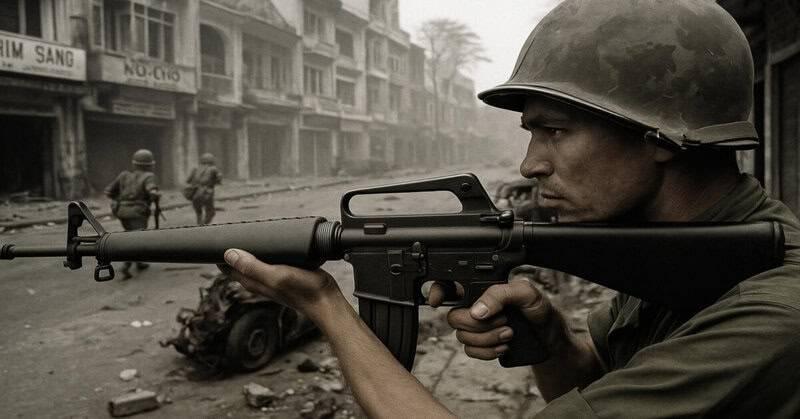
U.S. Marines advance through Hue’s war-torn streets amid fierce urban combat, 1968.
The Battle of Hue, lasting from January 31 to March 2, 1968, was the longest and bloodiest engagement of the Vietnam War. North Vietnamese and Viet Cong forces launched a surprise attack, seizing the ancient city of Hue, including the Citadel, the Imperial Palace, and the surrounding areas. This urban warfare involved intense house-to-house fighting, with U.S. Marines and South Vietnamese troops methodically clearing each building. The battle resulted in significant casualties: U.S. Marines suffered 142 killed and 857 wounded, while South Vietnamese forces lost 384 killed and 1,830 wounded. The Communist forces incurred over 5,000 killed. The city was heavily damaged, with approximately 40% of its buildings destroyed, leaving around 116,000 civilians homeless. The protracted and grueling nature of the Battle of Hue drew comparisons to other infamous urban battles, such as the Battle of Stalingrad during World War II, (historynet.com) highlighting the challenges and horrors of urban combat.
7. U.S. Military Response
U.S. and South Vietnamese forces swiftly reclaim territory during the Tet Offensive counteroffensive, 1968.
In response to the Tet Offensive, the U.S. military initiated a swift and forceful counteroffensive. Troops were rapidly mobilized, and air support was extensively utilized to reclaim occupied territories. Within weeks, U.S. and South Vietnamese forces had retaken most objectives, including the city of Hue. This rapid mobilization and recapture strategy mirrored U.S. responses in other post-World War II conflicts, such as the Korean War, where similar tactics were employed to regain lost ground (archives.gov).
8. The Myth vs. Reality of Victory
Tet Offensive: Tactical victories overshadowed by strategic shift in U.S. public opinion and policy.
While the U.S. and South Vietnamese forces achieved tactical victories by repelling the Tet Offensive’s assaults, the North Vietnamese secured a strategic triumph. The offensive’s surprise and intensity shattered American public confidence, leading to increased anti-war sentiment and calls for withdrawal. This shift in public opinion pressured policymakers, demonstrating how tactical successes can be overshadowed by strategic outcomes in warfare (history.com).
9. A Turning Point in Public Opinion
Protesters rally against war, reflecting shifting public opinion during Vietnam and Iraq conflicts.
The Tet Offensive significantly shifted American public opinion, leading to a surge in anti-war sentiment. This shift prompted widespread protests and influenced the 1968 presidential elections, with candidates advocating for de-escalation and withdrawal from Vietnam. Similar patterns have been observed in other major conflicts; for instance, during the Iraq War, public opposition reached new highs, with 63% of Americans in 2008 stating that the U.S. made a mistake in sending troops to Iraq. Such instances underscore how military engagements can profoundly impact public opinion and political landscapes (news.gallup.com).
10. The Hue Massacre
Mass graves in Hue reveal the tragic fate of civilians executed during the 1968 Tet Offensive.
During the 1968 Tet Offensive, communist forces systematically executed thousands of civilians and prisoners in Hue. Mass graves were discovered containing victims with hands tied behind their backs, many buried alive. This atrocity is comparable to other wartime massacres, such as the My Lai Massacre during the Vietnam War, where hundreds of unarmed civilians were killed by U.S. soldiers. Both events highlight the brutal realities of war and the severe consequences for non-combatants (content.time.com).
11. Johnson’s Withdrawal from the Race
President Johnson addresses the nation, announcing his withdrawal from the 1968 presidential race.
The Tet Offensive significantly eroded public support for President Lyndon B. Johnson’s handling of the Vietnam War. In response to mounting anti-war sentiment and declining approval ratings, Johnson announced on March 31, 1968, that he would not seek re-election. This decision mirrored historical instances where leaders faced political repercussions following military setbacks, such as President Harry S. Truman’s decision not to run in 1952 after the Korean War stalemate (history.com).
12. The Role of the North Vietnamese Army
North Vietnamese Army and Viet Cong coordinate conventional assaults and guerrilla tactics during Tet Offensive.
The North Vietnamese Army (NVA) and the Viet Cong (VC) played distinct yet complementary roles during the Tet Offensive. The NVA, as the regular military force of North Vietnam, provided strategic planning, logistical support, and conventional combat units for large-scale assaults. In contrast, the VC, operating within South Vietnam, utilized guerrilla tactics, local knowledge, and sabotage operations to infiltrate and disrupt South Vietnamese defenses. This collaboration mirrored alliances in other insurgencies, where regular and irregular forces coordinate to leverage their unique strengths (britannica.com).
13. The Offensive’s Code Name and Secret Planning
North Vietnamese forces launch surprise Tet Offensive, aiming to trigger widespread uprising in South Vietnam.
The Tet Offensive was officially termed “Tổng tiến công và nổi dậy,” translating to “General Offensive and Uprising.” This codename encapsulated the North Vietnamese strategy of launching a widespread military assault aimed at inciting a popular uprising in South Vietnam. Despite extensive preparations, the operation’s details remained highly secretive, catching U.S. forces off guard. This intelligence oversight parallels other historical instances, such as the surprise attack on Pearl Harbor during World War II, where prior warnings were not acted upon, leading to significant strategic surprises. (britannica.com).
14. Psychological Warfare
North Vietnamese psychological warfare during Tet Offensive: surprise attacks and propaganda to undermine opposition mor…
During the Tet Offensive, North Vietnamese leaders employed psychological tactics to destabilize the South Vietnamese government and erode U.S. resolve. By orchestrating surprise attacks and disseminating propaganda, they aimed to create an atmosphere of uncertainty and fear. This approach aligns with Sun Tzu’s principle that “all warfare is based on deception,” emphasizing the strategic use of misinformation to demoralize the enemy. In modern conflicts, such psychological operations have evolved, utilizing advanced technologies like cyber warfare and social media to influence public opinion and disrupt adversaries without direct confrontation (moderndiplomacy.eu).
15. Tet’s Enduring Legacy
The Tet Offensive reshaped military strategy, eroded public trust, and transformed global approaches to conflict.
The Tet Offensive profoundly impacted military doctrine, public trust, and foreign policy. It exposed the limitations of conventional warfare strategies, leading to a reevaluation of military tactics and the adoption of more flexible approaches. The offensive also eroded public confidence in government communications, highlighting the need for transparency. Globally, it influenced foreign policy decisions, emphasizing the importance of understanding local dynamics in conflict zones. Today, the Tet Offensive serves as a critical case study in strategy and public relations, illustrating the complex interplay between military actions and public perception (cfr.org).
Conclusion
The Tet Offensive’s scale and surprise redefined global military strategy and reshaped U.S. foreign policy.
The Tet Offensive stands as a pivotal event that reshaped military and political strategies worldwide. Its unexpected scale and intensity challenged prevailing assumptions about the Vietnam War, leading to a profound reassessment of U.S. military tactics and foreign policy. The offensive’s impact on public perception underscored the critical interplay between military actions and public opinion, influencing subsequent conflicts and diplomatic approaches. Its enduring legacy continues to inform strategic planning and political decision-making in contemporary global affairs (britannica.com).





 English
 Arabic
 French
 Spanish
 Portuguese
 Deutsch
 Turkish
 Italiano
 Russian
 Romaian
 Portuguese (Brazil)
 Greek
Greek