


Msphotographic/Getty Images
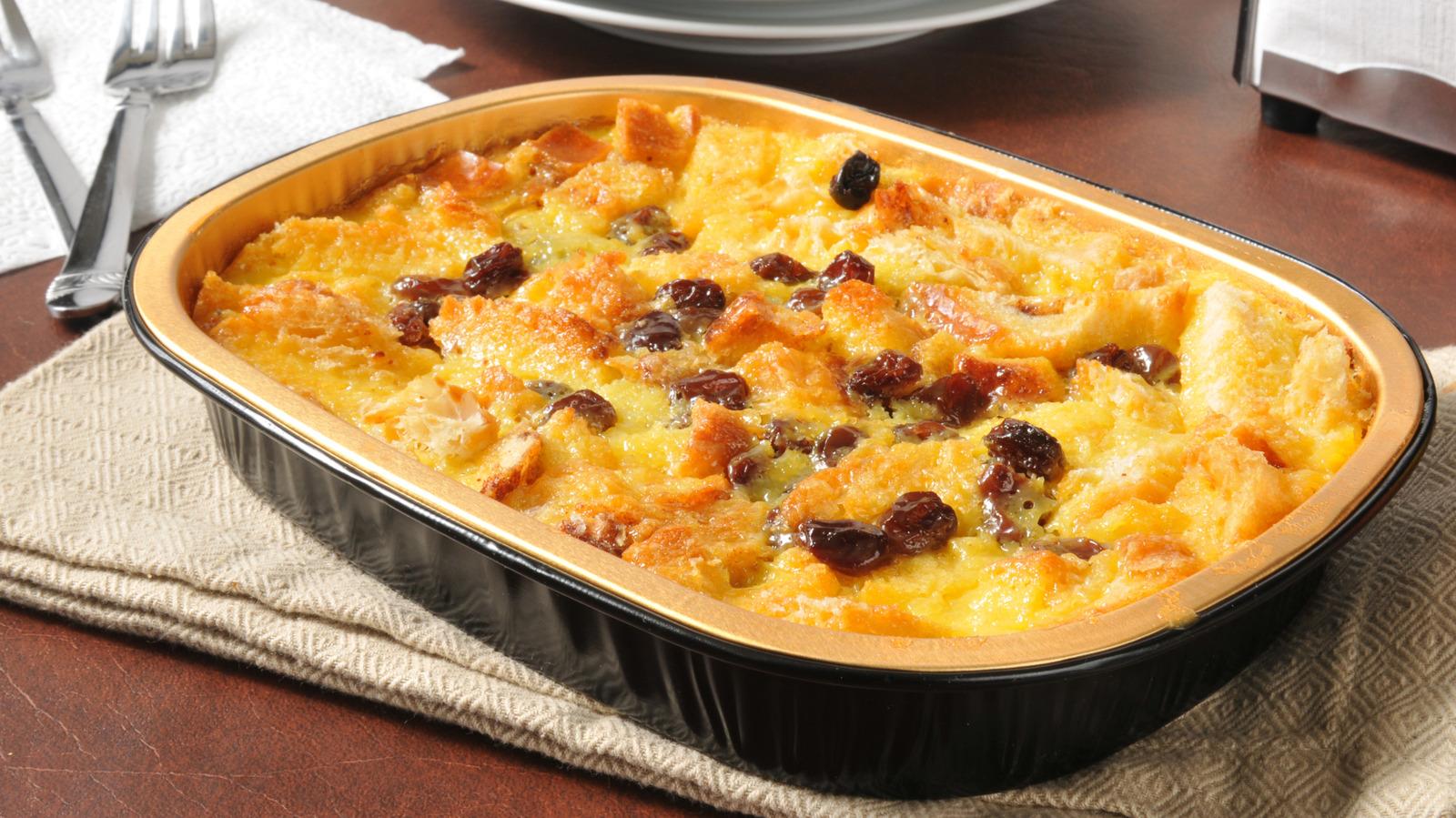
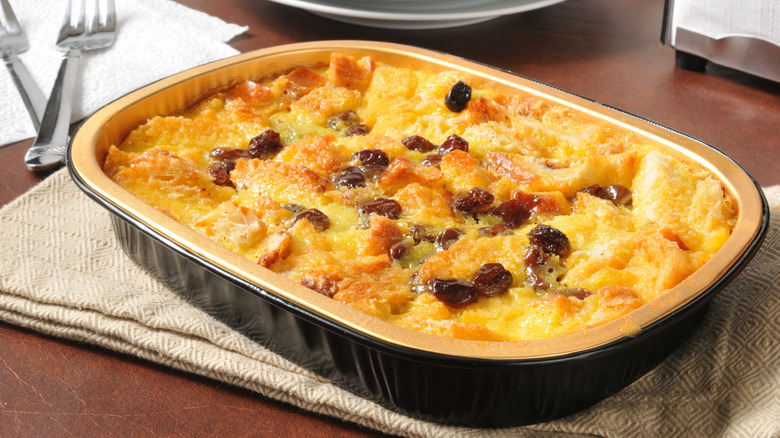
Bread pudding is a classic dessert consisting of slightly stale bread cooked in a custard of eggs and milk. It sounds pretty straightforward, but there are all kinds of ways that it can go wrong. You may have run into a number of problems, from bread that turns to mush or eggs that curdle and scramble, to custard that's way too solid or way too runny. There are mistakes that everyone makes with bread pudding when they're starting out, but luckily they're easy to avoid when you know how.
We spoke to four baking experts to get the 4-11 on the common missteps that many home cooks make with bread pudding. We interviewed Eka Soenarko, with QED Hospitality in New Orleans; Ainseanlea Bonds, food blogger and recipe developer at The Stush Kitchen; Lisa Keys, Chopped champion and author of two food blogs: Good Grief Cook and Joyful Crumbs; and Emmy Clinton, recipe developer of food blog Entirely Emmy.
Getting their expert insights, I discovered all the many ways that you can go wrong with this staple dessert — and what to do instead. Once you've had light shone on the common mistakes people make with bread pudding, you'll know how to side-step them and make a better dessert.
Using bread that's not stale enough or too stale
this_baker/Shutterstock
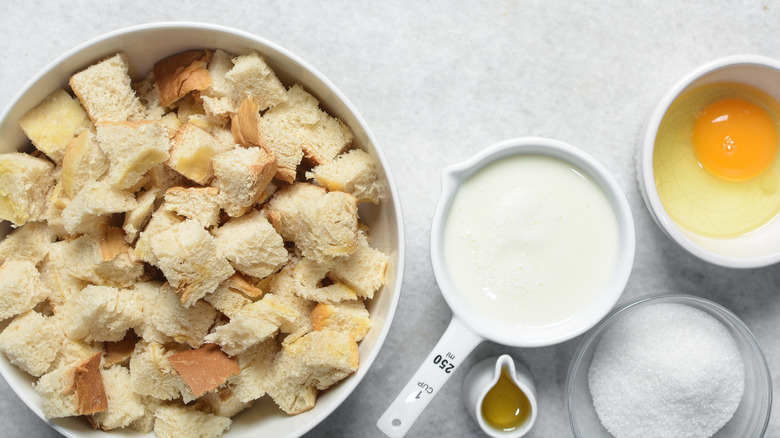
Bread pudding recipes often call for stale bread. Don't toss your old hamburger buns or leftover slices of bread and you could turn them into dessert. There's a good reason why stale bread is called for; too fresh and the pudding won't turn out. But there is such a thing as too stale, as well. You need to get the balance right.
All our experts advise against using bread that's totally fresh. "When you use soft bread that's fresh, it doesn't absorb the custard as well and can end up being gummy," Emmy Clinton tells us. Lisa Keys notes that "fresh bread will absorb too much liquid and result in a soggy pudding."
But Chef Eka Soenarko warns of using overly stale bread, stating it should be no more than four days old. "Too stale of bread also tends to yield soggy and mushy bread pudding," she says. "It can also develop off-flavors and an odd odor that negatively impacts the overall aroma and taste."
Luckily, if you want to make bread pudding and your bread is too fresh, there's something you can do about it. Ainseanlea Bonds recommends toasting your bread before using it. "I toss the bread cubes in a little melted butter, spread them on a baking sheet, and toast them on the top rack of the oven at 350 degrees Fahrenheit for 10-15 minutes, then let them cool before adding to the custard," she explains. "That's half the battle for a perfect bread pudding," she adds.
Not experimenting with bread types
worradirek/Shutterstock
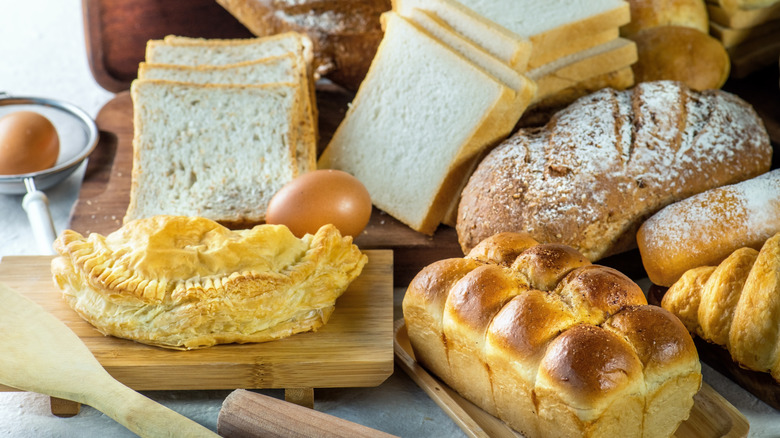
If you only ever use the same bread for this dessert, you're making a common mistake. Many people use whatever white bread they have in the house, whether that's a packaged sliced loaf or supermarket French bread. But, some types are better than others for making bread pudding. When you aren't mindful with your bread choice, you might not get the results you want.
"For the best texture, use a sturdy bread like brioche, challah, or thick-cut Texas Toast," Chopped champion Lisa Keys advises. "These breads have a higher egg and fat content, which helps them stay soft and custardy rather than turning soggy." You can even swap in croissants for a new take on bread pudding, as food blogger Emmy Clinton tells us. Plus, sweetened and enriched breads make a more decadent dessert in general.
You can also try out different breads to make it suitable for different dietary requirements. Clinton, for instance, focuses on making gluten-free food and has tried out a lot of different options to get the right texture for her bread pudding. "For the best gluten-free bread pudding, I recommend using a sturdy bread that's gluten-free, not soft sandwich bread," she says. Cubing the bread and letting it dry out is particularly important when making this dessert gluten-free, as it's more prone to getting soggy and falling apart.
Not using enough custard for bread pudding
this_baker/Shutterstock
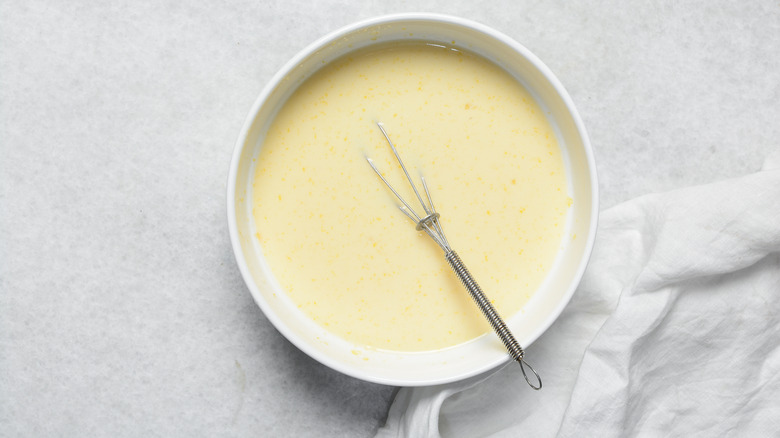
When you're troubleshooting your bread pudding recipe, what exactly is wrong with it? If it's disappointingly dry, you might not be using enough custard. There can be a number of reasons for this, from bad recipes to taking the measurements into your own hands.
"A common mistake is not making enough custard, leading to a dry and unevenly flavored bread pudding," pastry chef Eka Soenarko remarks. She notes that you need roughly 1 egg and 1 cup of liquid for every 4 ounces of bread. "A standard 9x13 baking dish typically requires about 8 cups of cubed bread and 4 cups of liquid custard," she tells us.
One reason that your recipe might have too little custard in it is that it's just not a great one. It's better to choose a recipe from a cookbook or website that's rigorously tested or from an author that you trust. But, sometimes, too little custard can be down to human error. You might decide to eyeball the milk, or maybe you have one slice of bread more than you need and decide to use it anyway so that it doesn't go to waste. Baking is precise, so you should follow the recipe exactly rather than deciding to wing it.
Mixing the eggs improperly
Suteren Studio/Shutterstock
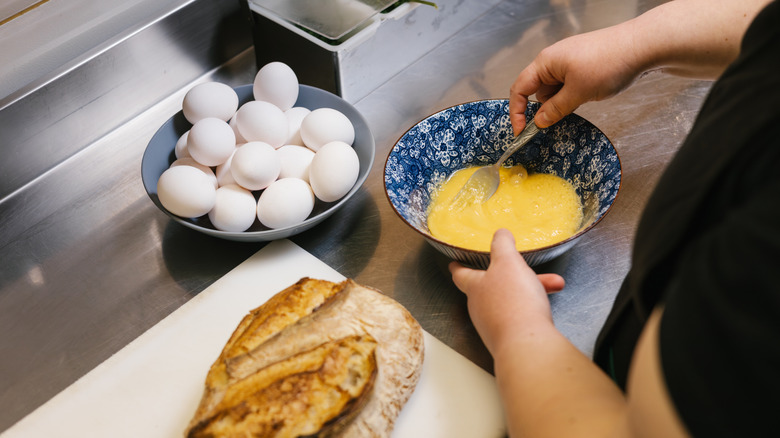
Whether you make a simple five-ingredient bread pudding recipe or something more elaborate, you need to be careful how you prepare it. The liquid part of a bread pudding is essentially a custard made of eggs and milk or cream that cooks and sets in the oven. And, although it's simpler than baking custard from scratch on the stovetop, you still need to approach it carefully. One common mistake our experts see is people not mixing the eggs correctly.
"If the egg yolks and whites are not fully beaten together, they can separate during baking, resulting in white and yellow streaks that look like scrambled eggs," says Eka Soenarko. Custard that's turned into scrambled eggs is basically the worst thing that can happen to bread pudding, so it's something that you should aim to avoid at all costs. Soenarko recommends fully beating the eggs until they're homogenous with a pale-yellow color. She says you can also strain the egg mixture "using a fine-mesh sieve to remove the thin, watery part of the egg white, eliminate the stringy chalazae, and catch shell fragments," if these have been an issue for you.
Once you've beaten the eggs, you can mix them in with the other ingredients and continue with the recipe as normal, making sure to whisk the eggs with the milk or cream thoroughly to avoid splitting. It doesn't have to take ages, but just don't be lax about it.
Not letting the custard soak into the bread
David McQ/Shutterstock
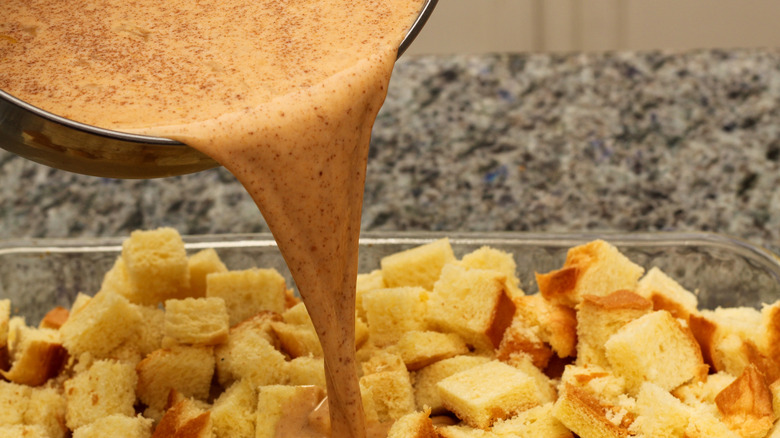
When you make bread pudding, do you mix up the eggs and milk, pour it over the bread, and then bake straight away? If so, you're making a common rookie error. You need to give the custard time to soak into the bread for the best results.
"Skipping the soaking time is a big mistake I see quite often," says recipe developer Ainseanlea Bonds. "The custard needs time to absorb fully into the bread," she adds. Why? Emmy Clinton explains that if the custard isn't set then it wasn't given enough time to soak into the bread properly. It can also result in the bread part of the pudding being dry, surrounded by custard, rather than the whole bread mixture having a custardy texture.
Not all of our experts agree on exactly how long to soak the bread, though. Clinton says you should "allow the bread to soak in the custard for 20 to 30 minutes at a minimum," while Bonds recommends 30 to 60 minutes. Lisa Keys gives us a particularly large range, saying you should soak for at least 5 minutes, but as long as overnight, which we imagine would give quite different textural results. We advise a 30 minute soaking in the first instance, increasing or decreasing as needed.
Sticking to the same bread pudding recipes every time
Wsmahar/Getty Images
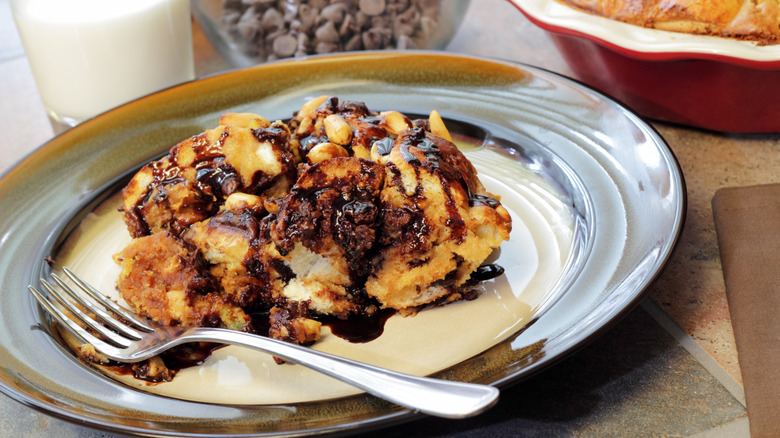
A classic bread pudding usually contains dried fruit, such as raisins, and is flavored with cinnamon. This is undoubtedly delicious, but it's a mistake not to branch out. There are so many ways to take bread pudding to the next level and flavor combinations to try out that you're missing out on some exciting options.
Emmy Clinton's suggestions for flavor combinations include honey, tahini, and orange zest; espresso, dark chocolate, and brown butter; and coconut milk custard with lime zest and mango. Ainseanlea Bonds says that all kinds of fruit flavors pair well with bread pudding. "I find it's better to use preserves or even jam over fresh fruit since they add a concentrated flavor without introducing excess moisture," she tells us. She sometimes combines jam and peanut butter to make an elevated PB&J bread pudding.
Eka Soenarko recommends chocolate as a great flavor pairing in a bread pudding. She also likes to brûlée the top of the bread pudding before serving it, "sprinkling some granulated sugar and using a hand torch to create the caramelization." This is a trick that we want to try out. "Those bits of charred bread and sugar crust bring the bread pudding eating experience onto the next level," she adds.
Overcooking or undercooking bread pudding
Pablo Morales Food/Shutterstock
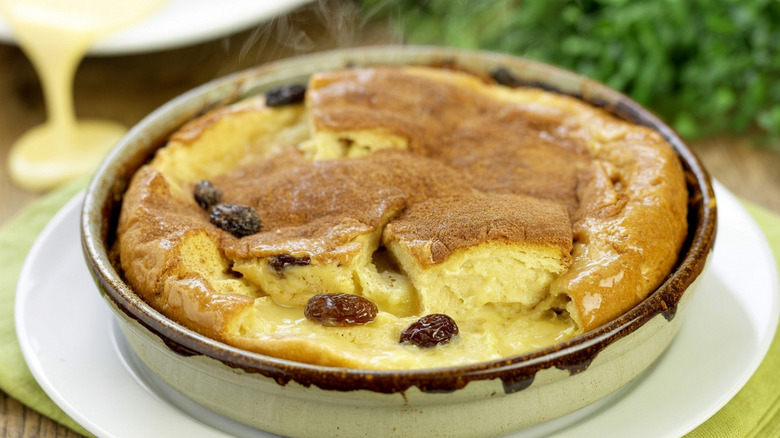
When the texture of your bread pudding isn't quite right, baking it for the wrong length of time is often the culprit. Overbaking and underbaking are both undesirable in different ways. This can be down to human error — forgetting to set a timer or deciding to take it out early when you're in a hurry — or it could be down to following the recipe blindly without looking at the signs of doneness.
Emmy Clinton warns us that overbaked bread pudding is usually dry, while Lisa Keys says "overbaking will result in a dry and rubbery texture." On the other end of the spectrum, Ainseanlea Bonds and Eka Soenarko both note that runny puddings are usually down to underbaking.
If you follow a good recipe, you can expect the cook time to be correct. However, there are factors that affect this. Perhaps you don't realize your oven runs hotter or cooler than it should. Or maybe you used a bigger or smaller dish than the recipe called for, which alters the depth and therefore how long it takes to cook through. So, it's good to be able to tell when it's done by looking at it, not just by watching the clock. "Bake the bread pudding until it is set, but still slightly jiggly in the center," Keys advises. It should be golden on the top, but not burned.
Using the wrong egg-to-milk ratio for the custard
this_baker/Shutterstock
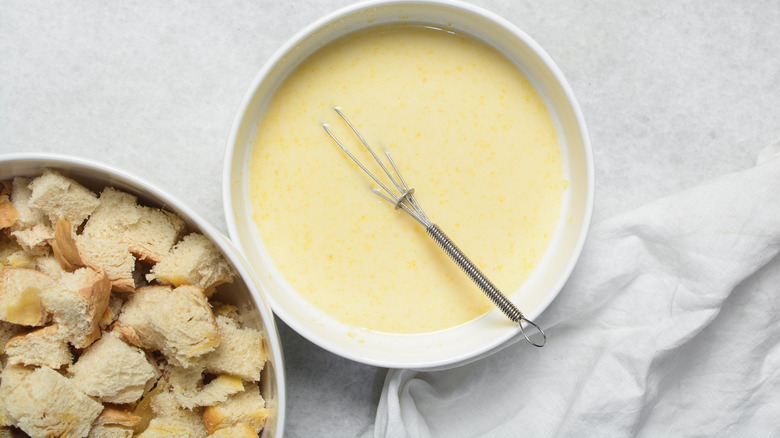
The custard is an important part of bread pudding. Without it, you'd just be eating stale old bread. It holds everything together, so if you use the wrong egg-to-milk ratio, it won't turn out properly. Either your pudding won't set or the texture will be way off. It's not a difficult thing to get right, but it does mean you should avoid any adjustments unless you do it carefully and know what you're doing.
Emmy Clinton points out that overly firm bread pudding can come from too many eggs in the custard mixture, while when it's runny, it can be down to custard that has too much milk compared to the number of eggs. The eggs are what set the custard, so when the quantities are off, things can go awry.
So, how should you avoid this? "Always follow a recipe and never eyeball the liquid-egg ratio, as this balance is delicate," Ainseanlea Bonds tells us. When you follow a good recipe, the quantities should be just right. If you decide to make a bit more custard, this is where things can go wrong. Size up the recipe proportionally instead of just guessing. "Look for a consistency similar to cold heavy cream," Bonds advises. "At this thickness, it should be fluid enough to soak into the bread without being soupy."
Setting the oven temperature too high
chettarin/Shutterstock
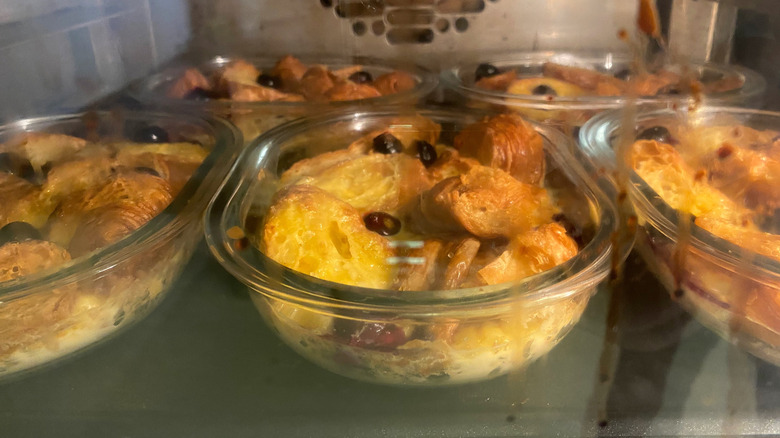
One of the worst things that can happen to your bread pudding is that it turns out curdled. This means you're left with lumps of scrambled egg, alongside a watery custard. While a few things can cause this, it's most commonly due to cooking at the wrong temperature.
"When bread pudding curdles, this means the eggs are overcooked because of too high a temperature in the oven," Emmy Clinton tells us. Chef Eka Soenarko explains the science of it in a bit more detail. "Bread pudding curdles when the egg custard is overcooked or heated too quickly, causing egg proteins to tighten and squeeze out liquid, resulting in a separated, grainy texture."
Our experts recommend cooking at a lower temperature than you might expect. Cooking low and slow at around 325 to 350 degrees Fahrenheit is the way to go for bread pudding. It's cooler than the temperature you'd often bake for desserts, and it means a longer cooking time, but if you push the temperature, you might end up with a scrambled mess. If you cook at a low temperature and you still experience curdling, you can try baking your bread pudding in a water bath. Soenarko explains that this buffers the heat and makes sure the mixture never boils. However, this generally isn't necessary and should only serve as a last attempt when troubleshooting your dessert.
Not paying attention to finishing touches
this_baker/Shutterstock
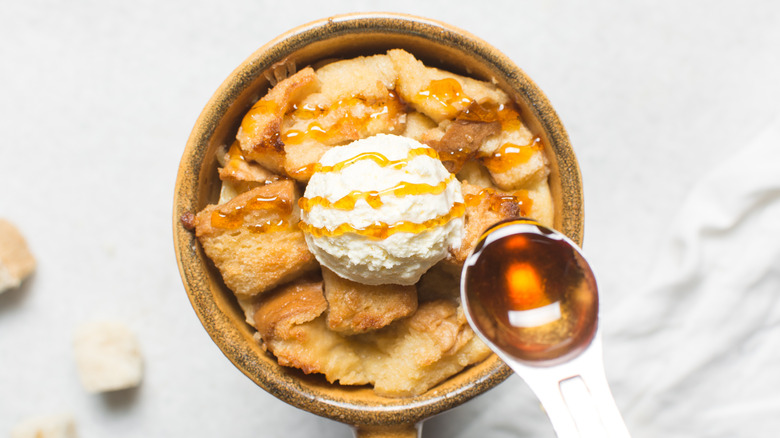
You might make a perfectly fine bread pudding. It may even be technically great, but if you don't pay attention to finishing touches and how you serve it up, it can end up boring and not worth revisiting. There are all kinds of ways you can make bread pudding extra special, some of them simple and others more elaborate.
The secret ingredient in The Pioneer Woman's bread pudding, for instance, is whiskey. Emmy Clinton, on the other hand, says you can level up bread pudding with something as simple as seasoning the custard correctly. "Even a pinch of salt makes a huge difference in bringing out the sweetness while balancing the richness," she says. Clinton is also a fan of topping her bread pudding. "While this may seem small, toppings add texture and contrast to the bread pudding that elevates the dish," she tells us. "Try adding toppings like a sugar crust, streusel or crumble, or nuts." These might be the extra ingredients you need to make something special.
Don't underestimate the importance of how you serve your bread pudding. Firstly, you need to let it sit for 15 to 30 minutes before serving. As it cools slightly, it firms up, so the textures are just right. And when it's ready to be eaten? "Bread pudding is best served warm, either on its own or with a scoop of vanilla ice cream, whipped cream, or a drizzle of sauce," Lisa Keys suggests.

 English
 Arabic
 French
 Spanish
 Portuguese
 Turkish
 Dutch
Dutch
 Italiano
 Russian
 Romaian
 Portuguese (Brazil)
 Greek
Greek