


In a triple-A world, Fable's Peter Molyneux just wants his new god game to bring "joy"
In a triple-A world, Fable's Peter Molyneux just wants his new god game to bring "joy"
My personal Game of the Year for 2025 was, as you likely expect, Clair Obscur: Expedition 33. Its narrative excellence, combined with its distinct French feel and unique visual identity set it apart from its competitors. I can safely say that, in my many years playing games and my slightly fewer years reviewing them, I've never seen anything like Sandfall's turn-based epic. But, as videogame production ramps up exponentially in terms of time and cost, it feels like the products themselves have increased in scope and scale. Most triple-A games offer sprawling open worlds, masterfully directed cutscenes, and soaring, gut-wrenching stories that are designed to operate more like movie plotlines than anything else. While in many ways that's a good thing - videogames are art, after all - it feels like some developers forget that there's a 'game' in 'videogames:' seriousness is, apparently, what sells.
As a result, we've seen some high profile titles struggle: Dragon Age: The Veilguard, Star Wars Outlaws, and even Bethesda's mighty Starfield. They had all of the 'right' ingredients: strong narratives, open worlds, and flashy combat, but they didn't have the fun. That's where the likes of indie game titans like Hades 2 or Expedition 33 come in: sure, having Simon kick your ass for the hundredth time in a row doesn't sound fun, but there's a sense of achievement when you finally defeat him: a sense of joy.
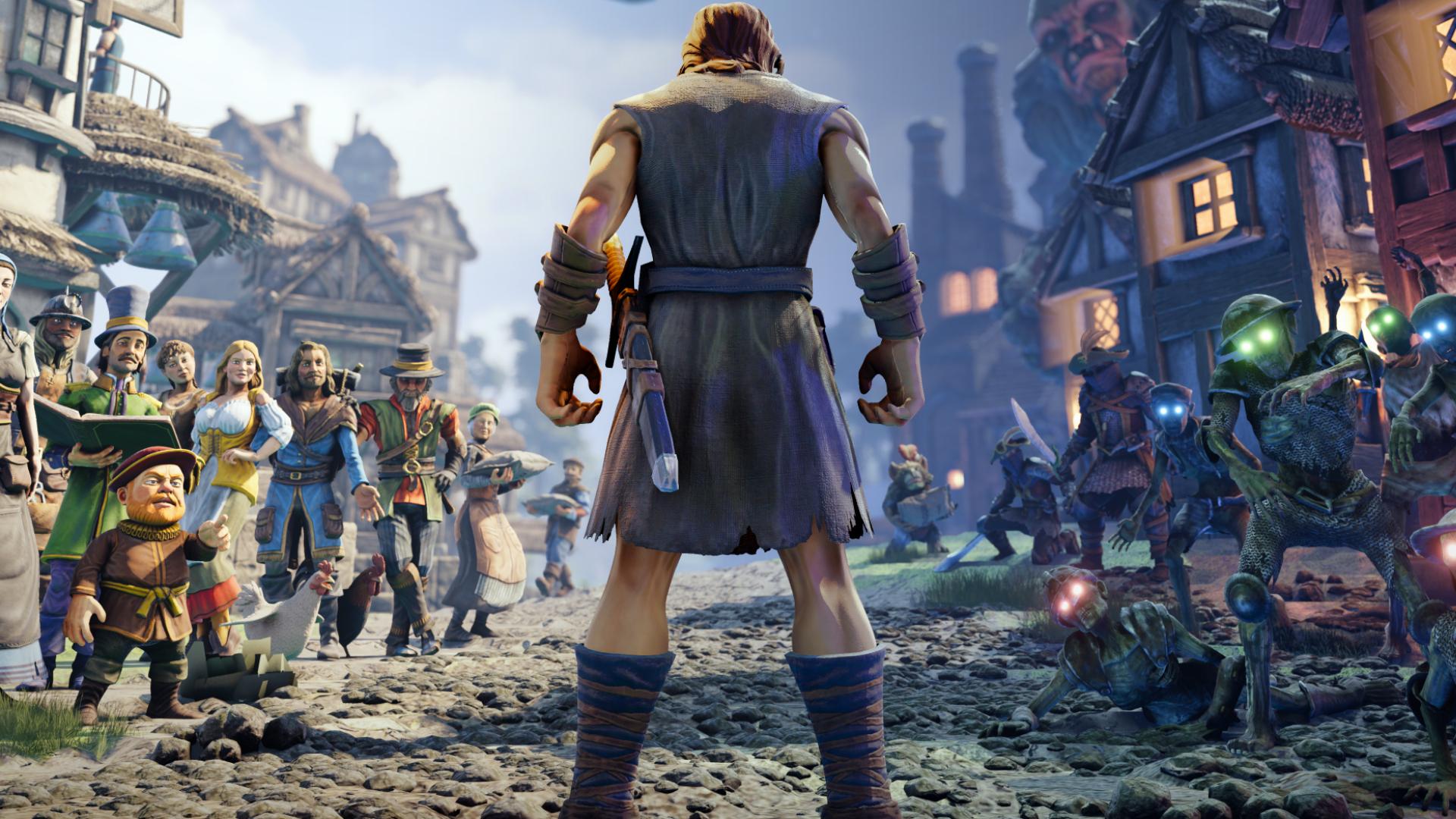
Joy is a word that Peter Molyneux keeps using in our interview about Masters of Albion, his upcoming god game. Molyneux is an emotional person by nature - something he professed to me early on in our conversation. His use of a world like 'joy' is perhaps unsurprising, then, but his emotions have consistently proven to be a blessing and a curse. While his excitement is infectious, it has often left people disappointed; something he's determined not to do this time around. The aim with MoA, he says, is to bring back that sense of playing a videogame for fun; that sense of pure escapism, of childhood wonder. When I say that videogames these days feel like they're losing their sense of "playfulness," he nods, the excitement visible in his eyes.
"I absolutely agree," he says in response to my comment. "When I was a kid, I loved Lego, but I didn't love the Lego that we have today. This is the perfect analogy: with the Lego we have today you can build Hogwarts Castle, or the Death Star: you can build incredible things. But you can't do what I used to do. With just simple blocks, I used to make things - in my imagination, I was making these incredible battles and castles. It looked shit, but in my mind it looked fantastic, and I was able to roleplay what went on in the most insignificant creation - my creation. It was my castle: it wasn't Hogwarts Castle, it was my castle. It was ridiculous and incredibly fragile, and it didn't look like anything, but it was mine.
"I think that's what you're harking about," he continues. "Yes, we've had some amazing gaming experiences with incredible visuals; incredible smooth, silky gameplay. Fantastic, I love it, I'll play it. But, there isn't that freedom, and that freedom to create something that I imagine. I want my hero to look like this because it's my imagination, not some designer's imagination. [With Masters of Albion], we've explored that."

It is one of the main things that draws me to Masters of Albion: the inherent freedom that the god game genre offers, coupled with Molyneux's signature 'Ye Olde English' humor. From flipping the bird at bandits to - borrowing his own example - shooting pork pies from cannons (we did that once here in Scotland, allegedly), Masters of Albion has the charm and the quirks that made the original Fable so beloved; a status that it too is likely looking to achieve. But ultimately, the Masters of Albion is simply about "joy."
"There's one word that I really want people to experience when they play Masters of Albion, and that is joy," he says, somewhat emotionally. "It's joy, Lauren. Joy can be suspense: in Masters of Albion's story, there is suspense, there's sacrifice, there'll be moments where we hope that we pull an emotional string in you. But it's the joy of playing the game."

"The reason, for me, that joy is so important is that, when I play a game, I want to escape. I want to escape this," he gestures to the space around him. "I want to escape this world: I want my vision to become tunneled. It's okay to be happy: it's okay to escape. I love some games where you go in and it feels so stressful and tense and you're on the edge of your seat. But I also want to escape, and I want to come away and have a smile on my face."
"We've really tried to focus on that joy [with Masters of Albion]," he continues. "Is it perfect? No. That's one of the reasons we're going into early access. Will we refine it and polish it and be looking at what people do? Absolutely. But when I play it - and I've played it thousands of times, it brings me joy."

 English
 French
 Spanish
 Portuguese
 Deutsch
 Turkish
 Dutch
Dutch
 Italiano
 Russian
 Romaian
 Portuguese (Brazil)
 Greek
Greek