




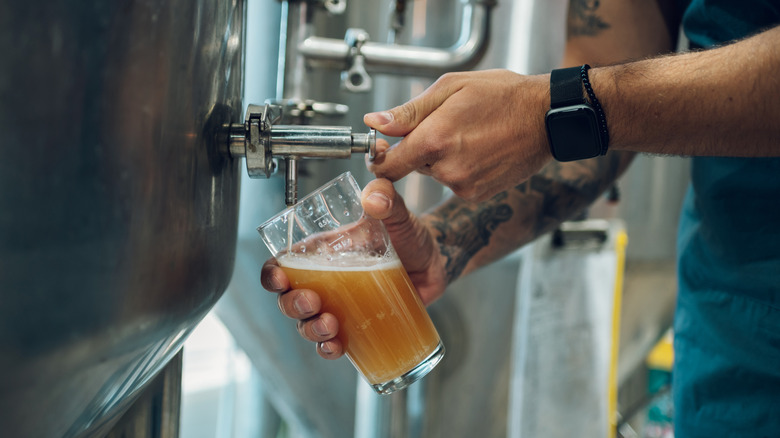
Anton Dobrea/Getty Images
Whether you love hoppy IPAs or barrel-aged chocolate stouts, the best craft beer in every U.S. state comes from breweries that aren't afraid to push the flavor envelope. However, not all tap rooms offer the same level of quality, and lax sanitary practices, particularly when it comes to tap line maintenance, are one of the brewery flags to look out for. To learn more about what's really going on inside those tap lines, we spoke with Stephen Alexander, sales and marketing director at Tall City Brewing and member of the public relations and marketing committee for the Texas Craft Brewers Guild, where he's also on the board of directors.
"Clean [tap] lines protect the beer, the brewery's reputation, and the guest experience," Alexander explains. As such, it is incumbent on a business to take care of its tap lines, or patrons could be subject to some unpleasant sensations. As for the indicators of poor maintenance and cleaning, Alexander cautions patrons to be on the lookout for "Sticky buildup on faucets, fruit flies hanging around taps." If you happen to take a sip, dirty tap lines can lead to "Sour or off flavors in a beer that shouldn't be sour, or buttery or funky flavors."
How can bars and breweries keep their taps clean?
Zamrznutitonovi/Getty Images
Draft beer systems consist of several components, including kegs, coolers, couplers, tubing, and faucets. When a customer orders a beer, the bartender opens the tap on the faucet, which pulls beer from within the chilled keg via tubing. Draft beer has a reputation for tasting better than what's served in cans and bottles because it's more likely to be fresh. Bar patrons typically order draft beer in larger volumes, so kegs get replaced quickly, whereas bottles and cans may linger for a little longer.
Of course, even the tastiest beer can be thwarted by dirty tap lines, which is why Tall City Brewing is so meticulous about sanitation. Sales and marketing director Stephen Alexander explains, "We treat draft maintenance like production equipment ... If the lines aren't clean, the beer you brewed isn't the beer people taste." Alexander characterizes this essential form of maintenance as "something happening behind the scenes constantly" at reputable breweries.
Within the brewing industry, tap line cleaning should take place at least every two weeks, but the frequency may increase for busier establishments. Along with tap lines, Alexander says that faucets should be disassembled for deep-cleaning. To keep draft beer at its best, keg components like gaskets and couplers also require regular care.

 English
 Arabic
 French
 Portuguese
 Deutsch
 Turkish
 Dutch
Dutch
 Italiano
 Russian
 Romaian
 Portuguese (Brazil)
 Greek
Greek