


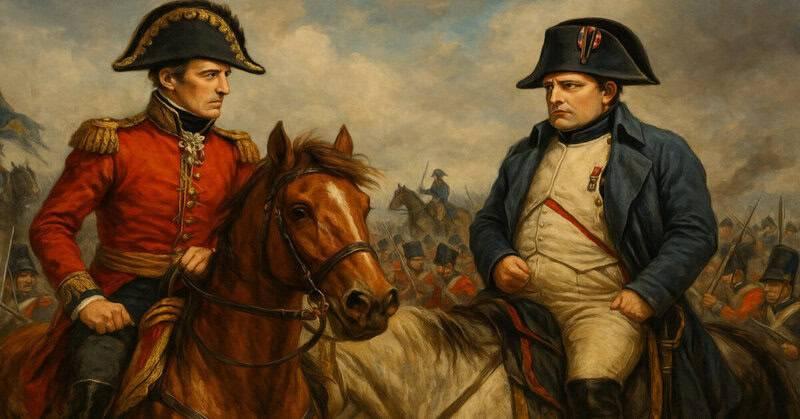
10 Reasons Why The Duke of Wellington Defeated Napoleon

0
39

10 Reasons Why The Duke of Wellington Defeated Napoleon

1. Superior Defensive Tactics

10 Reasons Why The Duke of Wellington Defeated Napoleon
Wellington’s defensive strongholds at Waterloo disrupt French assaults, pivotal in Napoleon’s ultimate defeat.

At the Battle of Waterloo, the Duke of Wellington demonstrated exceptional defensive strategies, effectively utilizing the terrain to his advantage. He established strongholds like Hougoumont Farm, which became pivotal in withstanding repeated French assaults. These fortifications allowed his troops to hold critical positions longer than anticipated, disrupting Napoleon’s offensive plans. Wellington’s adept use of defensive postures significantly contributed to the French forces’ repeated failures (historyextra.com).

2. Strategic Use of Terrain

10 Reasons Why The Duke of Wellington Defeated Napoleon
Wellington’s troops hold a fortified ridge at Waterloo, leveraging terrain to blunt French assaults.

Wellington’s forces were strategically positioned along a ridge at Waterloo, providing a natural defensive advantage and concealing troop movements. This positioning limited the effectiveness of French artillery and compelled Napoleon’s troops to attack uphill, significantly depleting their strength. The terrain played a crucial role in the resilience of the Allied forces (napoleon.org).

3. Reliable Allied Support

10 Reasons Why The Duke of Wellington Defeated Napoleon
Allied multinational troops unite at Waterloo, reinforced by Blücher’s Prussians to defeat Napoleon.

Wellington’s coalition comprised British, Dutch, Belgian, and German troops, forming a cohesive multinational force. Despite cultural and linguistic differences, this unity enhanced their manpower and presented a formidable front against Napoleon. The timely arrival of Prussian forces, led by Field Marshal Blücher, was pivotal. Their intervention overwhelmed the French, contributing significantly to the defeat of Napoleon’s exhausted army (britannica.com).

4. Mastery in Command and Control

10 Reasons Why The Duke of Wellington Defeated Napoleon
Wellington’s leadership and clear communication ensured swift, coordinated responses during critical battlefield momen…

Wellington’s disciplined command structure enabled swift responses to battlefield developments. His clear communication ensured efficient execution of orders, countering French attempts to sow confusion. His presence and calm under pressure instilled confidence in his troops during critical moments (nam.ac.uk).

5. Napoleonic Overconfidence

10 Reasons Why The Duke of Wellington Defeated Napoleon
Napoleon’s overconfidence against Wellington resulted in critical strategic errors and decisive Allied victories.

Napoleon’s underestimation of Wellington and his Allied forces led to strategic errors, including delayed orders and misjudgments of the opposition’s resilience. This overconfidence provided openings that Wellington effectively exploited (bbc.co.uk).

6. Effective Use of Cavalry

10 Reasons Why The Duke of Wellington Defeated Napoleon
Wellington’s strategic cavalry maneuvers repelled French assaults and decisively shifted the battle’s momentum.

Wellington effectively employed British and Allied cavalry for defensive counterattacks and to exploit French weaknesses, particularly during crucial moments of the French assaults. This judicious use of cavalry often turned the tide during critical phases of the battle (waterlooassociation.org.uk).

7. Resilience Under Heavy Fire

10 Reasons Why The Duke of Wellington Defeated Napoleon
Wellington’s disciplined troops repel repeated French attacks, maintaining steadfast defensive lines under pressure.

Despite relentless French artillery and infantry assaults, Wellington’s troops held their lines in key defensive positions for hours. Their discipline and morale withstood sustained pressure, blunting the effectiveness of French offensives. This steadfastness was crucial in resisting numerous enemy waves (militaryhistorynow.com).

8. Support From Local Populations

10 Reasons Why The Duke of Wellington Defeated Napoleon
Local Belgian and Dutch support bolstered Allied intelligence, logistics, and manpower during Wellington’s campaign.

Wellington’s forces benefited from the support of local Belgian and Dutch populations, who provided valuable intelligence, logistical assistance, and occasionally manpower. This network enabled the Allies to anticipate French movements and maintain vital supply lines. The contributions of these local communities were instrumental in the success of the Allied forces during the campaign (napoleon.org).

9. Timely Arrival of Prussian Reinforcements

10 Reasons Why The Duke of Wellington Defeated Napoleon
Prussian reinforcements flank Napoleon, enabling Wellington’s decisive counterattack and securing Allied victory.

The arrival of General Blücher’s Prussian army late in the day crippled Napoleon’s flanks and overstretched French forces. Their timely intervention gave Wellington the numbers to launch a decisive counterattack, sealing the Allied victory (britishheritage.org).

10. Exhaustion and Depleted French Forces

10 Reasons Why The Duke of Wellington Defeated Napoleon
Napoleon’s fatigued troops face Wellington’s well-supplied army at the pivotal Battle of Waterloo.

Napoleon’s army entered the Battle of Waterloo already worn from previous engagements. Attrition from earlier fighting, sickness, and lack of rest reduced French effectiveness, while Wellington’s forces maintained better condition through effective supply and discipline (history.com).

Conclusion

10 Reasons Why The Duke of Wellington Defeated Napoleon
Wellington’s strategic command and Allied unity secure victory at Waterloo, reshaping Europe’s future.

Wellington’s leadership, strategic acumen, and effective coalition management were pivotal in halting Napoleon’s ambitions at the Battle of Waterloo. His adept command and the timely support from Allied forces culminated in a decisive victory that reshaped European history. This triumph not only ended the Napoleonic Wars but also ushered in an era of relative peace, allowing Britain to solidify its global influence. The enduring legacies of both commanders continue to be studied, offering insights into military strategy and international diplomacy (history.com).

البحث
الأقسام
إقرأ المزيد
Food
Store-Bought Cookie Dough, Ranked Worst To Best
Store-Bought Cookie Dough, Ranked Worst To Best...
بواسطة Test Blogger1 2026-01-31 22:00:08 0 272
الألعاب
Hold the redstone phone, Hytale is hiring automation devs, and I'm ready for Minecraft kids to make me feel like a fool
Hold the redstone phone, Hytale is hiring automation devs, and I'm ready for Minecraft kids to...
بواسطة Test Blogger6 2026-01-24 13:00:38 0 393
Technology
See Samsung Galaxy S26s Privacy Display feature in action
Videos show Samsung Galaxy S26's new Privacy Display...
بواسطة Test Blogger7 2026-01-23 22:02:33 0 363
الألعاب
Deadlock release date estimate, latest news, trailers, and more
Deadlock release date estimate, latest news, trailers, and more When is the Deadlock...
بواسطة Test Blogger6 2026-02-06 17:00:17 0 104
Religion
Is It Possible for Someone to Lose Their Salvation in Jesus Christ?
Is It Possible for Someone to Lose Their Salvation in Jesus Christ? In scripture,...
بواسطة Test Blogger5 2026-01-23 20:02:09 0 407