




il21/Shutterstock
What's better than enjoying a glass of your favorite type of wine at the end of the day? Enjoying a glass of your favorite type of wine and showing off your excellent wine knowledge, of course. There are probably more rules surrounding wine than any other drink, and sometimes it's okay to break them. Other times they're myths that spread from person to person, like some kind of Bordeaux Bigfoot. One claim about this alcoholic beverage you can disregard is that you need to let it breathe.
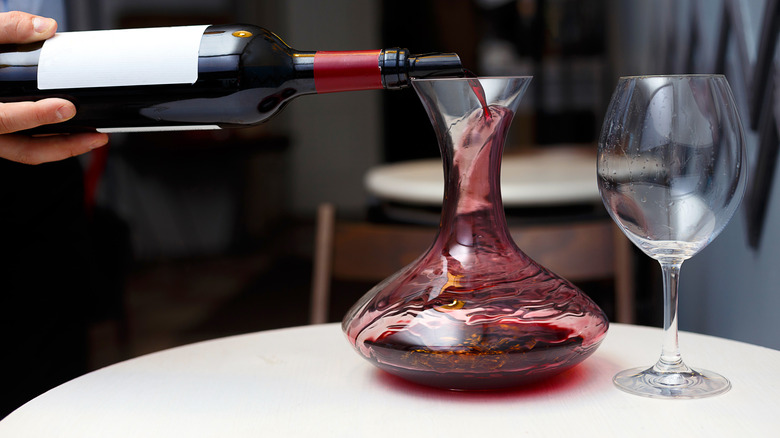
Letting wine breathe is the act of allowing the liquid to sit after opening it up. This can also be achieved by pouring wine into a wide glass like a decanter. The recommended length of the "breath" can vary depending on the type of wine: For Pinot Noir, it might only be 15 minutes, while a Cab Sav could sit for a whole hour. However, the basic idea ramins the same: to improve the flavor and aroma. Letting your cab blanc breathe was necessary back in the old days due to now-antiquated production processes. But for a modern wine, you can pretty much skip the whole step and enjoy it straight out of the bottle (or box; we don't judge).
Sulfur sparked the reason for breathing
Anna Volgina/Getty Images
Yes, the origin of this myth comes from a time when it was actually true. In the early days of commercial winemaking, wine was preserved with sulfur, a.k.a. "that thing that smells like rotten eggs," to help it travel long distances. In that context, the practice of airing out wine made a little more sense. Luckily, modern techniques mean no stinky smell, and no need to listen to this wine myth anymore.
Is there any point to letting wine breathe these days, then? It depends on whom you ask. Some wine aficionados claim that there is some benefit to aerating a big bottle of a decent-to-high quality red. The manufacturing company Coravin stresses that the breathing is "especially important for young red wines" to reach their full flavor potential. The process "can soften the harsh edges" of tannic wines, even those without a sulfury stink. A proponent of the practice on Reddit claimed breathing can strengthen wine's aroma in a good way (though not always) and acknowledged that ultimately it's up to you to decide. Still, unless you have a very, very vintage red, you can leave the breathing to the winos, not the wine.

 English
 Arabic
 French
 Spanish
 Portuguese
 Deutsch
 Turkish
 Italiano
 Russian
 Romaian
 Portuguese (Brazil)
 Greek
Greek