


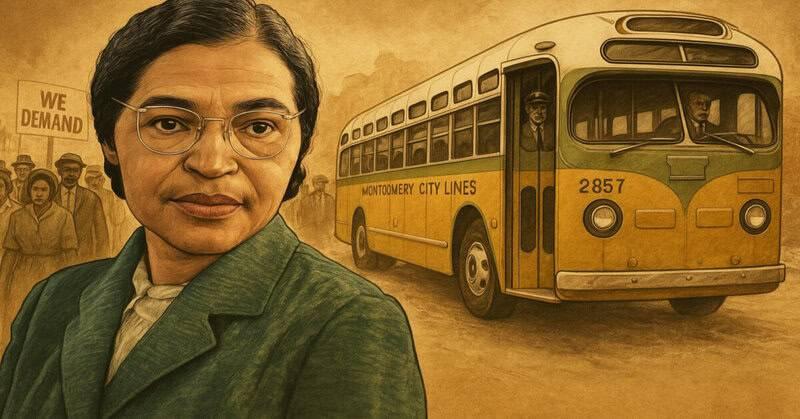
Black History Month: 12 Facts You Didn’t Know About Rosa Parks

0
22

Black History Month: 12 Facts You Didn’t Know About Rosa Parks

1. Rosa Parks Wasn’t Always First to Refuse a Bus Seat

Black History Month: 12 Facts You Didn’t Know About Rosa Parks
Image Source: Pexels.

Before Rosa Parks’ renowned act of defiance, 15-year-old Claudette Colvin refused to surrender her seat on a segregated Montgomery bus on March 2, 1955. Inspired by historical figures like Harriet Tubman and Sojourner Truth, Colvin’s courageous stand occurred nine months prior to Parks’ similar protest. However, due to her age and personal circumstances, Colvin did not become the face of the movement. Instead, Parks, a respected NAACP member, emerged as the iconic symbol of resistance. (history.com)

2. She Was a Seasoned Activist Before the Bus Boycott

Black History Month: 12 Facts You Didn’t Know About Rosa Parks
Rosa Parks working as NAACP secretary, documenting racial violence and advancing civil rights activism.

Before her iconic act of defiance, Rosa Parks was deeply involved in the civil rights movement. She served as the secretary of the Montgomery chapter of the National Association for the Advancement of Colored People (NAACP), where she worked alongside leaders like E.D. Nixon. Parks was also active in investigating and documenting instances of racial violence, contributing to the NAACP’s efforts to challenge systemic injustice. Her longstanding commitment to activism laid the groundwork for the Montgomery Bus Boycott. (Biography.com)

3. Rosa Parks Worked with Martin Luther King Jr.

Black History Month: 12 Facts You Didn’t Know About Rosa Parks
Rosa Parks’ arrest sparks the Montgomery Bus Boycott, launching Martin Luther King Jr.’s leadership.

Rosa Parks’ courageous act of defiance on December 1, 1955, led to her arrest and ignited the Montgomery Bus Boycott. This pivotal event propelled a young Martin Luther King Jr. into the national spotlight as the leader of the boycott. Parks, a seasoned activist and secretary of the Montgomery NAACP, collaborated closely with King and other leaders to organize the 381-day protest, which ultimately resulted in the desegregation of Montgomery’s public buses. (history.com)

4. She Lost Her Job After Her Arrest

Black History Month: 12 Facts You Didn’t Know About Rosa Parks
Rosa and Raymond Parks endured severe financial hardship after losing their jobs following her arrest.

Following her arrest on December 1, 1955, Rosa Parks faced significant personal and financial hardships. She was dismissed from her position as a tailor’s assistant at the Montgomery Fair department store in January 1956. Her husband, Raymond Parks, also lost his job as a barber at Maxwell Air Force Base. This loss of employment plunged the couple into severe economic instability, with their combined income dropping from approximately $3,700 in 1955 to just $661 by 1959. The financial strain continued for nearly a decade, leading them to relocate to Detroit in 1957. (loc.gov)

5. Parks Faced Years of Hardship After the Boycott

Black History Month: 12 Facts You Didn’t Know About Rosa Parks
Rosa Parks perseveres through adversity, continuing her civil rights activism after relocating to Detroit.

Following the Montgomery Bus Boycott, Rosa Parks and her family endured significant economic and personal hardships. Both Rosa and her husband, Raymond, lost their jobs due to their involvement in the boycott. They faced harassment and threats, leading them to relocate to Detroit in 1957 to join Rosa’s brother. Despite these challenges, Parks continued her activism, supporting civil rights causes and eventually working as an administrative aide in the Detroit office of Congressman John Conyers Jr. (kinginstitute.stanford.edu)

6. She Was Part of the Fight for Justice in Detroit

Black History Month: 12 Facts You Didn’t Know About Rosa Parks
Rosa Parks advocates for civil rights and social justice as aide to Congressman John Conyers Jr.

After relocating to Detroit in 1957, Rosa Parks continued her activism by working as an administrative aide to Congressman John Conyers Jr. from 1965 to 1988. In this role, she addressed constituent concerns, including welfare benefits, social security, and job discrimination. Parks also advocated for political prisoners and victims of police abuse, supporting cases like that of Joanne Little, who was acquitted in 1975 after being charged with killing a jailer who sexually assaulted her.

7. Parks Helped Investigate Sexual Assaults

Black History Month: 12 Facts You Didn’t Know About Rosa Parks
Image Source: Wikimedia Commons.

In 1944, Rosa Parks investigated the gang rape of Recy Taylor, a Black woman in Abbeville, Alabama. Taylor was abducted and assaulted by six white men; despite her courageous testimony, no charges were filed. Parks, then an NAACP investigator, documented Taylor’s account and mobilized support through the Alabama Committee for Equal Justice for Mrs. Recy Taylor, highlighting systemic racial violence against Black women (washingtonpost.com).

8. She Was the First Woman to Lie in Honor at the U.S. Capitol

Black History Month: 12 Facts You Didn’t Know About Rosa Parks
Image Source: Pexels.

Following her death on October 24, 2005, Rosa Parks was honored with a public viewing in the Rotunda of the U.S. Capitol, becoming the first woman and only the second African American to lie in honor there. This rare tribute, typically reserved for heads of state, was accorded to Parks in recognition of her pivotal role in advancing civil and human rights (history.house.gov).

9. Rosa Parks Received the Presidential Medal of Freedom

Black History Month: 12 Facts You Didn’t Know About Rosa Parks
Rosa Parks receives the Presidential Medal of Freedom from President Bill Clinton, honoring her civil rights legacy.

In 1996, Rosa Parks was awarded the Presidential Medal of Freedom, the highest civilian honor given by the U.S. executive branch, in recognition of her pivotal role in advancing civil rights and equality. President Bill Clinton presented the medal to Parks in a private Oval Office ceremony on September 15, 1996. This honor acknowledged her courageous act of defiance in 1955, which became a catalyst for the Montgomery Bus Boycott and the broader civil rights movement (Library of Congress).

10. She Wrote an Autobiography for Children

Black History Month: 12 Facts You Didn’t Know About Rosa Parks
Rosa Parks’ autobiography shares personal stories and insights into her pivotal role in civil rights.

In 1992, Rosa Parks authored “Rosa Parks: My Story,” a compelling autobiography that offers young readers an intimate look into her life and the civil rights movement. Co-written with Jim Haskins, the book provides personal anecdotes and insights, making it an invaluable resource for understanding her experiences and the broader struggle for equality (publishersweekly.com).

11. She Had a Close-Knit Family and Support System

Black History Month: 12 Facts You Didn’t Know About Rosa Parks
Rosa and Raymond Parks, united in marriage and activism, forged a powerful legacy for civil rights.

Rosa Parks’ activism was deeply supported by her family, particularly her husband, Raymond Parks. Married in 1932, Raymond, a self-educated barber, was a steadfast advocate for civil rights and encouraged Rosa’s involvement in the NAACP. Their shared commitment to equality and justice provided Rosa with a strong foundation, enabling her to face the challenges of the civil rights movement with resilience and determination (Rosa Parks Institute).

12. The Bus Where Parks Sat Is Now in a Museum

Black History Month: 12 Facts You Didn’t Know About Rosa Parks
Rosa Parks’ historic Montgomery bus, restored and displayed at The Henry Ford Museum, Dearborn.

The bus where Rosa Parks made her historic stand is preserved and displayed at The Henry Ford Museum in Dearborn, Michigan. This 1948 General Motors bus, known as Bus 2857, was restored to its 1955 appearance and is part of the museum’s “With Liberty and Justice for All” exhibition. Visitors can board the bus to experience the setting of Parks’ courageous act, which ignited the Civil Rights Movement (thehenryford.org).

Site içinde arama yapın
Kategoriler
Read More
Other
Electronics Thermal Management Materials Market Growth Analysis 2023–2031 Backed by a 6.4% CAGR
The Electronics Thermal Management Materials Market encompasses materials specifically engineered...
By Shalini Sonk 2026-01-30 11:32:23 0 371
Technology
Work smarter with side-by-side results from today’s top AI models thanks to this tool
Work smarter with side-by-side results from today’s top AI models thanks to this tool...
By Test Blogger7 2026-01-28 06:01:52 0 209
Technology
Don’t count your old PC out — give it a refresh with this $10 Windows 11 Pro license
Don’t count your old PC out — give it a refresh with this $10 Windows 11 Pro license...
By Test Blogger7 2026-02-01 11:00:27 0 150
Oyunlar
Take-Two boss says gen-AI has played "zero part" in GTA 6's creation, even though his studios are "embracing" it more widely
Take-Two boss says gen-AI has played "zero part" in GTA 6's creation, even though his studios are...
By Test Blogger6 2026-02-04 00:00:22 0 144
Religion
Is It Possible for Someone to Lose Their Salvation in Jesus Christ?
Is It Possible for Someone to Lose Their Salvation in Jesus Christ? In scripture,...
By Test Blogger5 2026-01-23 20:02:09 0 268