




Theo Wargo/Getty Images
Martha Stewart lives on a 153-acre estate in Bedford, New York, among acres and acres of pristine landscapes, orchards, and gardens. Although she developed an interest in gardening from a young age and is very knowledgeable when it comes to plants and flowers of all kinds, she has plenty of help tending her land. Her head gardener, Ryan McCallister, has been working with Stewart since 2011 and has become well-known himself through the appearances he's made on his famous boss's television shows. He is partially responsible for Stewart's stunning vegetable garden harvests. McCallister's Instagram page is bursting with stunning photos of the flora and fauna on the Bedford estate, including a clip from late 2023 showcasing a medlar tree.
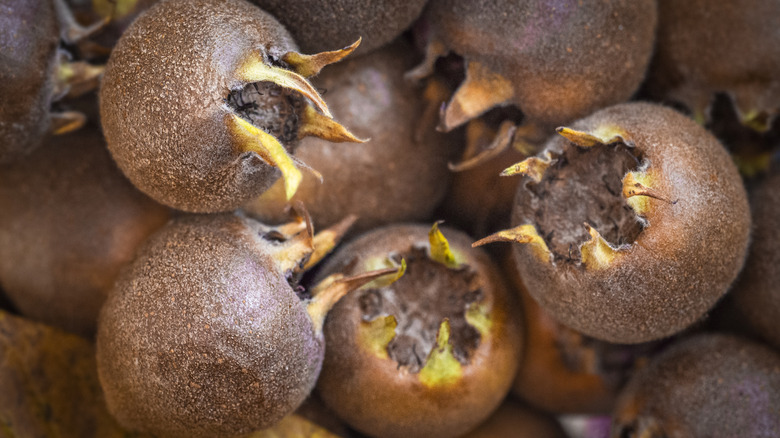
McCallister explains in the caption of the video, "Medlars, an ancient relative of apples and quince, are the last winter fruit. They need to go through many frosts, or picked and left to 'blet' for a number of weeks (similar process to persimmons) to become edible. They have a mushy texture inside when ripe and taste similar to cinnamon applesauce." Stewart made her sentiments about the fruit known when she commented, "I ate ten all at once." Ripe medlars are not the most attractive fruits when they're ripe; their trees are bare and brown without any leaves left, and the fruits are dark and shriveled, but with the slightest bit of pressure, they can be split open to reveal the soft pulp inside.
All about medlar fruit
Ineskoleva/Getty Images
Martha Stewart posted a blog about the fruits she grows on her estate and included a short description of her medlars. The small fruits are botanically related to roses and are native to Southwestern Asia (near Iran) and Southeastern Europe. She explains the process of "bletting" (which Ryan McCallister made reference to in the aforementioned Instagram post) as letting the fruit sit until they are nearly rotten. It's only then that they'll be ripe and good to eat or use in recipes. She suggests that ripe medlars taste like ripe dates (which happen to be the best white sugar substitute you've probably never tried), toffee apples, or apple butter. If they are underripe, they are sometimes described as hard and bitter or sour.
Because ripe medlars are very soft, they really cannot be sliced or cut into chunks. The fruit's paste-like consistency makes it good to put on a plate or dish and serve with a cheeseboard. Think of it as an alternative to quince paste or jam; it can be a nice counterpart to salty, funky cheeses like blue, the cheese invented by accident. You can also enjoy it raw on breakfast staples like oatmeal, yogurt, or cottage cheese. As an ingredient, medlar makes tasty jam that you can use in cookies or tarts, or bake it into muffins.

 English
 Arabic
 French
 Spanish
 Portuguese
 Deutsch
 Turkish
 Dutch
Dutch
 Italiano
 Russian
 Romaian
 Greek
Greek