


Child From World’s Oldest Burial Was Neanderthal-Homo Sapiens Hybrid
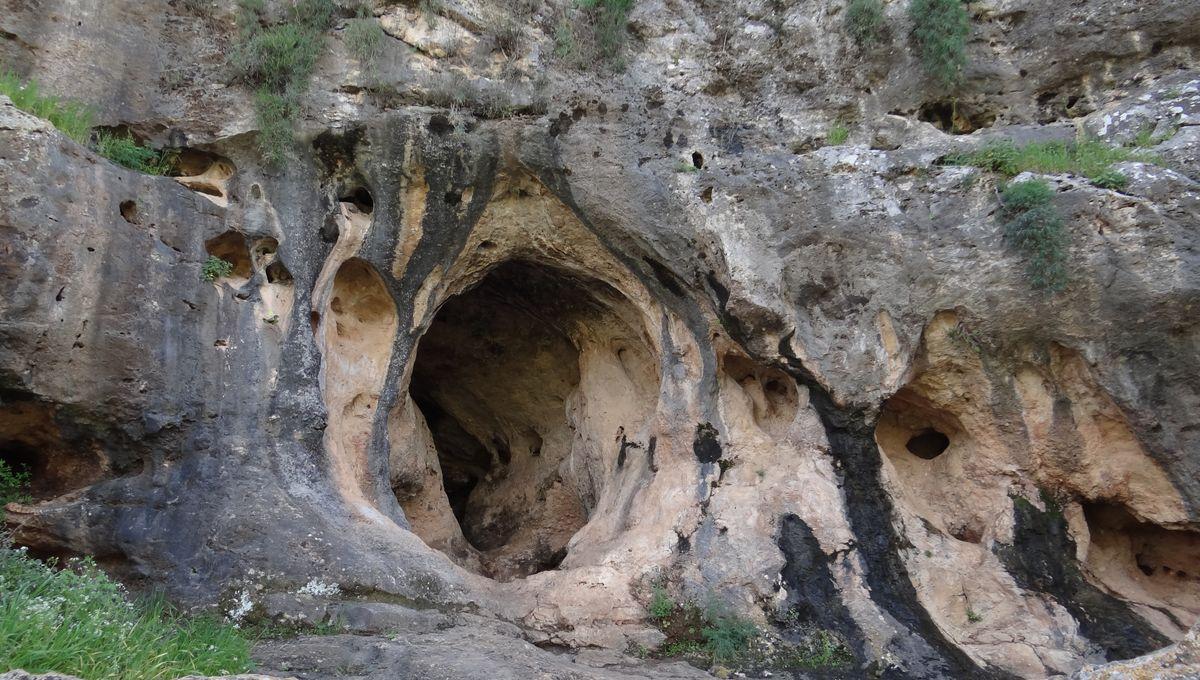
Child From World’s Oldest Burial Was Neanderthal-Homo Sapiens Hybrid
A little over 100,000 years ago, groups of prehistoric humans in the Levant suddenly began burying their dead, marking one of the most significant cognitive and behavioral leaps in the history of our species. Yet these primordial grave-diggers weren’t quite like us, and new research reveals that a young child from the world’s oldest cemetery may have been a Neanderthal-modern human hybrid.
The inhumation trend took hold in what is now Israel, with early burials found at sites including Tabun, Qafzeh, Nesher Ramla, Tinshemet, and Skhul. However, the identity of those occupying the graves has remained an open question for decades, with some skeletons appearing somewhat like archaic Homo sapiens while others may have been more Neanderthal-like. To shed light on the matter, the authors of a new study re-examined the braincase and jawbone of a child that was buried in Skhul Cave around 140,000 years ago. Likely a girl who died between the ages of three and five, the individual was initially considered “a transitional Homo phase between Neanderthals and modern humans,” but was later recognized as “Anatomically Modern Human”, the researchers explain. Yet not everyone is convinced that the Skhul child belongs to the Homo sapiens lineage, particularly given the similarities some of the bones show to those of Neanderthal children from France and Spain. The study authors therefore conducted CT scans of the neurocranium and mandible, as well as creating the first 3D model of the bony labyrinth of the inner ear. After examining various morphological traits, the researchers found that “while the general profile of the reconstructed cranial vault in the posterior view matches with Homo sapiens, the mandible is similar in shape to Neanderthal.” As such, they conclude that “the combination of features seen in [the Skhul child] may suggest that the child is a hybrid.” The question is: who were the adults who buried this child whose lineage was not exclusively sapiens? Anne Dambricourt Malassé The bony labyrinth was also compared to a number of archaic hominins, including Neanderthals from France and an early band of Homo sapiens known as Cro-Magnon. Overall, this key feature of the inner ear was found to match that of modern humans, with little resemblance to Neanderthals. In contrast, however, the rounded dental arch and the alignment of the canines and incisors are hallmarks of Neanderthal morphology. Ultimately, then, the researchers say that the child should not be assigned to any particular species, and that it would be more appropriate to classify the specimen as part of a Skhul “paleodeme”. Moreover, the inability of this ancient creature to fit into any defined human lineage reinforces the idea that the Middle-Paleolithic Levantine community was a mish-mash of human species that all intermingled to create a genetically, biologically, and culturally mixed population. “Therefore, contrary to the prevailing paradigm, the earliest known mortuary practices involving burials cannot be attributed exclusively to Homo sapiens over Homo neanderthalensis,” write the authors. “The fact that [the Skhul child] cannot be allocated to Homo sapiens nor to Homo neanderthalensis, but rather to a young hybrid, contributes to the fundamental research in paleocognition devoted to the emotional behavior and the emergence of the symbolic mind,” they add. In an email to IFLScience, study author Anne Dambricourt Malassé explained that while these findings help to fill some gaps in the paleoanthropological record, they also leave a number of questions unanswered. “We conclude different Homo groups interacted, but what lineages?,” she says. “There are no Neanderthal fossils so old in the Levant, which raises different hypotheses not addressed in the [study].” One possibility, of course, is that these fossils simply haven’t been found yet, although Dambricourt Malassé says the appearance of the Skhul child may also indicate the existence of “an unknown Indigenous lineage” in the Levant that predated the arrival Homo sapiens and “evolved with neandertal-like growth factors.” “The question is: who were the adults who buried this child whose lineage was not exclusively sapiens?” she ponders. The study has been published in the journal l’Anthropologie.

 English
 Arabic
 French
 Portuguese
 Deutsch
 Turkish
 Dutch
Dutch
 Italiano
 Russian
 Romaian
 Portuguese (Brazil)
 Greek
Greek