


The Dark Sides Of Uranus's Moons Are The Wrong Way Round
The Dark Sides Of Uranus's Moons Are The Wrong Way Round
Uranus is a very weird planet, and it turns out that there is a newly discovered oddity to add to its already extensive list. Astronomers used Hubble to study the interactions between the planet's weird magnetic field and its moons, trying to demonstrate that a well-founded hypothesis was true. They found out the very opposite.
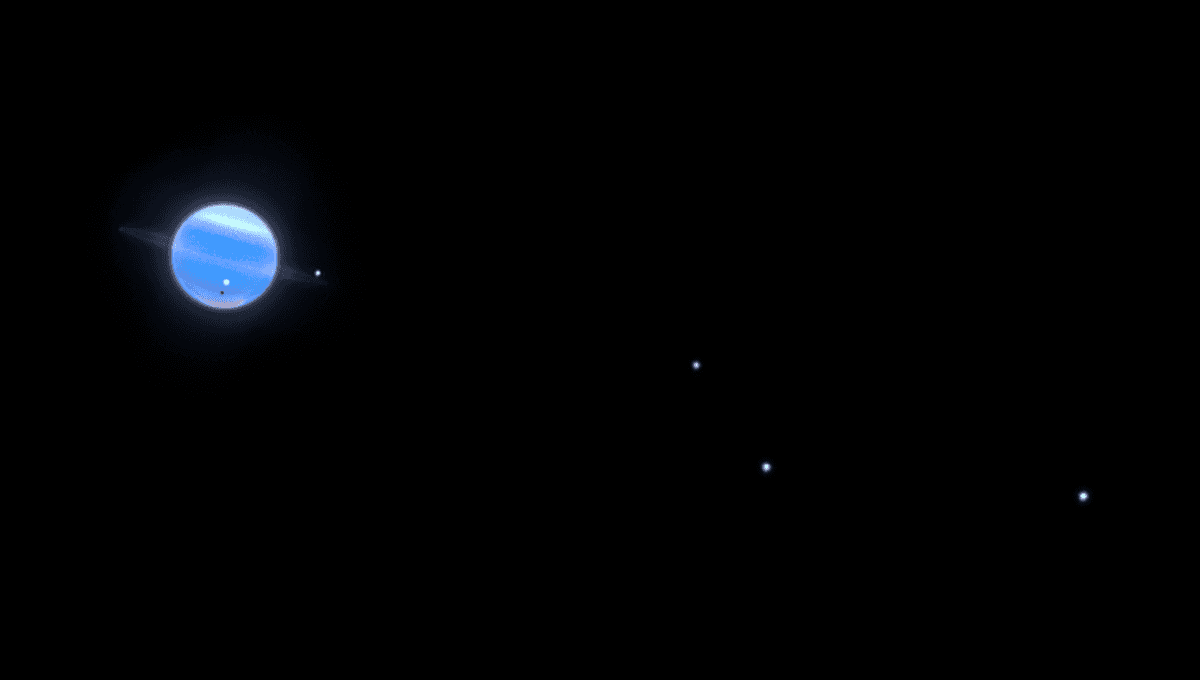
Uranus orbits on its side, so that its poles take turns facing the Sun. Also, its magnetic field doesn’t go through the center of Uranus, creating a peculiar magnetosphere around the planet and its moons. Even that considered, astronomers expected to see a clear effect on the four main moons: Ariel, Umbriel, Titania, and Oberon. These are all tidally locked, meaning they always show the same face to the planet, just like our Moon. The magnetic field of Uranus is also tilted at 59 degrees, so it constantly sweeps past the moons faster than they can orbit the planet. The expectation from models is that it would cause a rain of charged particles onto the trailing side of those moons. This process should have darkened that face of the moons, and in comparison, the leading side should look brighter. More electrons slamming on one side would make that side darker. The model suggests that the trailing side gets more electrons, so it should be darker. It makes perfect sense. Unfortunately, Uranus stubbornly refuses to make sense. It is the leading side of two of these moons that has somehow darkened, as if they are the wrong way around. “Uranus is weird, so it's always been uncertain how much the magnetic field actually interacts with its satellites,” principal investigator Richard Cartwright of the Johns Hopkins University’s Applied Physics Laboratory said in a statement. “For starters, it is tilted by 98 degrees relative to the ecliptic.” The cause of it all is not likely to be the magnetosphere. Astronomers suspect it might be dust, a bit like having bugs on a windshield. Titania and Oberon have a darker and redder leading hemisphere compared to their trailing hemisphere, something not seen in inner moons Ariel and Umbriel, which have similar hemispheres. Small irregular moons around Uranus slowly throw dust into orbit following micrometeorite impacts. The dust is swept away by the larger outer moons. “We see the same thing happening in the Saturn system and probably the Jupiter system as well,” added co-investigator Bryan Holler of the Space Telescope Science Institute. “This is some of the first evidence we’re seeing of a similar material exchange among the Uranian satellites.” “So that supports a different explanation,” said Cartwright. “That's dust collection. I didn't even expect to get into that hypothesis, but you know, data always surprise you.” What about the magnetic field? It is possible that the magnetosphere is less active than previously imagined, or it is a lot more complicated. Knowing Uranus, it is probably the latter. The team will continue observations and use data from JWST to try to better understand what’s going on. The results were presented at the 246th Meeting of the American Astronomical Society in Anchorage, Alaska, on June 10.

 English
 Arabic
 French
 Spanish
 Portuguese
 Turkish
 Dutch
Dutch
 Italiano
 Russian
 Romaian
 Portuguese (Brazil)
 Greek
Greek