


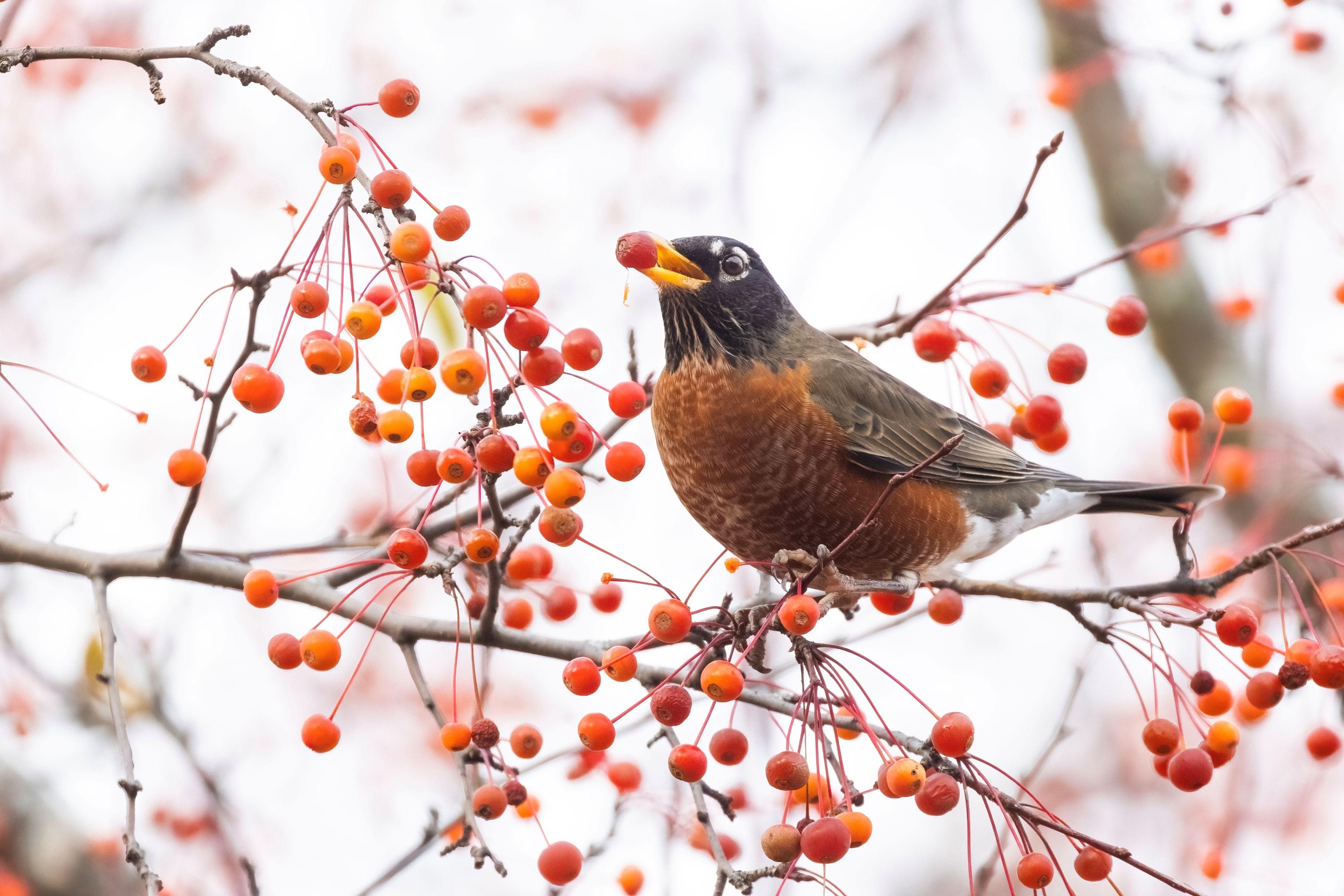
Naturally decorated for the winter season, this easy-care collection of trees and shrubs is festooned with clusters of bright red, orange, and blue-black berries for weeks. The colorful fruit will beckon backyard guests. Songbirds visit these living birdfeeders for sustenance when the rest of the landscape has limited foraging options. The birds visit so frequently that trees and shrubs are often plucked clean of fruit by late winter.
Our plant list includes trees and shrubs for landscapes of all sizes. For a tiny plot, choose a small cultivar that promises big berry production.
Matthew Benson
1. Crabapple
Growing 8 to 25 feet tall and 4 to 15 feet wide, crabapples (Malus spp.) are small to medium trees with spring flowers in shades of white, pink, and red that turn into long-lasting clusters of colorful fruit. The fruit color varies by cultivar.
How to grow: Plant in full sun and well-drained soil. Easy-care crabapples are tolerant of a wide range of soils and will tolerate drought once established. Prune trees in late winter; don’t prune in spring or summer when trees are susceptible to disease. Zones 4–8
Recommended varieties: ‘Prairifire’ with dark red fruit; ‘Red Jade’ with bright red fruit; ‘Indian Magic’ with orange fruit.
2. Hawthorn
A North American native tree with bright white spring flowers, hawthorn (Crataegus spp.) is decorated with clusters of red berries in winter. Some trees have large thorns along the branches, which make them great hedge plants where you want an impenetrable barrier. The trees are medium in size, growing 25 to 35 feet tall and wide.
How to grow: Plant in full sun and average soil. Plants tolerate poor, dry soil well. Pests and diseases are problems for many hawthorns; choose a resistant variety. Zones 3–8.
Recommended varieties: Washington hawthorn (C. phaenopyrum), a species with thorns along its branches and bright red fruit; ‘Winter King’, a thornless cultivar of C. viridis, is prized for its red fruit. Both have good disease resistance.
Laurie Black
3. Winterberry
A deciduous holly with red berries, winterberry (Ilex verticillata) is a native shrub that grows just 6 to 8 feet tall. To produce berries, you need a male and a female plant. Generally, one male plant is sufficient for pollinating 6 to 10 female plants.
How to grow: Plant in full sun or part shade and moist soil. Winterberry will tolerate a variety of soil types but grows best in moist, but not wet, soil that is rich in organic matter. Zones 3–9.
Recommended varieties: ‘Berry Poppins’ grows just 3 to 4 feet tall and is a prolific berry producer when combined with ‘Mr. Poppins’ as a pollinizer.
Marty Baldwin
4. Juniper
Native North American evergreen trees and shrubs, junipers (Juniperus spp.) produce blue wax-covered cones that look like berries. The soft, fleshy fruit is full of nutritious seeds favored by waxwings, thrushes, and warblers.
How to grow: Plant in full sun and well-drained soil. Junipers tolerate poor, sandy soil and hot conditions. Zones 3–9.
Recommended varieties: ‘Alpine Carpet', a groundcover shrub that grows just 8 inches tall and 36 inches wide. ‘Aquavita’ grows 15 feet tall and has a striking blue color.
Blaine Moats
5. Viburnum
Fragrant spring flowers, blemish-free foliage, and long-lasting berries make this native shrub (Viburnum spp.) a prized member of the landscape. Plant several different viburnum species to explore the diversity of size, texture, and berries in this big plant group.
How to grow: Plant in full sun or part shade and well-drained soil. Some species tolerate wet, boggy soil well. Zones 2–9.
Recommended varieties: ‘Sparkler’ is a cultivar of arrowwood viburnum (Viburnum dentatum) growing 10 to 15 feet tall with blue-black berries in winter. ‘Hahs’ is an American cranberry bush viburnum ( V. opulus var. americanum) that grows 6 to 8 feet tall and produces red berries.
Andreas Trauttmansdorff
6. Cranberry Cotoneaster
Cotoneaster apiculatus is a low-growing shrub well-suited for a mixed shrub border. It spreads 3 to 6 feet wide and produces small pink-white flowers in spring and cranberry red fruit in late summer. The fruit is sometimes used as a substitute for traditional cranberries. The berries persist into winter.
How to grow: Plant in full sun or part shade and moist, well-drained soil. Shrubs grow best where they receive regular rainfall, though the shrub tolerates dryness and salt. Zones 4–7.
Recommended varieties: 'Tom Thumb' is a tidy, compact variety that grows 1 to 2 feet tall and spreads 5 feet.

 English
 Arabic
 Spanish
 Portuguese
 Deutsch
 Turkish
 Dutch
Dutch
 Italiano
 Russian
 Romaian
 Portuguese (Brazil)
 Greek
Greek