


World’s Oldest Poison Arrows Were Used By Hunters 60,000 Years Ago
World’s Oldest Poison Arrows Were Used By Hunters 60,000 Years Ago
Prehistoric hunter-gatherers in South Africa applied deadly poisons to their stone arrows 60,000 years ago. Amazingly, the toxin they used is still employed by some Indigenous hunters in the region today, indicating a remarkably early origin for this ongoing lethal practice.
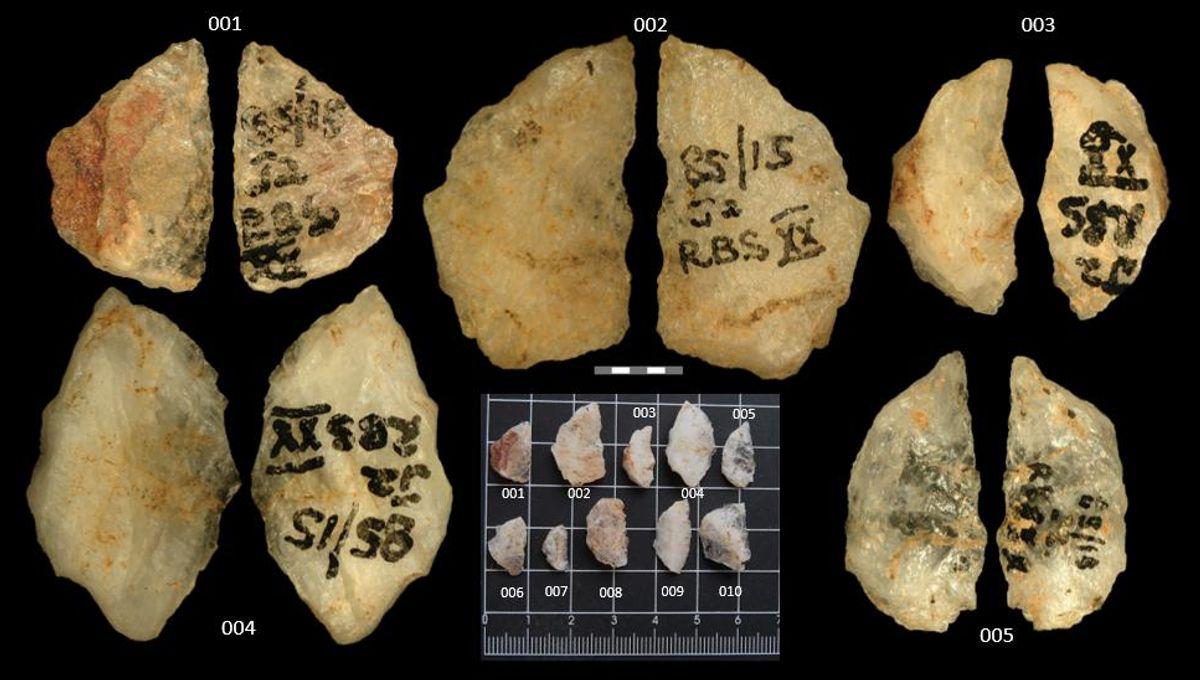
The rest of this article is behind a paywall. Please sign in or subscribe to access the full content. Researchers used a series of micromolecular analysis techniques to examine 10 quartz arrowheads recovered from a layer of sediment dated to 60,000 years ago at the Umhlatuzana Rock Shelter in KwaZulu-Natal. Of these, five were found to contain residues of the poisonous alkaloids buphandrine and epibuphanisine, which are produced by the plant Boophone disticha – known locally as gifbol, meaning “poison bulb”. I was somewhat surprised that we identified the same gifbol arrow poison on five of the arrow tips. Professor Marlize Lombard Abundant in the area, gifbol remains a well-known source of arrow poison, and was first described by Swedish naturalist Carl Peter Thunberg – sometimes referred to as the father of South African botany – when he observed hunter-gatherers using these toxins to hunt game in the 1770s. Some of the arrows he collected were also analyzed by the study authors and were found to contain the same alkaloids as those from Umhlatuzana. “I was somewhat surprised that we identified the same gifbol arrow poison on five of the arrow tips, as well as on four ethno-historical arrowheads that were brought to Sweden from South Africa about 250 years ago,” study author Professor Marlize Lombard, from the University of Johannesburg, told IFLScience. “Importantly, this does not mean that the Kalahari bowhunters of today are frozen in time. Instead it demonstrates that their ancestors already had very advanced ways of hunting – long before previously thought, and possibly before elsewhere in the world,” she told IFLScience. Indeed, prior to this discovery, the oldest known poison-laced weapons were dated to just 6,700 years ago, and came from Kruger Cave in South Africa. Similar bone-tipped poison arrows have also been found in Egypt, but these are just over 4,000 years old. Don’t get the wrong idea though; these arrows weren’t designed to kill their prey upon impact, nor was the poison intended to work quickly. Instead, the ancient projectiles featured small tips that were engineered to break off from their shaft after impact and remain just under the victim’s skin as the toxin slowly did its work over a period of hours to days. The Umhlatuzana bowhunters of 60,000 years ago were not much different from us in their technical capabilities. Professor Marlize Lombard Hunters would therefore have to continue tracking their prey even after scoring a direct hit, sometimes over long distances. “The poison was likely used within the context of persistence hunting, where its primary function was to reduce the time required to track and subdue a wounded animal, thereby lowering the overall energetic cost of the hunt,” explained study author Professor Sven Isaksson from Stockholm University. According to Lombard, this strategy may have been used to capture springboks, wildebeests, zebras, or even giraffes. “Tracking game through the bush, and then focusing to shoot an arrow accurately over about 30 meters [98 feet] at a moving target, whilst not disturbing the target, is cognitively similar to driving a gear-shift car in city traffic or flying a drone for several hours and landing it on a specific spot afterwards,” she said. “Adding poison to the mix also means an extended planning time, and an abstract understanding of the potency of the poison,” Lombard added. All in all, the researcher said, these capabilities suggest that “the Umhlatuzana bowhunters of 60,000 years ago were not much different from us in their technical capabilities.” The study has been published in the journal Science Advances.

 English
 Arabic
 French
 Spanish
 Portuguese
 Deutsch
 Turkish
 Dutch
Dutch
 Russian
 Romaian
 Portuguese (Brazil)
 Greek
Greek