


Antarctic Scientists Have Just Moved The South Pole – Literally
Antarctic Scientists Have Just Moved The South Pole – Literally
New Year's celebrations are a little bit different in Antarctica. Under the relentless summer daylight and searing cold, the ragtag crew of souls who have found themselves at the planet’s southernmost point take part in an unusual but important ritual.
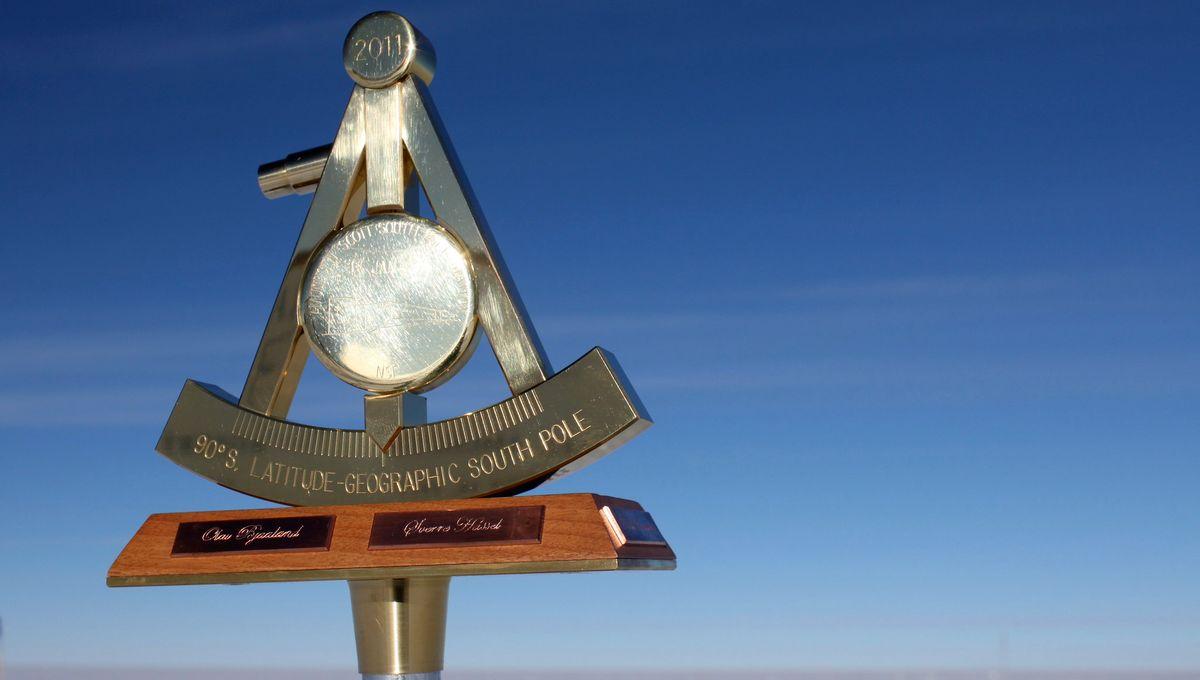
The rest of this article is behind a paywall. Please sign in or subscribe to access the full content. Each year around January 1, the crew of the Amundsen-Scott South Pole Station must move the stick in the ice that designates the geographic South Pole. Run by the United States Antarctic Program, the station is located deep within the Antarctic interior at 90°S, the geographic South Pole, sitting on top of an ice sheet at an elevation of approximately 2,835 meters (9,301 feet) above sea level. The station’s annual pole move isn’t because the magnetic pole of Earth has shifted (although that is another problem polar scientists must battle with). Instead, it’s because ice sheets are dynamic and constantly moving, like a super-thick syrup running off a pancake. The geographic South Pole is a fixed point where Earth's rotation axis meets the surface, but it sits atop a slowly drifting sheet of ice. Near the Amundsen-Scott South Pole Station, that ice is slipping toward the Weddell Sea at a significant pace. Over time, this steady motion carries both the station and the surface marker rate of around 10 meters (33 feet) per year across the solid rocky continent far below. So, each New Year’s Day, scientists carefully survey the area and reset the marker. The old pole is removed and placed into a cabinet while the new pole is unveiled during a small ceremony attended by a huddled crew of researchers, technicians, and support staff stationed at the pole for the summer. This isn’t an issue on the other side of the planet at the North Pole. Here, there’s no solid land at all. The Geographic North Pole sits in the middle of the Arctic Ocean, covered by floating sea ice that is constantly breaking, reforming, and drifting with winds and currents. None of this should be confused with the magnetic pole, which wanders independently of both the North and South geographic poles. The magnetic South Pole, for instance, is currently drifting north-northwest around 55 kilometers (34 miles) per year, according to NOAA. Marking this ever-moving point with a physical stick would be nearly impossible and, to be honest, a fairly fruitless endeavor.

 English
 Arabic
 French
 Spanish
 Portuguese
 Deutsch
 Turkish
 Italiano
 Russian
 Romaian
 Portuguese (Brazil)
 Greek
Greek