


Fractal Design Terra review - still a champion of sleek mini-ITX cases
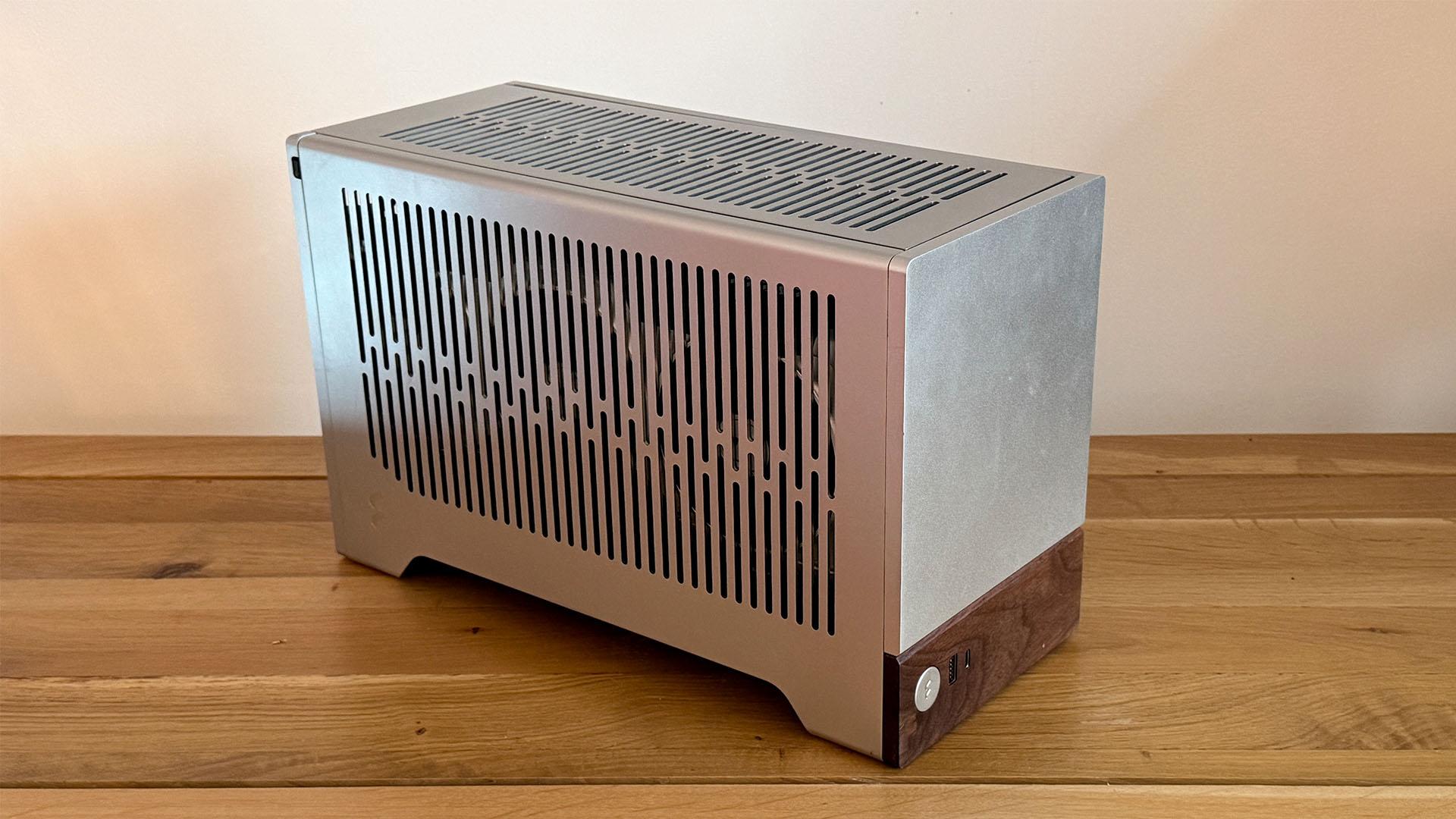
Fractal Design Terra review - still a champion of sleek mini-ITX cases
Verdict

The Fractal Design Terra brings elegant Mini-ITX style to the masses and its flexible cooling arrangement means that while liquid cooling support is poor, you can prioritize triple-slot GPUs or better CPU cooling in a tiny case that’s surprisingly easy to work with.
Pros
- Beautiful design
- Adjustable motherboard tray
- Tool-less flip open side panels
- Can house triple-slot GPUs
Cons
- Expensive
- Severe CPU cooler height limitations
- Poor liquid cooling support
- SFX PSUs only
While there are plenty of cheaper options than the Fractal Design Terra when it comes to capable Mini-ITX cases - The Hyte Revolt 3, Ssupd Meshlicious, and Cooler Master NR200P are all more capable too - as you approach 10 liters in capacity, design and cooling start to play more pivotal roles. Cramming in the latest hardware while keeping it cool, all in a tiny but attractive chassis, is the goal of most cases of this size, but there are usually serious compromises. That's where the Terra's internal design comes in, allowing you to pick between housing triple-slot GPUs or coolers large enough to handle decent CPUs.
This versatility, along with excellent build quality and a design that - even years after its initial release - remains iconic, still makes this one of the best PC case options around. Fractal Design is arguably the PC company with the best eye for design right now - just see its Refine gaming chair for another example - and the Terra is a classic example of what it does so well. Read on below to find out what it does and doesn't excel at.

This is a sandwich-style case, so the motherboard faces one side panel and the GPU sits at its back, facing the other, using a PCIe riser cable to connect the two. This means that the CPU cooler height limit is very restricted, but rather than having a fixed limit here, the entire motherboard tray can move back and forth, giving the GPU or the CPU areas greater depth.
As a result, this case can house some of the largest GPUs out there, but if you have a dual-slot card, you can boost the CPU cooler height instead. This case is far smaller than the likes of the Cooler Master NR200P, and has a much smaller volume than many vertical tower cases, such as the Hyte Revolt 3 and Ssupd Meshlicious, so this adjustability is crucial to allowing it to be used with a reasonable variety of systems.
Specs
| Fractal Design Terra specs | |
| Case type | Mini tower |
| Dimensions (W x D x H) | 153 x 343 x 218mm |
| Material | Aluminum, steel |
| Available colors | Black, white |
| Panels | 3 x aluminum |
| Weight | 4kg / 8.8lbs |
| Front panel | 1 x USB Type-C, 1 x USB Type-A |
| Drive bays | 6 x 3.5-inch, 4 x 2.5-inch, 2 x 3.5-inch/4 x 2.5-inch |
| Form factors | E-ATX, ATX, micro-ATX |
| Cooling | 1 x 120mm |
| GPU cooler clearance | 77mm 77mm (dual-slot GPU), (48mm with triple-slot GPU) |
| Maximum graphics card length | 322mm |
| Extras | PSU spacers, Velcro cable ties |
| Price / MSRP | $220 / $175 |
Features
At the heart of the Terra is an adjustable spine that shifts the motherboard tray towards either side panel, creating more space for the CPU or GPU. For example, with a CPU cooler height limit of 48mm, there's 62mm remaining for the GPU, which is enough to house some of the largest cards out there. However, that doesn't leave much room for the CPU cooler. In fact, you'll be limited to very low-power CPUs and low-profile coolers.

The various notches in the adjustment allow for compromise, though, with a more balanced option being to maximize the CPU cooler side to 77mm, leaving 43mm for the GPU depth. This is still big enough to house an RTX 5080 Founders Edition and have space enough for coolers such as Noctua's NH-L12Sx77, which, incidentally, was made with the Terra in mind and can cope with most CPUs. Ultimately, there are loads of different configurations that are possible with this case, but the crucial point is that you genuinely can house and effectively cool a high-end gaming PC inside this chassis.
Liquid cooler support, or indeed any kind of cooling expansion, is extremely limited. There's space for a 120mm liquid cooler behind the PSU, but only if you're prepared to use a GPU that's 200mm or less in length. There's space for a 120mm fan under the PSU and graphics card too, which may help shift air from flow-through coolers. To further aid this, there are spacers that can be fitted next to the PSU to offset the end of the graphics card and add clearance to improve airflow. However, fitting this fan is tricky due to the proximity of the PSU cables.
In terms of build quality, everything feels very well-made and fits together tightly with no sharp edges. The front panel ports comprise one USB 3.2 (Gen 2×2, 20Gbps) Type-C port and USB 3.0 Type-A port. For storage, internally, there are just two 2.5in SSD mounts with no 3.5in hard disk mounts at all. As usual in cases of this size, it is only compatible with SFX power supplies so won't fit a normal ATX PSU. The Terra does at least support SFX-L PSUs as well, though.
A crucial party piece of the Fractal Terra is the ability of its aluminum side panels to hinge upwards, for quick and easy access to the interior. They can also be removed, along with the roof panel, for complete access to your system. There aren't really any spaces to stow cables, though, so you'll want to keep these to a minimum and make good use of the included cable ties.

Fractal Design does at least provide handy tips in the manual for the best routes to run common cables, but you'll likely need to spend a little extra time choosing the right length cables and routing them in just the right manner - it's a fiddlier build process than you may be used to. The front panel features an elegant wooden fascia, with the aluminum panels above being available in a variety of colors. The iconic combo is the 'jade' green and walnut, but we've tested the plain, silvery, aluminum version, which still looks fantastic.
Of course, the elephant in the room, as far as design goes, is that this case has no windows and no viable internal space for any RGB lighting. Instead, it's a case whose style is all external. It's meant to be a small, understated, and classy addition to your desk.
The upshot of this design approach is that it allows for all the side, top, and bottom panels to be perforated for good ventilation. The only downside to note - other than is you're not keen on the elongated-hole grille design - is that none of these panels have dust filters, so you'll likely need to de-dust your hardware regularly, to keep it from clogging up with dust.
Performance
For our cooling and noise tests, we use a standardized test system, though for mini-ITX cases, this system is different to the one we use for ATX and larger cases. The system consists of an AMD Ryzen 7 9800X3D, 32GB Kingston Fury DDR5 6000MT/s RAM, ASRock Phantom Gaming B850I Lighting WiFi motherboard, 1TB Samsung 990 Pro SSD, MSI RTX 5070 Ti 16G Ventus 3X graphics card, Noctua NH-L12Sx77 cooler, and a Phanteks Revolt SFX 750 power supply.
Something we noticed straight away during our testing is that having the GPU fans right up against the side panel drastically increased the noise level as the air rushes around the vents, seeing the decibels climb to a very unpleasant 46dBA with the GPU fans locked at 60% for testing (the speed at which they usually peak in games). We'd definitely suggest leaving a gap of at least 5mm here.
The CPU was also a little toasty, as the lack of a full mesh in the side panel, and the fact the cooler was sitting right up against it, meant that airflow was somewhat restricted. The peak temperature of 96°C was definitely very toasty, but thankfully, the CPU just about avoided throttling.

The GPU topped out at 78°C, which is around 7°C warmer than we'd expect in a normal ATX case. With a 120mm fan added in the base, neither temperature budged, although we definitely felt more warm air rising up through the top vent.
We also tested how the system coped if we forced the CPU, GPU, and case fans down to be no louder than 35dBA. To acheive this, we cut the graphics card fan speed from 60% to 40%, but we only had to reduce the CPU fan speed to 95%. As a result of these tweaks, the CPU temperature rose by just 1°C, but the GPU increased by 9°C, hitting 87°C under full load.
Price
The Fractal Design Terra's price is currently around $200, and this reasonably high price for such a small case reflects both the niche appeal of the Mini-ITX form factor and the high-quality materials used for this particular model. It is notably a step up in build quality compared to budget options. We doubt anyone would fail to be impressed by the Terra and its stylish design.
Verdict
The Fractal Design Terra has become an iconic case, and for good reason. This very small Mini-ITX case is beautifully made, looks fantastic, and its adjustable interior gives you the flexibility to build a powerful system that suits your needs. It's extremely compact, yet it does just about cope with high-end hardware, even if cooling expansion is very limited.
There are some caveats to this praise, though. It adjustable motherboard tray that allows up to triple-slot graphics cards to be housed in this case does live up to this claim, but this then limits CPU cooler space so much that we wouldn't recommend you actually opt for this arrangement. There's also lost space thanks to the side panel vent design, as placing the GPU cooler right up against it results in significant airflow noise at higher GPU fan speeds. This is a real shame, as making the most of this space is critical.
Using an AIO liquid cooler means further compromise here in terms of restricting GPU length, and making use of this case's single 120mm fan mount proved tricky and unproductive too. Unless you're planning on fine-tuning your CPU, 120W TDPs are the absolute limit if you're throwing demanding multi-threaded workloads at it on a regular basis. Ideally, you'll have less power-hungry CPUs.
Ultimately, we'd recommend most gamers opt for a graphics card no larger than 2.5 slots-wide and accompany this with a CPU that's no higher than 120W TDP. So, a reasonable compact RTX 5070 or RX 9070 XT, or even an RTX 5080 Founders Edition, alongside a Ryzen 9800X3D or 7500X3D would be viable configurations.
So long as you're aware of its limitations, the Terra is a truly great case. It looks fantastic, it's really well built, and it's easy to work with for such a small case. There are a few changes we'd like to see in a sequel, and it's better-suited to mid-range PCs than anything truly high-end, but if you're taken with its design and prefer it over cheaper, more popular options, then it has very few other shortcomings.

 English
 Arabic
 French
 Spanish
 Deutsch
 Turkish
 Dutch
Dutch
 Italiano
 Russian
 Romaian
 Portuguese (Brazil)
 Greek
Greek