


Al Naslaa: What Made This Enormous Boulder In Saudi Arabia Split In Two? Nobody’s Quite Sure
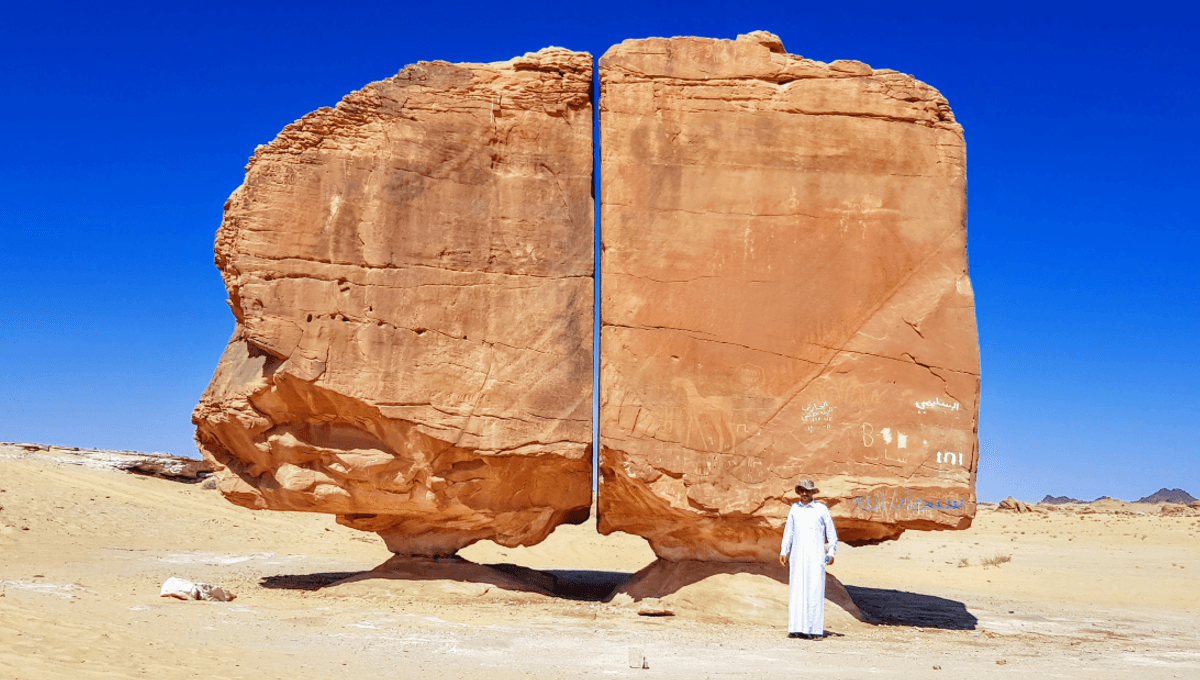
This "Al Naslaa" Rock In Saudi Arabia Is Perfectly Split Down The Middle. Weird Thing Is, Nobody’s Quite Sure How It Happened
If you were to go for a stroll about 50 kilometers south of Saudi Arabia’s Tayman Oasis, you’d likely stumble across one of Earth’s most perplexing geological formations. There, sitting on two near-perfect pedestals, is an enormous boulder about 9 meters (30 feet) across – and weirdest of all? It’s split perfectly down the middle.
The rest of this article is behind a paywall. Please sign in or subscribe to access the full content. The divide is straight enough to appear as if it were cut with a laser, and yet despite the instability the rock has yet to lean and close the gap. The effect makes the rocks appear almost as if they are levitating, so it’s hardly surprising some have been quick to suggest it must be the work of something extraterrestrial. Don’t get too excited, thought. There are plenty of Earthly explanations to the mystery of Al Naslaa. Found in the Tayma Oasis, Saudi Arabia, Al Naslaa Rock isn't just a weird-looking rock; it's also a petroglyph. Arguably one of the most photogenic in the world. Petroglyphs are images made by carving or engraving the surface of a rock (as opposed to pictographs, painted onto rocks). Depictions of Arabian horses, ibexes, and humans can be seen on Al Naslaa’s surface. Exactly when the carvings were committed to the stone isn’t known, but the sandstone rocks are believed to date back thousands of years. There are several theories surrounding Al Naslaa’s perfect split down the middle. One is that the rock sits on a fault line and that the split was first created as the ground beneath the rocks shifted causing it to split in half at a weak point. The crack created by this activity could then have become something of a wind tunnel for sand-laden gusts sweeping across the landscapes. As the grains passed through the gap over thousands of years, it may have effectively sanded down the uneven crack to create a perfectly smooth surface. It could also be that the crack is a joint, which in geology means when a break naturally forms in a rock without displacement. The fracture divides the rocks and can often be unusually straight, like that seen in Al Naslaa. Another theory is that freeze-thaw weathering may have caused the divide. If some water had gotten into a small crack sometime in ancient history, it could have frozen and expanded, gradually causing the crack to get bigger and increasing the likelihood of further freeze-thaw erosion. If the weather then got warm again, all the ice would disappear and leave behind a perfect divide in the sandstone rock. As for the strange pedestals Al Naslaa sits on, these are actually quite common in desert landscapes. Known as mushroom rocks, they’re usually the result of weathering from fast winds or glacial activity. Al Naslaa is made of sandstone, which as rocks go is pretty weak. It's a good candidate for weathering, then, but it's also possible that humans could've had a stab at creating the divide. Simple metal tools would be capable of shearing the rock down the center, but as for why someone would bother? That’s a whole other question. It’s possible that ancient civilizations created the peculiar rock sculpture as a geographical landmark, site of religious significance, or an early example of art. But hey, as the petroglyphs on its surface go to show, not everything we do as humans serves a purpose beyond expression. If you’d like to have a punt at solving the mystery of Al Naslaa, you can find this site of natural wonder in the Tayma Oasis in Saudi Arabia, not far from the Al Knanafah Wildlife Sanctuary. Just remember to tip off your old pals at IFLScience if you work it out.An ancient petroglyph
How did Al Naslaa get split in two?
Al Naslaa VS the weather
Could humans have created Al Naslaa?
Where can I find Al Naslaa?

 English
 French
 Spanish
 Portuguese
 Deutsch
 Turkish
 Dutch
Dutch
 Italiano
 Russian
 Romaian
 Portuguese (Brazil)
 Greek
Greek