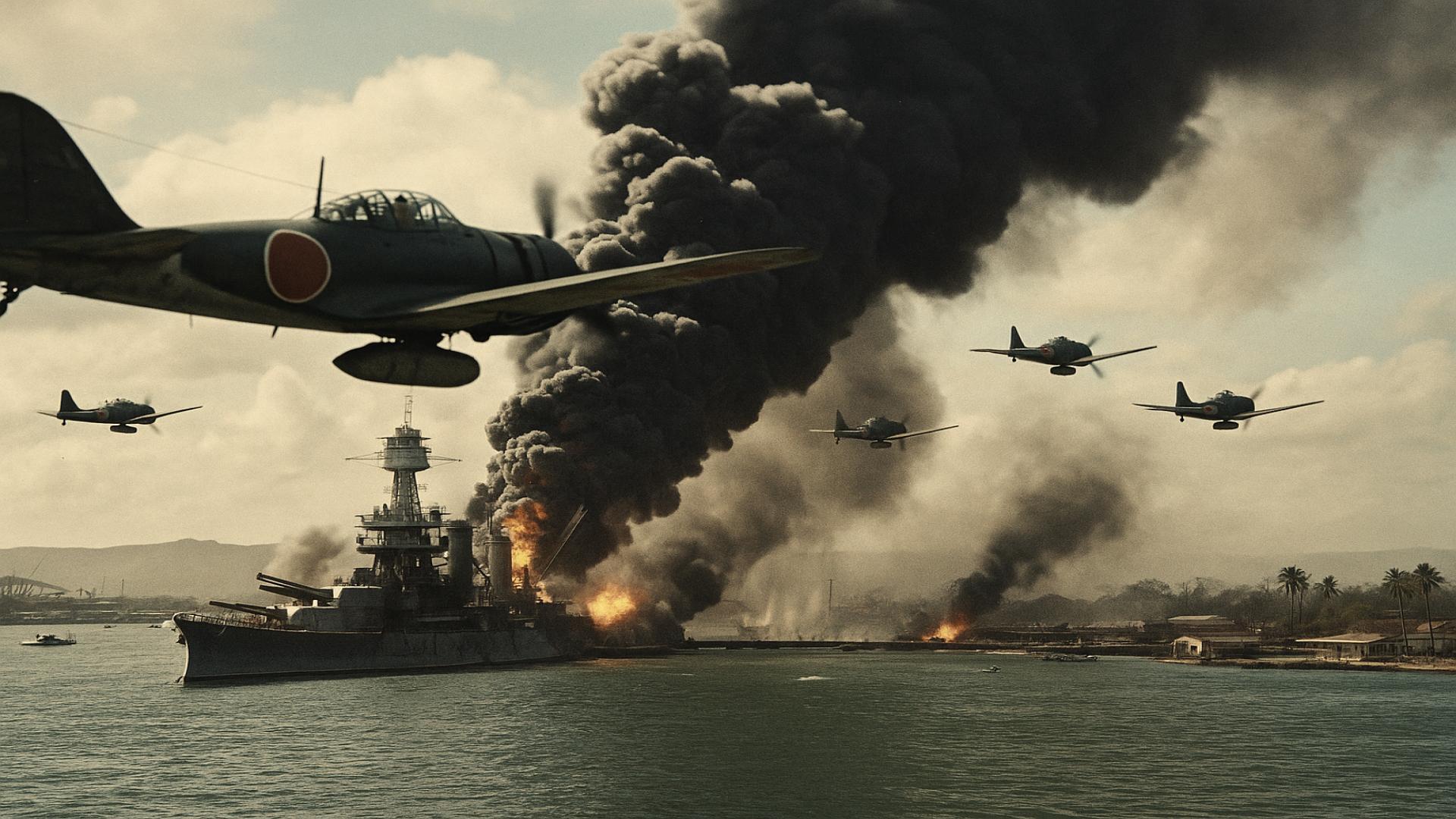
Pearl Harbor: 12 Facts and Myths About the Japanese Attack on the U.S. Pacific Fleet

0
21

Pearl Harbor: 12 Facts and Myths About the Japanese Attack on the U.S. Pacific Fleet - History Collection

4. Myth: All the Pacific Fleet Was Destroyed

Pearl Harbor: 12 Facts and Myths About the Japanese Attack on the U.S. Pacific Fleet
U.S. aircraft carriers absent during Pearl Harbor attack, preserving vital naval strength for retaliation.

While the attack on Pearl Harbor was devastating, it did not annihilate the entire Pacific Fleet. Notably, the U.S. aircraft carriers—USS Enterprise, USS Lexington, and USS Saratoga—were not in the harbor during the assault. Their absence preserved a crucial component of the U.S. naval strength, enabling a swift response in subsequent battles. For more details, refer to the National WWII Museum’s article on the attack (nationalww2museum.org).

5. Fact: Over 2,400 Americans Died

Pearl Harbor: 12 Facts and Myths About the Japanese Attack on the U.S. Pacific Fleet
Pearl Harbor attack claims 2,390 lives; USS Arizona endures heaviest loss with 1,177 fallen.

The attack on Pearl Harbor on December 7, 1941, resulted in the loss of 2,390 American lives, including both military personnel and civilians. The USS Arizona suffered the highest number of casualties, with 1,177 crew members perishing. Additionally, 49 civilians were killed, some due to enemy action and others from friendly fire (nps.gov).

6. Myth: Japan Declared War Before the Attack

Pearl Harbor: 12 Facts and Myths About the Japanese Attack on the U.S. Pacific Fleet
Delayed Japanese war declaration contributed to heightened diplomatic tensions following the Pearl Harbor attack.

Contrary to the belief that Japan declared war prior to attacking Pearl Harbor, the Japanese government intended to deliver a declaration of war to the United States before the assault. However, due to delays in decoding the 5,000-word document, the declaration was not delivered until after the attack had commenced. This miscommunication led to diplomatic tensions and is detailed in the State Department archives (japantimes.co.jp).

7. Fact: The Attack Prompted U.S. Entry into WWII

Pearl Harbor: 12 Facts and Myths About the Japanese Attack on the U.S. Pacific Fleet
President Roosevelt addresses Congress after Pearl Harbor, prompting the United States’ entry into World War II.

The attack on Pearl Harbor on December 7, 1941, directly led to the United States’ entry into World War II. The following day, President Franklin D. Roosevelt addressed Congress, leading to a unanimous declaration of war against Japan. This pivotal moment is documented in the Congressional Record (congress.gov).

8. Myth: The Attack Was a Complete Success for Japan

Pearl Harbor: 12 Facts and Myths About the Japanese Attack on the U.S. Pacific Fleet
Japanese attack on Pearl Harbor leaves key U.S. carriers and infrastructure intact, enabling swift recovery.

While the Japanese attack on Pearl Harbor on December 7, 1941, achieved initial tactical success, it did not fulfill all strategic objectives. Notably, the Japanese failed to destroy the U.S. aircraft carriers, which were not present during the attack and would later play a pivotal role in the Pacific theater. Additionally, critical infrastructure such as oil storage facilities and dry docks was left largely intact, enabling the U.S. Navy to recover swiftly. This oversight allowed the United States to rebuild its fleet and launch counteroffensives, ultimately leading to Japan’s defeat. For a detailed analysis, refer to the article “The Attack on Pearl Harbor: A Strategic Japanese Failure” on jesterpolitics.com.

9. Fact: Many Civilians Were Caught in the Crossfire

Pearl Harbor: 12 Facts and Myths About the Japanese Attack on the U.S. Pacific Fleet
Honolulu firefighters battle flames at Hickam Air Force Base during the Pearl Harbor attack, 1941.

The attack on Pearl Harbor on December 7, 1941, resulted in civilian casualties and significant damage to infrastructure. The Honolulu Fire Department responded to fires caused by the assault, including those at Hickam Air Force Base, where enemy bombing led to the destruction of the base’s fire station. Fire Captains Thomas Macy and John Carreira, along with Hoseman Harry Tuck Lee Pang, made the ultimate sacrifice on that fateful day. Six other firefighters were injured in the bombings. In all, these nine firefighters were awarded the Order of the Purple Heart and became the only civilian firefighters in the U.S. to have ever received this honor (fire.honolulu.gov).

10. Myth: Only Japanese Planes Were Involved

Pearl Harbor: 12 Facts and Myths About the Japanese Attack on the U.S. Pacific Fleet
Japanese midget submarines launched during the Pearl Harbor attack faced limited success against U.S. defenses.

While the Japanese attack on Pearl Harbor on December 7, 1941, is predominantly remembered for its aerial assault, it also involved the use of Japanese midget submarines. These small, two-man submarines were launched from larger “mother” submarines and attempted to infiltrate the harbor to attack U.S. ships. However, their impact was minimal, as most were destroyed or failed to complete their missions. For more details, refer to the article “The Midget Subs That Beat the Planes to Pearl Harbor” on History.com.

11. Fact: Many Acts of Heroism Occurred

Pearl Harbor: 12 Facts and Myths About the Japanese Attack on the U.S. Pacific Fleet
Sixteen sailors honored with the Medal of Honor for extraordinary bravery during Pearl Harbor attack.

The attack on Pearl Harbor on December 7, 1941, witnessed numerous acts of extraordinary bravery. Among the 16 sailors awarded the Medal of Honor for their valor that day were:

Seaman First Class James Richard Ward: Remained at his post on the USS Oklahoma, holding a flashlight to guide turret crew members to safety, sacrificing his life in the process.
Chief Boatswain Edwin J. Hill: Released the USS Nevada from its mooring, then swam to the ship to continue directing its defense after it was underway.
Ensign Francis C. Flaherty: Assisted shipmates in escaping the sinking USS Oklahoma, ultimately losing his life in the effort.
Ensign Herbert C. Jones: Directed the defense of the USS California, despite being wounded, and continued to lead until the ship was abandoned.
Rear Admiral Samuel G. Fuqua: Led the defense of the USS West Virginia, organizing counterattacks and maintaining crew morale under heavy fire.
Chief Watertender Peter Tomich: Remained below deck on the USS Utah, ensuring the ship’s boilers were secured, which contributed to the ship’s stability and the crew’s survival.

These individuals exemplify the courage and selflessness displayed by many during the attack, contributing to the resilience and eventual victory of the United States in World War II. For a comprehensive list of Medal of Honor recipients from the attack, refer to the Congressional Medal of Honor Society’s records (cmohs.org).


12. Myth: The Attack Could Have Been Easily Prevented

Pearl Harbor: 12 Facts and Myths About the Japanese Attack on the U.S. Pacific Fleet
Historians cite intelligence failures and underestimation of Japan, complicating effective Pearl Harbor defense.

Despite some intelligence indicating potential Japanese aggression, a successful defense of Pearl Harbor would have been challenging. Historians note that U.S. military leaders underestimated Japan’s capabilities and intentions, leading to complacency. The attack’s surprise was compounded by intelligence failures and miscommunications, making effective defense difficult. For a detailed analysis, refer to the article “Intelligence, Japanese attack on Pearl Harbor” by the U.S. Army (army.mil).

البحث
الأقسام
إقرأ المزيد
Music
Download Festival’s Bathroom Policy Sparks Debate
Download Festival’s Bathroom Policy Sparks Debate — Here's What They SaidDownload Festival / Matt...
بواسطة Test Blogger4 2025-05-28 20:00:08 0 3كيلو بايت
أخرى
Technological Convergence in Mobile Audio and Sensors
The global Smart Phone Micro Electronic-Acoustics market leads the nation's...
بواسطة Priya Singh 2025-11-05 02:57:06 0 900
Technology
Turn everyday photos into pro-level shots with this $20 lifetime tool
Luminar Mobile for iOS and Android TL;DR: Take...
بواسطة Test Blogger7 2025-10-07 10:00:23 0 952
Food
Popular 60-Year-Old Midwest Donut Chain Files For Bankruptcy
Popular 60-Year-Old Midwest Donut Chain Files For Bankruptcy...
بواسطة Test Blogger1 2025-10-31 19:00:16 0 806
Technology
Meta Ray-Ban Display fail wasnt the worst. These tech demos are more cringe.
Meta Ray-Ban Display: Zuckerberg's demo fail wasn't the most cringe in tech history...
بواسطة Test Blogger7 2025-09-19 00:00:15 0 1كيلو بايت