


JWST Finds The Best Evidence Yet Of A Lava World With A Thick Atmosphere
JWST Finds The Best Evidence Yet Of A Lava World With A Thick Atmosphere
The very ancient super-Earth TOI-561 b must have a thick atmosphere, data from the JWST indicates, or its day side would be even hotter than it is. This represents the strongest evidence yet of a rocky planet beyond the Solar System with such a substantial atmosphere. There’s no chance of life here – at least on the sort of chemistry we understand, given the planet’s extreme heat – but the fact an atmosphere has lingered for so long is encouraging for other worlds.
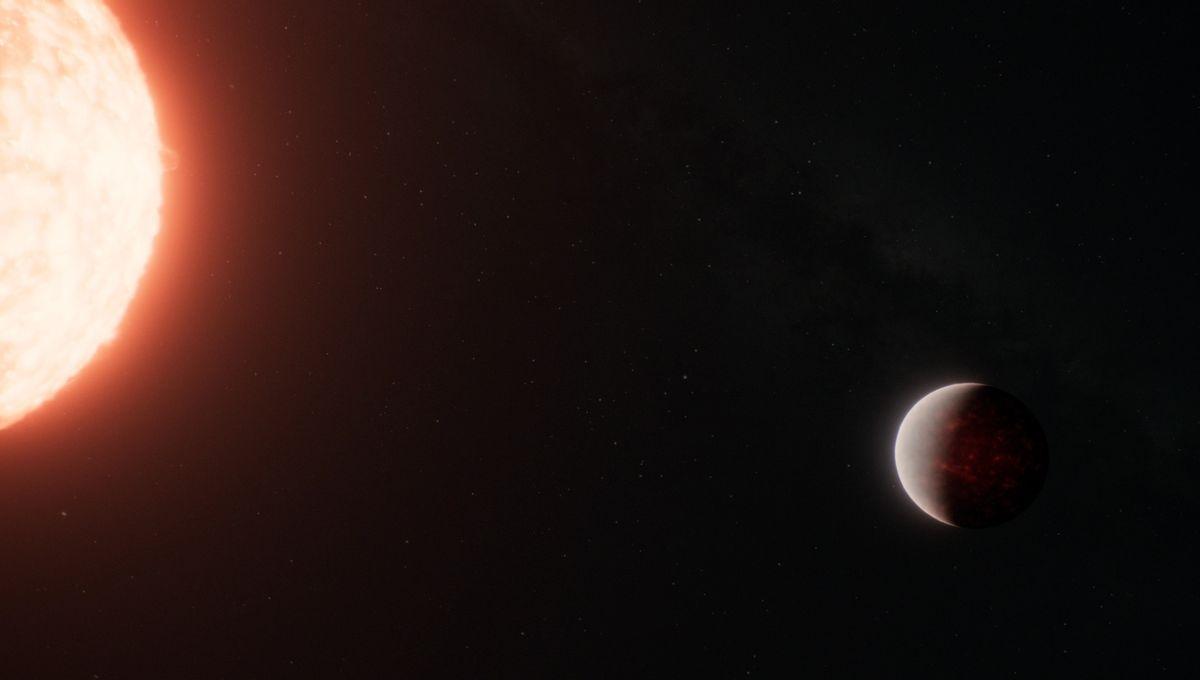
The rest of this article is behind a paywall. Please sign in or subscribe to access the full content. The discovery of the planets TOI-561 b, c and d four years ago was something of a surprise to astronomers because the star they circle is so primeval. TOI-561 is estimated to be around 10 billion years old, and while there is substantial uncertainty about that figure, it’s probably one of the oldest stars we know within our own galaxy. The planets all orbit too close to be likely candidates for late capture; instead, these almost certainly formed out of the same cloud their star did. All three are super-Earths – that is, planets a little larger than our own, but closer to Earth in size than Neptune. The surprise comes from the fact that when they formed, the galaxy had less of the elements that make up rocky worlds than it does today, yet TOI-561 b’s density is not much lower than Earth’s. Now the innermost of the three has another unexpected finding, the maintenance of a thick atmosphere. Last year the JWST found evidence another boiling super-Earth, 55 Cancri e, has something cooling its daylight side, likely an atmosphere with strong winds redistributing the heat. Additional time devoted to TOI-561b makes an even stronger case for something similar. TOI-561 b is now the fourth very hot planet we’ve found whose temperatures don’t match what would be expected if it was bare rock, and it’s got the largest deviation yet. That means the evidence for an atmosphere that could disrupt conditions is even stronger. We don't know what a world with a magma ocean and a thick atmosphere would look like, but this is one artist's guess. Image credit: NASA/ESA/CSA/Ralf Crawford (STScl) TOI-561 b is tidally locked, so one side always faces its star and gets very hot, 1,800 degrees Celsius (3,200 degrees Fahrenheit). Yet that’s still much cooler than the expected temperature based on the fact it is 40 times closer to its star than Mercury is to the Sun, whizzing round in just 10.6 hours. That proximity should produce a temperature of 2,700 degrees Celsius (4,900 degree Fahrenheit). After a few other models failed, the only explanation the authors of a new study found plausible is an atmosphere thick enough to redistribute a lot of the heat from the star-facing side of the planet to the nightside. "Strong winds would cool the dayside by transporting heat over to the nightside,” said Dr Anjali Piette, of University of Birmingham in a statement. “Gases like water vapor would absorb some wavelengths of near-infrared light emitted by the surface before they make it all the way up through the atmosphere. (The planet would look colder because the telescope detects less light.) It's also possible that there are bright silicate clouds that cool the atmosphere by reflecting starlight." That’s unexpected, because despite the fact that TOI-561 b’s gravity would be stronger than Earth’s, holding onto its atmosphere would have been a challenge. All that heat gives molecules more energy to escape, and the stellar storms to which it is closely exposed strip outer layers, so TOI-561b must be losing some of its atmosphere to space. "Based on what we know about other systems, astronomers would have predicted that a planet like this is too small and hot to retain its own atmosphere for long after formation," said Nicole Wallack of Carnegie Science. "But our observations suggest it is surrounded by a relatively thick blanket of gas, upending conventional wisdom about ultra-short-period planets." Something must be replenishing the atmosphere, and the authors think that is a cycle where gases get captured by the magma ocean before escaping again. "This planet must be much, much more volatile-rich than Earth to explain the observations. It's really like a wet lava ball,” said Dr Tim Lichtenberg of the University of Groningen. The atmosphere could also overturn thinking about TOI-561 b’s composition. We know TOI-561 b’s mass from the gravitational pull it applies to its star, and have estimated its size from the light it blocks when it passes in front. Comparing these two leads to a density modestly lower than Earth’s, which was initially explained by it having a relatively smaller core and more silicate rocks. However, the JWST measurements have leant credibility to an alternative explanation: that the atmosphere is so deep it blocks a lot of light reaching us, and creates an impression of a planet much larger than the solid body. Time on the JWST is so precious it usually just checks out planets as they pass in front of their stars, looking for changes in radiation at specific wavelengths that would indicate absorption in an atmosphere. For TOI-561 b, however, 37 continuous hours were secured, ensuring the telescope pointed at the planet while it completed almost four orbits of its star. The study is published open access in The Astrophysical Journal Letters.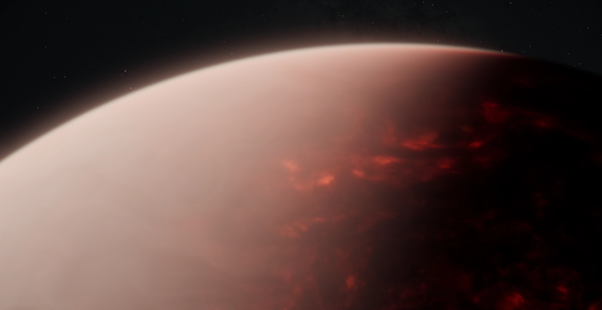

 English
 Arabic
 French
 Portuguese
 Deutsch
 Turkish
 Dutch
Dutch
 Italiano
 Russian
 Romaian
 Portuguese (Brazil)
 Greek
Greek