


10 Facts About War Horses Throughout The Ages

0
34

10 Facts About War Horses Throughout The Ages - History Collection

4. Knights and Horses: The Heart of Medieval Armies

10 Facts About War Horses Throughout The Ages
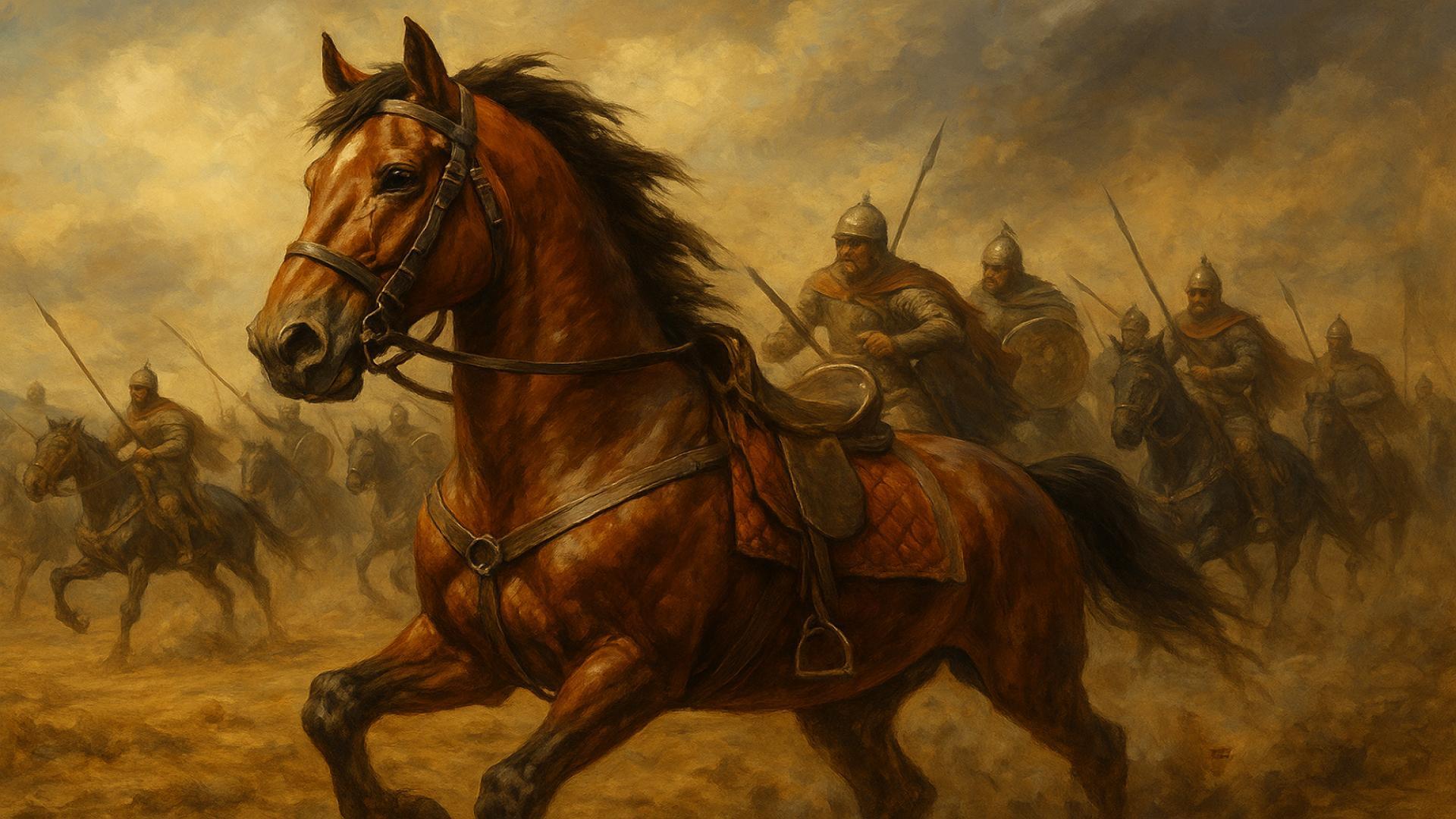
Armored knight astride a powerful warhorse, symbolizing medieval Europe’s feudal power and battlefield dominance.

In medieval Europe, knights and their heavy war horses were central to military strategy and social hierarchy. These armored steeds provided knights with the mobility and protection necessary for effective combat, enabling them to execute charges and maintain battlefield dominance. The bond between knight and horse was emblematic of the feudal system, where the nobility’s martial prowess was closely tied to their equestrian skills and the strength of their mounts. This relationship underscored the knights’ role as both warriors and landowners, integral to the defense and expansion of medieval kingdoms (nationalgeographic.com).

5. War Horses Received Specialized Armor and Equipment

10 Facts About War Horses Throughout The Ages
Image Source: Pexels.

Throughout history, war horses were equipped with specialized armor, known as barding, to enhance their protection in battle. This armor varied across cultures, reflecting the unique military needs and resources of each civilization. In ancient Persia, the cataphracts were heavily armored cavalry units whose horses were shielded with scale armor made from iron or bronze, often stiffened with leather. This design provided substantial protection against enemy weapons (warfarehistorynetwork.com). During the Middle Ages, European knights adopted barding to safeguard their steeds. In the Middle East, particularly during the Islamic Golden Age, horse armor was prevalent. Lamellar armor, consisting of small, overlapping plates, was commonly used to protect both riders and their mounts. This design offered flexibility and effective defense against various weapons. The development and use of specialized horse armor across these cultures underscore the critical role of war horses in military strategies and the lengths to which civilizations went to protect these valuable assets.

6. Famous War Horses Gained Legendary Status

10 Facts About War Horses Throughout The Ages
Legendary war horses Bucephalus and Marengo exemplify the enduring bond between rider and steed.

Throughout history, certain war horses have achieved legendary status, symbolizing the deep bond between rider and steed and their pivotal roles in shaping historical events. Two of the most renowned are Alexander the Great’s Bucephalus and Napoleon Bonaparte’s Marengo. These horses not only served as loyal companions but also became symbols of their riders’ legacies, embodying the spirit and determination of the eras they represented.

7. Horses Revolutionized Indigenous Warfare

10 Facts About War Horses Throughout The Ages
Horses revolutionize Indigenous warfare, enabling swift raids, expanded territories, and intensified tribal conflicts.

The introduction of horses by Europeans profoundly transformed Indigenous warfare, granting Native American and Mongolian societies enhanced mobility and altering tribal dynamics. In North America, particularly among the Plains Indians, horses revolutionized hunting and combat strategies. Mounted warriors could execute rapid raids, outflank enemies, and cover vast distances swiftly, significantly increasing their effectiveness in battle. This newfound mobility also intensified intertribal conflicts, as tribes competed for control over horse herds, which became symbols of wealth and power (history.com). Similarly, in Mongolia, the domestication of horses was pivotal to the success of the Mongol Empire. Under leaders like Genghis Khan, Mongol warriors utilized their exceptional horsemanship and mounted archery skills to conquer vast territories. The strategic use of horses enabled rapid movement, surprise attacks, and effective communication across the steppes, solidifying the Mongols’ dominance in Eurasian warfare (mongolianz.com).

8. War Horses Served in World Wars

10 Facts About War Horses Throughout The Ages
Horses supporting military operations in World Wars, vital for logistics, transport, and communication duties.

During both World War I and World War II, horses continued to play a vital role in military operations, particularly in transportation, logistics, and messenger duties, even as mechanization advanced. Their adaptability and reliability in challenging terrains made them indispensable assets to various armies. In World War I, horses were extensively used for logistical support, including pulling ambulances, carrying supplies, and moving ammunition. They were also crucial for reconnaissance and for carrying messengers, as well as for pulling artillery, ambulances, and supply wagons. The presence of horses often increased morale among the soldiers at the front. Similarly, during World War II, horses remained essential for transporting troops, artillery, and supplies, especially in regions where mechanized vehicles were less effective. The German Army, for instance, employed approximately 2.75 million horses, while the Soviet Union utilized around 3.5 million. Despite the increasing mechanization of warfare, horses’ versatility and reliability ensured their continued presence on the battlefield, underscoring their enduring significance in military history (iwm.org.uk).

9. The Decline of the War Horse in Modern Warfare

10 Facts About War Horses Throughout The Ages
Tanks and firearms revolutionize warfare, rendering cavalry obsolete and ushering in mechanized armies.

The advent of technological innovations such as tanks and firearms led to the reduced use of cavalry and war horses, signaling a shift to mechanized armies. During World War I, the static nature of trench warfare and the introduction of tanks rendered traditional cavalry charges increasingly ineffective. Tanks, introduced in 1917, began to take over the role of shock combat, providing greater mobility and firepower than horse-mounted units. By World War II, mechanized units had largely replaced horse-mounted cavalry. The development of tanks and armored vehicles offered superior mobility, protection, and firepower, making traditional cavalry obsolete. This transition marked a significant shift in military strategy, emphasizing mechanized forces over traditional horse-mounted units (army.mil).

10. War Horses in Art, Literature, and Memory

10 Facts About War Horses Throughout The Ages
War horses celebrated in art, literature, and memorials for their enduring valor and sacrifice.

Throughout history, war horses have been immortalized in art, literature, and memorials, reflecting their profound impact on human culture and history. From ancient epics to modern works, these representations honor the valor and sacrifice of these noble animals. In literature, Michael Morpurgo’s 1982 novel “War Horse” narrates the journey of Joey, a horse enlisted in World War I, and his bond with his young owner, Albert. The novel’s success led to a stage adaptation in 2007, featuring life-size horse puppets by the Handspring Puppet Company, which won multiple awards, including an Olivier Award for Best New Play. In art, Franz Marc’s 1913 painting “The Tower of Blue Horses” depicts four blue horses in a dynamic composition, symbolizing strength and vitality. The painting is considered one of Marc’s masterpieces, though it went missing in 1945. Memorials also honor the contributions of war horses. The Horse Memorial in Port Elizabeth, South Africa, commemorates the horses that served and died during the Second Boer War. Designed by Joseph Whitehead, the life-sized bronze statue features a kneeling soldier offering water to a service horse, symbolizing the deep bond between soldiers and their mounts. These artistic and memorial representations underscore the enduring legacy of war horses, highlighting their integral role in human history and the deep connections formed between humans and these remarkable animals.

Conclusion

10 Facts About War Horses Throughout The Ages
Image Source: Pexels.

Throughout history, war horses have profoundly influenced military strategies, cultural symbols, and human narratives. From their pivotal roles in ancient chariotry to their symbolic presence in art and literature, these noble animals have embodied strength, loyalty, and valor. Their enduring legacy continues to shape our understanding of warfare and the deep bond between humans and horses (washingtonpost.com).

Search
Categories
Read More
Other
US Lawn Mowers Market Trends: Growth, Share, Value, Size, and Analysis By 2032
As per MarkNtel Advisors The US Lawn Mowers Market size is valued at around USD 6.2 billion in...
By Sonu Kumar 2025-11-24 18:07:31 0 444
Science
Africa Wants To Change Misleading World Map, The "Wow!" Signal Was Likely From An Extraterrestrial Source, And Much More This Week
Africa Wants To Change Misleading World Map, The "Wow!" Signal Was Likely From An...
By test Blogger3 2025-08-30 10:00:10 0 1K
Games
Half Life 3 Steam Machine rumors just won't go away, with high RAM prices now somehow connected
Half Life 3 Steam Machine rumors just won't go away, with high RAM prices now somehow connected...
By Test Blogger6 2025-12-15 16:01:35 0 207
Games
The best Fortnite skins June 2025
The best Fortnite skins June 2025 As an Amazon Associate, we earn from qualifying purchases...
By Test Blogger6 2025-06-02 12:00:12 0 3K
Science
In 1962, A Boy Found A Radioactive Capsule And Brought It Inside His House — With Tragic Results
In 1962, A Boy Found A Radioactive Capsule And Brought It Inside His House — With Tragic...
By test Blogger3 2025-09-12 16:00:12 0 1K