


Pixel-Shot/Shutterstock
We may receive a commission on purchases made from links.
While many kitchen appliances introduced in the mid-20th century have lasted through decades and transformed into modern, technologically-advanced machines, not all of them have stuck around. In fact, there are some kitchen appliances that kids today have never seen. Even major appliances, like refrigerators and stove units from the 1950s, might be nearly unrecognizable to those born in recent decades. One gadget-like appliance Gen Z is sure to find obscure is the electric carving knife.
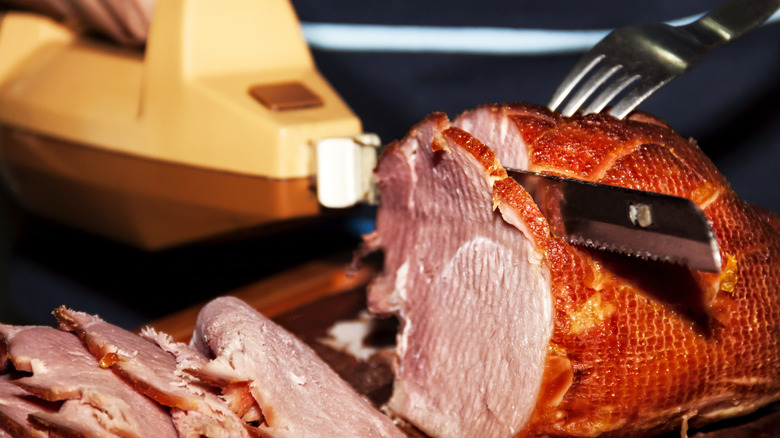
In 1964, Jerome Murray invented the electric carving/kitchen knife (Murray was the inventor of other midcentury devices, including a life-saving medical pump and the airplane boarding ramp). Electric carving knives were all the rage in the latter half of the 1960s and into the '70s, with approximately one-third of families owning one by 1971. This nostalgic knife consists of a motorized handle that powers two reciprocating, serrated stainless steel blades. It made cutting veggies, fruit, cheese, bread, meat, and cakes smoother, easier, and more even, according to companies that produced the early electric knives, such as General Electric, KitchenAid, Rival, and Black + Decker.
While most kitchen gadgets of the mid-20th century were marketed toward women, specifically homemakers, the electric kitchen knife's target audience also included men. This was mainly due to traditional gender roles of the time, which dictated that the "man of the house" should be the one to carve the turkey, ham, or whatever other hunk of meat was on the table. Advertisements for Hamilton Beach's Commercial Electric Knife were aimed at professional chefs as a way to create more consistent cuts that would maximize profitability.
Are electric carving knives still used in kitchens today?
Rebecamello/Getty Images
It turns out, electric carving knives might have been another kitchen appliance people were brainwashed into thinking they needed. The decline in sales of electric knives is likely due to a number of factors, including the rise of high-quality manual knives in the 1980s, which were constructed of more durable, yet lightweight material that any home cook could master. Electric carving knives might be helpful for cutting deboned hams, turkey, and roasts, but they can't slice through the tough parts of meat (like cartilage) the way a sharp chef knife can.
Electric knives were also more of a hassle to get out, clean, and put away than a regular knife sitting in a drawer or a knife block on the counter. Moreover, in the 1980s, another gimmicky kitchen knife took over in popularity. The Ginsu knife was touted on infomercials as being so sharp it could cut through aluminum cans. The Ginsu played on the rising popularity of Japanese knives, which were made with premium steel.
That said, electric kitchen knives are not completely obsolete. While they may never be the kitchen appliance that Gen Z can't live without, some people still find them useful for certain tasks like filleting fish, cutting corn off the cob, slicing thin, uniform pieces of meat or bread, or slicing a large quantity of food. For modern electric knives, Hamilton Beach and Black + Decker both sell highly rated and reasonably priced motorized, corded knives on Amazon.

 English
 Arabic
 French
 Spanish
 Portuguese
 Deutsch
 Dutch
Dutch
 Italiano
 Russian
 Romaian
 Portuguese (Brazil)
 Greek
Greek