


11 Shrubs That Will Bloom More Beautifully If You Prune Them in Winter
11 Popular Shrubs to Prune This Winter for More Flowers Next Summer
What’s the best time to prune flowering shrubs? It depends on when they flower, or more precisely, when they form their flower buds. Spring bloomers develop their flower buds in the year before they bloom, so pruning should be done immediately after flowering. If you prune later, such as during the dormant season, you will be removing flower buds and reducing the flower display.
Shrubs that bloom later—in summer or fall—generally produce their flower buds on the current season’s growth, also called new wood. Therefore, the best time to prune late bloomers is over the dormant season—winter or very early spring, before new growth begins. If you wait until these shrubs are actively growing, you’re likely to cut off many of their flower buds.
The following summer- and fall-blooming shrubs should be pruned while they are dormant. Careful pruning improves their form, maintains a manageable size, and stimulates a bigger and better flower show.
Smooth Hydrangea
Native to eastern North America, the smooth hydrangea (Hydrangea arborescens) begins to bloom in mid-summer and continues into fall. Its tiny white flowers form flattened clusters up to 6 inches across.
How to prune: Prune smooth hydrangea in winter to reduce height and to encourage new growth for better flower production. Be sure to remove any damaged or weak stems before new growth begins.
Panicle Hydrangea
One of the hardiest hydrangeas (down to Zone 3), panicle hydrangea (Hydrangea paniculata) is a large shrub that should be pruned in late winter or very early spring. Leaving the dried flower heads after they fade provides winter interest in the garden.
How to prune: Start by removing any damaged, crossing, or spindly branches. To encourage stronger stems and more abundant flowers, cut each stem back by up to one-third of its length, making your cuts just above a plump node.
Glossy Abelia
Denny Schrock
Although deciduous in cooler regions, glossy abelia is semi-evergreen to evergreen in warmer zones. Its small, pink-tinted flowers appear continuously from late spring through fall. As the flowers drop off, they leave behind a pretty, rosy calyx that further extends its seasonal interest.
How to prune: In colder regions where dieback is common, remove any dead branches. To encourage new vigorous growth and abundant flowers, cut about a third of the stems back to the ground. During the growing season, some varieties produce long, thin shoots. To keep the shrub looking tidy, remove them as you spot them.
Buttonbush
Photo: Denny Schrock
Throughout summer, the native buttonbush (Cephalanthus occidentalis) sports spheres of scented, tightly clustered white flowers that resemble pincushions. These are followed by button-like reddish nutlets that persist into winter and may be consumed by ducks and other waterfowl. Annual pruning in winter or early spring will keep a buttonbush tidy.
How to prune: First, remove dead or damaged wood and crossing branches. Cut back remaining branches to improve its shape and reduce its size if desired. To rejuvenate an overgrown specimen, remove up to one-third of the oldest stems, cutting them back to the ground.
Beautyberry
Beautyberry (Callicarpa spp.) is best known for its magnificent display of purple, pink, or white fruit that forms in the fall and can last well into winter. The pink-tinted white flowers appear in tight clusters in early summer along the stems. It blooms and fruits best on young stems.
How to prune: Cut the oldest stems back to the ground in winter. Alternatively, cut all the stems back to about 6 inches. This will reduce the size of the shrub while encouraging more flowers and fruit.
Bush Honeysuckle
Denny Schrock
Bush honeysuckle (Diervilla spp.), a member of the honeysuckle family, is an adaptable shrub with sweetly scented flowers. It forms a neat mound of arching stems that sport shiny green foliage and yellow summer blooms.
How to prune: Though its natural shape is attractive, you can encourage a more compact form by cutting it back to the ground in winter. It will grow back quickly in spring and produce flowers on the current season’s growth.
To limit the spread of bush honeysuckle, prune away the suckers as they appear.
Chaste Tree
Marty Baldwin
Compact varieties of chaste tree (Vitex agnus-castus) look more like shrubs and work well in smaller gardens. Taller forms can be pruned to grow as small trees. The best time to prune chaste tree is in late winter.
How to prune: To create a multi-stemmed shrub, select four or five main branches and remove the small twiggy branches that form along them. This creates better air circulation and lets more sun into the inside of the shrub. If you want to reduce the size, cut the main branches back to a node or side branch. Alternatively, cut the entire plant back to the ground and let it resprout in the spring.
Butterfly Bush
Carson Downing
Butterfly bushes (Buddleia davidii) are fast-growing summer-blooming shrubs that come in a variety of sizes and flower colors. Because it spreads aggressively via seeds, the butterfly bush is considered an invasive plant in many areas of the U.S. Regular pruning is key not only to contain the shrub's size, but also to prevent older cultivars from reseeding. Newer butterfly bushes often have been bred to be sterile.
How to prune: To keep your butterfly bush compact and loaded with blooms, prune in late winter or very early spring. Focus on removing dead or damaged branches and shortening those that remain. Alternatively, cut the entire plant back to about six inches from the ground.
Summersweet
Summersweet (Clethra spp.) is an adaptable North American native shrub that produces bottlebrush-like flower clusters in late summer after most shrubs have finished blooming. Dwarf varieties fit easily into small gardens, while larger types are well suited to shrub borders, rain gardens, and moist woodlands. All attract pollinators.
How to prune: Prune in late winter or just as the leaves begin to unfold in spring. Remove dead, damaged, and crossing branches to encourage better air circulation. For a tidier look, also remove old seed capsules. Cut back branches to a side node if you want to limit the shrub's size.
Summersweet produces new shoots from rhizomes, so if you want to limit its spread, remove these suckers when they appear.
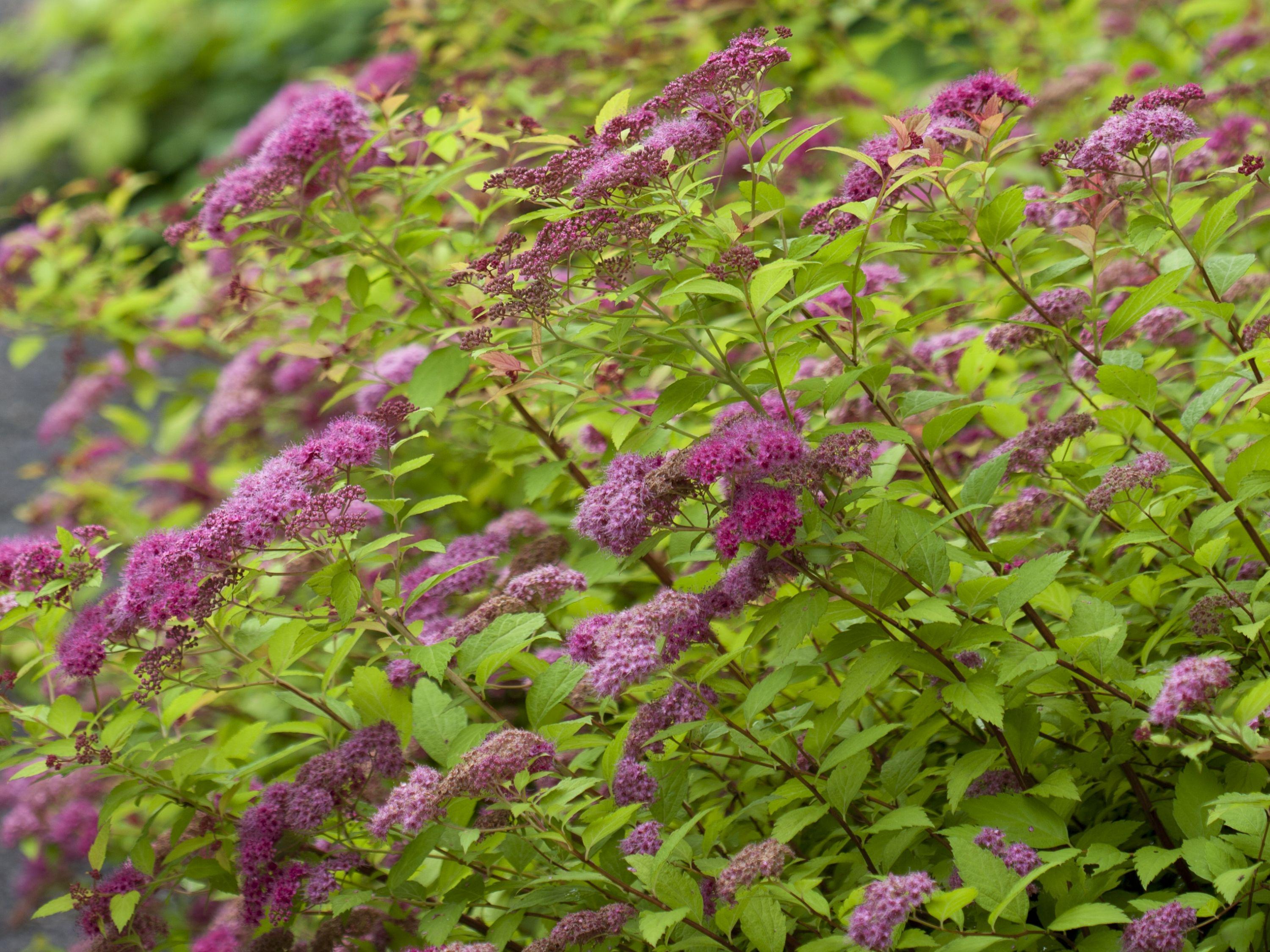
Bumalda Spirea
Laurie Black
Bumalda spirea (Spiraea × bumalda), a hybrid of two spirea species, is an easy-to-grow mounding shrub with flattened clusters of white to deep pink flowers from late spring through midsummer. The shrub flowers on the current year’s growth.
How to prune: Bumalda spirea generally needs little in the way of pruning, but you should remove any dead or damaged branches in late winter or early spring. Cut back remaining branches if you desire to tidy up their shape and reduce their size. During the growing season, a light shearing to remove spent flowers will encourage further blooms.
Potentilla
Potentilla (Potentilla fruticosa) is a low-growing, versatile shrub that blooms continuously from late spring through summer in shades of orange, yellow, pink, red, and white on current season's growth.
How to prune: The goal is to ensure good air circulation and to maintain a neat, mounded shape. This is best done by removing a few of the oldest branches each year. As they age, the shrub may need a more drastic pruning since old canes don’t produce many flowers. To rejuvenate an older plant, cut 50 to 75% of the oldest, thickest canes back to the ground to allow for new shoots to develop.

 English
 Arabic
 French
 Spanish
 Portuguese
 Deutsch
 Dutch
Dutch
 Italiano
 Russian
 Romaian
 Portuguese (Brazil)
 Greek
Greek