


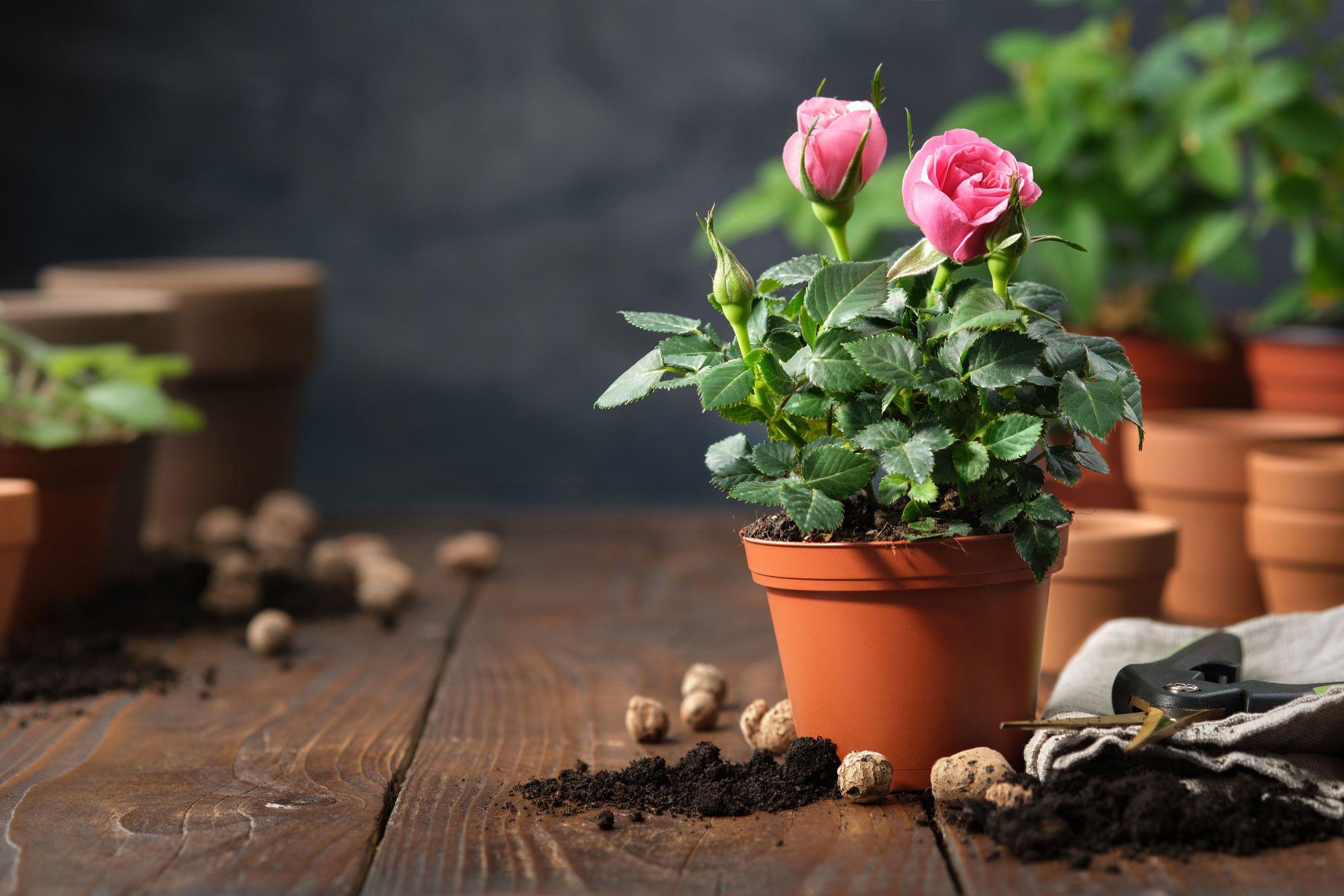
Growing roses in pots offers flexibility and beauty for homes without garden space or for those who enjoy moving plants around. The charm of scented roses blooming in containers—whether by a seating area, hanging at nose level, or in a sunroom corner—is undeniable. Although potted roses may not be as vigorous or productive as garden-grown varieties, you can still nurture thriving container roses with the right care. This includes understanding their unique watering, fertilization, pruning, and pest management needs, ensuring they flourish with expert tips and thoughtful attention.
Tips for Growing Roses in Pots
"The problem with pot culture is that it requires thoughtful maintenance," says Gregg Lowery, curator at The Friends of Vintage Roses, home to one of the world's most renowned rose collections.
Charles Quest-Ritson, Country Life garden columnist and co-author of the award-winning RHS Encyclopedia of Roses, goes further: “In the long term, you will never have anything to match roses grown in garden soil, or in the soil of a glass house.”
However, you can still achieve lovely results with container-grown roses by adjusting your expectations and following these expert tips for rose care.
1. Keep a careful watering schedule.
“Watering is the number one concern,” says Lowery. “It's not on your schedule. It's on the plants’ schedule. That's the hard part for all of us.” Quest-Ritson agrees, noting that both underwatering and overwatering present challenges. Symptoms for each can be similar: wilting soft growth. If overwatered, you might notice a foul smell.
Overwatering is easier to fix. With a well-draining mix and container, overwatering is less likely. Indoor roses can have more drainage issues because saucers or cachepots retain moisture. Self-watering pots might also retain too much moisture for these plants.
Related
If possible, take indoor roses out of their saucer or cachepot and water them outside or in a sink. Let all of the excess water drain for several minutes before putting them back in place. The same is true for outdoor roses grown in decorative pots without drainage.
Taking indoor roses outside to water and allowing them to drain before bringing them back can help. The same applies to outdoor roses in decorative pots without drainage.
Usually, the bigger issue is providing enough water. During hot, dry spells, Lowery waters outdoor roses almost every other day to keep them healthy. “If they’re not, they suffer terribly,” he notes.
Don’t wait until your roses wilt before watering. While they might revive, blooming frequency and abundance will be reduced. Water thoroughly until it flows from the drainage holes. Consider using a moisture meter to guide you.
2. Pick the right rose.
The type of rose you select influences both its performance and the care required. Lowery suggests choosing dwarf polyantha roses, which thrive in pots due to their compact size. These varieties, along with petite groundcover roses and miniatures, are excellent options as they can live contentedly in containers for years.
For the adventurous, pots allow for growing almost any rose you want. You could encourage a large climber to grow as a shrub or contain a suckering rose that might spread too freely in a garden. Keep in mind, though, that non-compact roses need extra attention and might not be as healthy in pots over time.
Opt for own-root roses instead of those grafted onto rootstock, as grafted rootstock can take up too much space in a pot. Quest-Ritson emphasizes that own-root varieties balance better with limited container space and offer improved cold hardiness.
3. Use a rich, well-draining potting mix.
Experienced gardeners often have their own potting mix recipes with unique ingredients. Guoliang Wang, a professor of horticulture with the Jiangsu Provincial Commission of Agriculture and author of Old Roses of China, cites an ancient Chinese formula: “Fired soil, surface soil from the forest, vegetable garden soil, and fermented organic matter.”
While you don't need anything too elaborate, Quest-Ritson advises choosing a mix that's rich in nutrients. Many experts favor a sterile, soilless potting mix, which you can typically purchase premixed. Consider enhancing your mix with peat moss, vermiculite, sand, or perlite—up to 25% of the blend—to boost drainage. Lowery specifically recommends including finely ground volcanic rock for optimal results.
4. Select a pot with enough space and good drainage.
The pot’s shape, size, material, and color affect your rose's growth. For instance, taller pots offer better drainage, darker pots heat up quicker, and unglazed terracotta promotes aeration. Plastic pots are durable but may fade in sunlight. Ensure whatever container you choose has several drainage holes.
“I will never, ever put a rose in a pot that has only one hole in the bottom,” says Lowery, noting that roots can block a single hole. He's lost many plants to this issue with terra-cotta pots.
If your pot only has one hole–or no holes–use a drill and a large bit to make more. Cachepots and architectural containers like concrete urns are the exception. In either case, you don't plant directly in them. You plant your rose in a pot with drainage holes and then slide that pot inside the decorative container. When you water, pull the pot out and let the water drain from the bottom for a few minutes before replacing it.
For container size, Lowery suggests a 7-gallon pot is ideal for small varieties like dwarf polyanthas. Nurseries often keep roses in their modest-sized nursery pots for a couple of years and you can too, but expect it to plateau and decline rather than continue to develop.
You’ve probably heard about drainage layers of rocks, sand, or pot shards–either that you need them at the bottom of your pot to improve drainage or that they’re one of the groundless gardening myths floating around. There’s some debate around this, but unless you’re intrigued by the science and history, you can skip it because your plants will be fine either way.
“I am now confident that drainage layers do tend to reduce soil water retention in the majority of cases,” says Avery Rowe, an independent researcher who has investigated the question. “Personally, I never use drainage layers, because it's an unnecessary extra effort that makes only a small difference.”
Steve Reiners, a professor of horticulture at Cornell University, says you don’t need extra drainage anyway if your potting mix and container drain well. “My biggest concern is that I may lose the media through the drainage holes,” says Reiners. “I will often use a sheet of newspaper at the bottom and forgo any additional sand or gravel or anything on top of the paper. In this way, I can maximize the volume of the media that holds both water and nutrients. With the pot shards and pebbles, I lose that precious volume. Maybe not a lot but to some degree.”
David Reed, a horticulture professor at Texas A&M, says that the academic consensus is that drainage layers are counterproductive but that the truth may be more complicated. “Bottom line, I do not know the definitive answer.” But Reed says, “It is OK to put something in the bottom of the pot to prevent the soil or growing medium from clogging up the holes.”
5. Find the ideal spot(s) for your pot.
Whether you’re gardening on your balcony, in a window box, he ideal spot typically means the sunniest location. While some roses tolerate shade, most need full sun for vibrant blooms and healthy foliage.
The beauty of container-grown roses is flexibility—they can move as needed. Chinese rose expert Wang notes that in ancient China, roses were so prized they were brought indoors during flowering, placed in living rooms, studies, or tea rooms.
If your rose is fragrant, consider moving it to a bedroom when it blooms, allowing you to enjoy its soothing aroma. During daytime, it belongs outside in full sun. Protect your floors with a saucer or cachepot when indoors.
Container mobility offers another advantage: during hot summers, roses can go semi-dormant or produce faded blooms. By moving pots to cooler, partly shaded spots and increasing watering, you can enhance bloom quality, color, and fragrance beyond what's possible in-ground.
6. Feed your roses.
Similar to potting mixes, everyone seems to have a different approach to feeding roses However, rosarians agree it's necessary. Lowery suggests applying a thick layer of mulch and compost in your pots annually. This provides slow-releasing nutrients, controls weeds, limits evaporation, and builds healthy soil.
Lowery uses chemical fertilizers only when he hasn't maintained organic practices. “Sometimes I get lazy…then I find I'm forced to use fertilizers,” he admits, adding that a general slow-release fertilizer alone isn't enough. "Calcium is used up in about a year and can be added easily via CalMag, but that formulation isn’t available in a dry form, or in another form that is immediately usable,” he adds.
If you end up using a fertilizer, carefully follow the instructions on the package. As with watering, there's a delicate balance between not enough and too much.
7. Keep garden weeds and other plants out.
If you haven't encountered the idea of placing companion plants with your roses, be cautious with the concept. The "thriller, filler, spiller" method can sometimes harm your roses.
“I’ve had roses die from that,” says Lowery. “One Veronica groundcover overtook a four-year-old rose. At the end of the season, because I had not dealt with it, the rose died. The groundcover had taken up all of the root space.”
Lowery advises planting complementary plants in separate pots, arranging them around your rose for a cohesive look.
Weeds can also quickly encroach, stealing space, water, and nutrients. Remove them promptly. Applying a thick layer of mulch effectively prevents weed growth.
8. Deadhead and prune.
Most repeat-blooming roses thrive when deadheaded regularly, except for self-cleaning varieties like the Kolorscape series. Deadheading involves removing spent blooms by cutting or twisting off the flower stem, and it’s crucial during the growing season.
Pruning the entire bush at least once a year. If you have a larger rose in a pot, prune more frequently. Confined root space can result in excessive top growth that stresses the plant. If you don’t maintain size harmony between the top and root, the plant may stress and develop dieback, needing pruning later on.
9. Control pests and disease.
Growing roses in pots offers protection from deer, groundhogs, and Japanese beetles. However, they can be quickly affected by pests and diseases, with a slower recovery compared to garden roses.
To prevent disease, keep your roses healthy by placing them in full sun and avoiding overhead watering. Prune to avoid congestion. Skip chemical sprays when possible due to their increased intensity in close, less-ventilated areas like patios and homes.
Be vigilant for stem borers. Their larvae cause dieback. Spot small, green worm-like creatures on fresh growth on young growth and remove them promptly. Cut branches with hollow tips past stem borer damage.
10. Repot and root prune.
Roses typically start to decline after two or three years in a pot. If you're temporarily container-ing them before planting in the ground, that’s fine. For indefinite container growth, you'll need to repot. Remove the rose from its pot, trim roots to fit without circling them, and replant with fresh soil. Prune the top to maintain balance with the root size.
The best time for root pruning is during winter dormancy. Pruning in the growing season, especially summer, may be harmful. Root pruning presents challenges.
“The moment you get into the business of root pruning...galls are almost an inevitability the longer you keep a rose in a pot,” says Lowery. “Once a particular plant is infected by gall, any piece you take off that plant to root a new plant of it may have that bacteria in it already.”
Lowery advises meticulous sanitation, saying: “if you were extremely fastidious in cleansing everything—cleansing your pruners beforehand and then drenching the cuts with a product that prevents that bacteria from invading” you can minimize the risk of galls.
11. Protect in winter.
Quest-Ritson highlights winter protection as a major challenge for potted roses, as “the roots freeze at temperatures where they would be safe in the ground.”
This presents both challenges and opportunities. Winter protection is labor-intensive, but success means growing roses beyond your Hardiness Zone. For example, Zone 4 requires potted roses for survival beyond a summer.
Check the nursery tag for your rose's hardiness. In Zone 8, if a rose is hardy to Zone 4, there's little concern, though wind protection is wise.
In Zone 7, if a rose matches or is less hardy, consider protection—placing pots near walls or indoors in garages, sheds, or sunrooms. Some semi-evergreen roses with shade tolerance may tolerate your sunniest window in winter.
Frequently Asked Questions
-
Roses are vigorous and need significant water and nutrients. Containers limit space, eventually stressing plants and making them more disease-prone. They may become scraggly and unhealthy over time.
-
With proper care, a rose can thrive indefinitely in a pot. Regular root and branch pruning, as well as soil renewal every five years—or more frequently every two to three years in some cases—ensures health and vigor, best done during winter dormancy or early spring.

 English
 Arabic
 French
 Spanish
 Portuguese
 Deutsch
 Turkish
 Dutch
Dutch
 Italiano
 Russian
 Portuguese (Brazil)
 Greek
Greek