


Why Does The Earth's Closest Approach To The Sun Take Place During Winter?
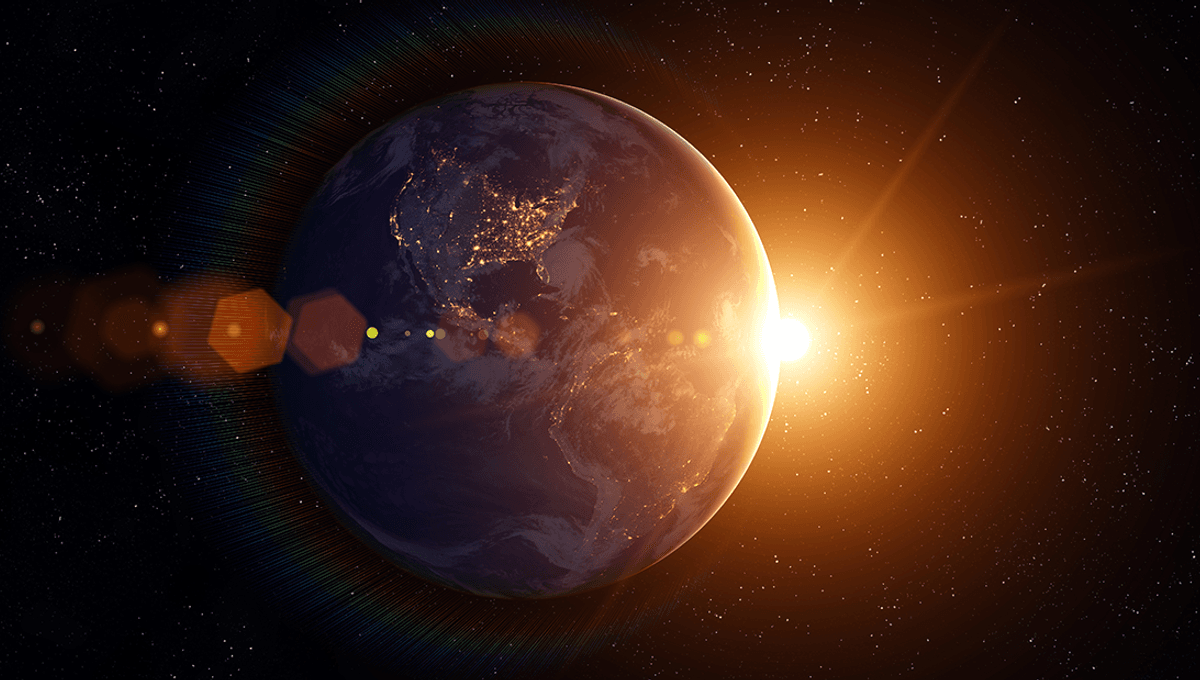
Why Is Earth Closest To The Sun During Winter?
Perihelion – or the Earth's closest approach to our host star – will take place on January 3, 2026. At this point, our planet will be around 2.5 million kilometers (1.5 million miles) closer to the Sun than we are at aphelion, the point when Earth is furthest from our old reliable yellow dwarf.
The rest of this article is behind a paywall. Please sign in or subscribe to access the full content. This can be confusing or seem counterintuitive to some people living in the northern hemisphere. Why should our winter take place during our closest approach to the big ball of gas which provides our planet with warmth? It is actually pretty simple to explain, especially when you remember that the southern hemisphere exists. There, the Earth's closest approach to the Sun takes place during the summer. The key thing to remember is that the seasons are due to the Earth's axial tilt, and not our proximity to the Sun, which only varies by around 3 percent between aphelion and perihelion (though putting it in millions of kilometers makes it sound more dramatic). First up, what causes the seasons? This is the result of the Earth's 23.5-degree axial tilt away from our orbital plane. When your Hemisphere of residence is tilted more towards the Sun it receives more sunlight, and that's summer. When it's pointed further away it receives less, and that's your winter. Now, what causes perihelion, and aphelion? This is the result of the Earth's elliptical orbit. While you may think of the Earth's orbit as being circular (thank you, simplified diagrams) the Earth traces out an ellipse, and the shape of this ellipse changes as the result of our favorite gas giants (no offence meant, Neptune and Uranus, but you might not be gas giants anyway) over the course of hundreds of thousands of years. "Earth’s annual pilgrimage around the Sun isn’t perfectly circular, but it’s pretty close. Over time, the pull of gravity from our solar system’s two largest gas giant planets, Jupiter and Saturn, causes the shape of Earth’s orbit to vary from nearly circular to slightly elliptical. Eccentricity measures how much the shape of Earth’s orbit departs from a perfect circle. These variations affect the distance between Earth and the Sun," NASA explains. "Eccentricity is the reason why our seasons are slightly different lengths, with summers in the Northern Hemisphere currently about 4.5 days longer than winters, and our springs about three days longer than falls. As eccentricity decreases, the length of our seasons gradually evens out." The Earth's current ellipse currently has a very low eccentricity, of about 0.0167, or simply put it is almost circular. As a result the seasons are almost the same length, but not quite. Astronomically speaking, the seasons are defined by which quadrant in our orbit the Earth is passing through, and though years remain roughly the same length, the length of the seasons vary by how much time we spend in each quadrant. This varies, with Earth spending less time at perihelion. "The imaginary line joining a planet and the Sun sweeps out – or covers – equal areas of space during equal time intervals as the planet orbits. Basically, the planets do not move with constant speed along their orbits. Instead, their speed varies so that the line joining the centers of the Sun and the planet covers an equal area in equal amounts of time," NASA explains of Kepler's second law. "The point of nearest approach of the planet to the Sun is called perihelion. The point of greatest separation is aphelion, hence by Kepler's second law, a planet is moving fastest when it is at perihelion and slowest at aphelion." As aphelion currently takes place during summer in the Northern Hemisphere, and perihelion in the southern summer, this means that the Northern Hemisphere currently enjoys around four days more of summer than the Southern Hemisphere. This won't be the case forever. As our calendars don't perfectly match our orbit around the planet, the timing of aphelion and perihelion get shifted throughout the years. In 1,000 years, summers in the Northern Hemisphere will be around six hours longer than they are today, per Timeanddate.com. Aphelion and perihelion are currently very close to the solstices (or the shortest and longest days of the year, again due to our axial tilt) but the fact that they are currently only a few weeks apart is a coincidence. This would probably be more difficult to figure out in 1246 CE, when the December solstice took place on the same day as perihelion. Since then, they have drifted apart from each other at a rate of around one day every 58 years. Per timeanddate.com, in 6,430 CE perihelion will coincide with the March equinox. But in short, to answer the question of the title, the Earth's closest approach to the Sun only takes place in winter for one hemisphere, and due to a coincidence. And it won't be like that forever, either.

 English
 Arabic
 French
 Spanish
 Deutsch
 Turkish
 Dutch
Dutch
 Italiano
 Russian
 Romaian
 Portuguese (Brazil)
 Greek
Greek