


Sheep And... Rhinos? There’s A Very Cute Reason You See Them Hanging Out Together
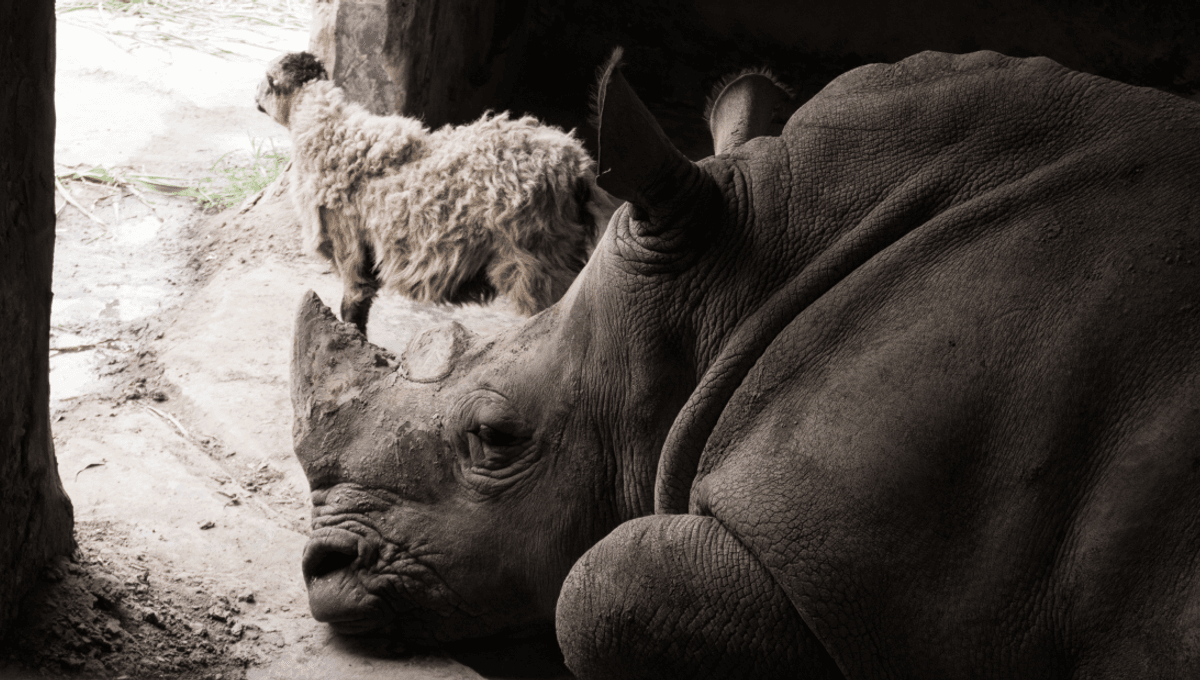
Why Do You See So Many Rhinos Hanging Out With Sheep?
On August 4, 2014, a Pedi lamb named Lammie arrived at the Hoedspruit Endangered Species Centre (HESC) in South Africa with a mission: to become a companion animal for an orphan named Gertjie. Their friendship would capture the hearts of millions, but it was a bit of an odd one. Why? Well, because Gertjie was a rhino.
The rest of this article is behind a paywall. Please sign in or subscribe to access the full content. Gertjie was just 3 months old when his mother was killed by rhino poachers. He was found next to her body and taken to the HESC for rehabilitation, but there was something missing. White rhinos are the most social species of rhinoceros. Though they’re largely solitary as adults, mothers and their calves form groups called “crashes”. Without any rhinos that could act as a suitable surrogate, the HESC got creative. Sheep and rhinos are very different animals, but they do share some crucial similarities. They’re both mammals and both ungulates, but while sheep are even-toed ungulates, rhinos are odd-toed ungulates – a split that probably put them on different branches of life around 55 to 65 million years ago. Toes aside, they are both hoofed plant eaters, which comes in handy from an animal husbandry perspective. Sheep will happily graze alongside unrelated animals, are rarely aggressive, and are highly social animals with a strong flocking instinct. It’s the same reason why goats have been found to reduce stress in socially isolated horses. “We often get asked why our rhinos are seen with sheep at their side,” wrote the HESC on Facebook. “Sheep make excellent companion animals for orphaned wildlife and also make great surrogates, as they take on any species as their own. Their placid natures help to calm the rhinos down, which is an absolute necessity as orphaned rhinos are often traumatised and skittish when they arrive.” The HESC has taken the approach forward, successfully pairing several other rhinos with companion sheep, including Lammie, Mielie, Vlooi, and Babette. “The sheep are placed with the rhinos in their bomas at night and will fall asleep against them to offer them emotional security," they wrote. "Esmé and Mielie were introduced at a young age and have grown up together. Thaba and Vlooi have also become firm friends after Vlooi provided Thaba with much-needed emotional support when his first companion sheep Babette sadly passed away.” In an ideal circumstance, juvenile animals would grow up in more naturalistic pairings, which is why the HESC was keen to introduce Gertjie to another orphaned rhino named Matimba. It was a successful pairing, and you can see photos of them snuggling together on the HESC website. These kinds of emotional support surrogates have been successful among other animals, too. At Metro Richmond Zoo, Virginia, a cheetah cub named Kumbali was rejected by his family after needing to be removed for medical care. He started showing signs of anxiety, so the zoo found him a friend in the form of a Labrador puppy called Kago, who himself was rescued from a kill shelter in Alabama before being donated as a companion. According to the zoo, dogs have been used as companions for cheetahs in captivity for over 40 years. San Diego Zoo pioneered this idea, and other zoos have followed the practice. “This symbiotic relationship would never happen in the wild,” Metro Richmond Zoo wrote in a blog post in 2015. “However, we believe the positive outcomes outweigh any negative. As the two grow up together, they create a bond that becomes almost inseparable, sibling-like. They provide companionship for each other. The dog has a calming influence because the cheetah will take behavioral cues from the dog – learning not to fear his surroundings, but instead embracing them with confidence.” Speaking of unusual animal associations, ever wondered why caimans don’t eat capybaras?

 English
 Arabic
 French
 Spanish
 Portuguese
 Deutsch
 Turkish
 Dutch
Dutch
 Italiano
 Russian
 Romaian
 Greek
Greek