


TeodorLazarev/Shutterstock
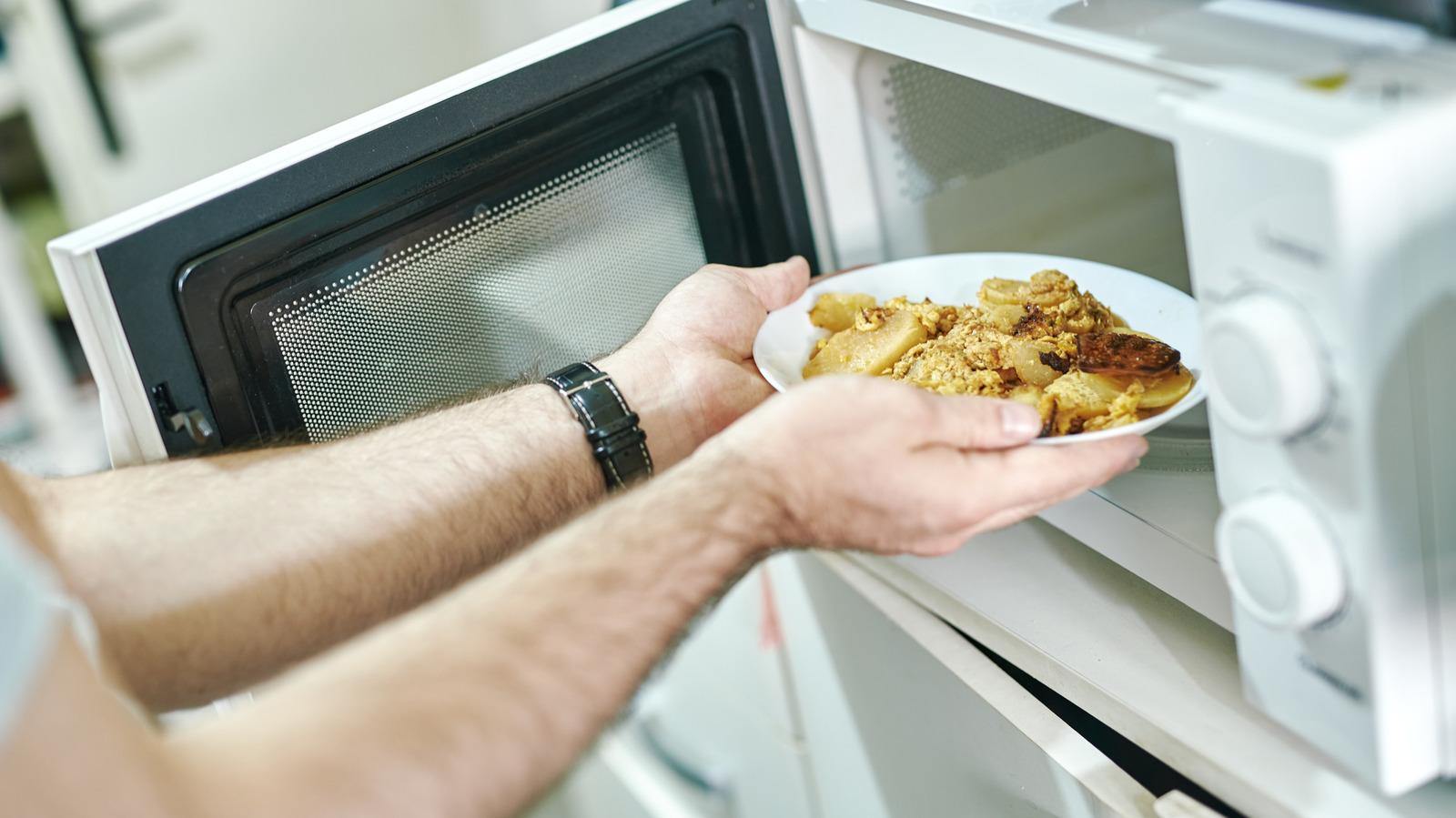
It's no secret that leftovers taste good, but reheating them can be a hassle — especially if you're in a rush. While a microwave is the easiest option, it often makes food soggy and unappetizing. One alternative gaining social media traction is the convection steam oven, sometimes called a combi-steam oven. Such appliances are particularly adept at preserving leftovers' original quality. Plus, they can cook a whole range of cuisine by using a unique combination of heat and moisture that supports even cooking without drying out your food.
On the most basic level, a steam oven primarily relies on steam to cook food. These appliances incorporate small water tanks. Water is filtered into a boiler and heated, and the resulting steam is released into the oven's main compartment. However, convection steam ovens allow you to choose steam only, convection only, or a combination of the two. This last option is a kind of "best-of-both-worlds" scenario. Steam helps food retain its natural moisture while the convection function circulates heat to ensure even cooking. In comparison to a conventional microwave, a convection steam oven offers far more options that allow you to customize cooking environments for specific meals.
Microwaves are convenient, but they're not quite as sophisticated. A microwave works by heating the water naturally found inside food. That water moves outward as food cooks. This accounts for the soggy and sometimes shriveled quality of microwaved meals.
Will convection steam ovens really replace microwaves?
Convection steam ovens offer many of advantages over traditional microwaves. There is the aforementioned leftovers issue, with some models having specific settings for cooking leftovers. Convection steam ovens can also be used in place of regular ovens, cooking food more quickly. They are also timesavers when it comes to lengthy tasks such as blanching vegetables. All in all, convection steam ovens are more versatile than traditional microwaves, with uses ranging from cooking perfectly steamed vegetables to making fast food leftovers taste fresh.
Still, no appliance is without its downsides. Full-sized steam ovens can be quite large, often too cumbersome for the average kitchen and especially unsuitable for many apartment dwellers. There's also the price tag. Costing from $4,000 to $7,000, they are not exactly budget-friendly.
On the flip side, compact steam ovens, similar in size to microwaves, can mitigate these issues. While still more costly than the average microwave, they're often sold for a few hundred dollars, a far more feasible price range for the average consumer. As such products receive positive buzz, we could see more widespread adoption of convection steam ovens as an alternative to traditional microwaves.

 English
 Arabic
 French
 Spanish
 Portuguese
 Deutsch
 Dutch
Dutch
 Italiano
 Russian
 Romaian
 Portuguese (Brazil)
 Greek
Greek