


 PUBLISHED
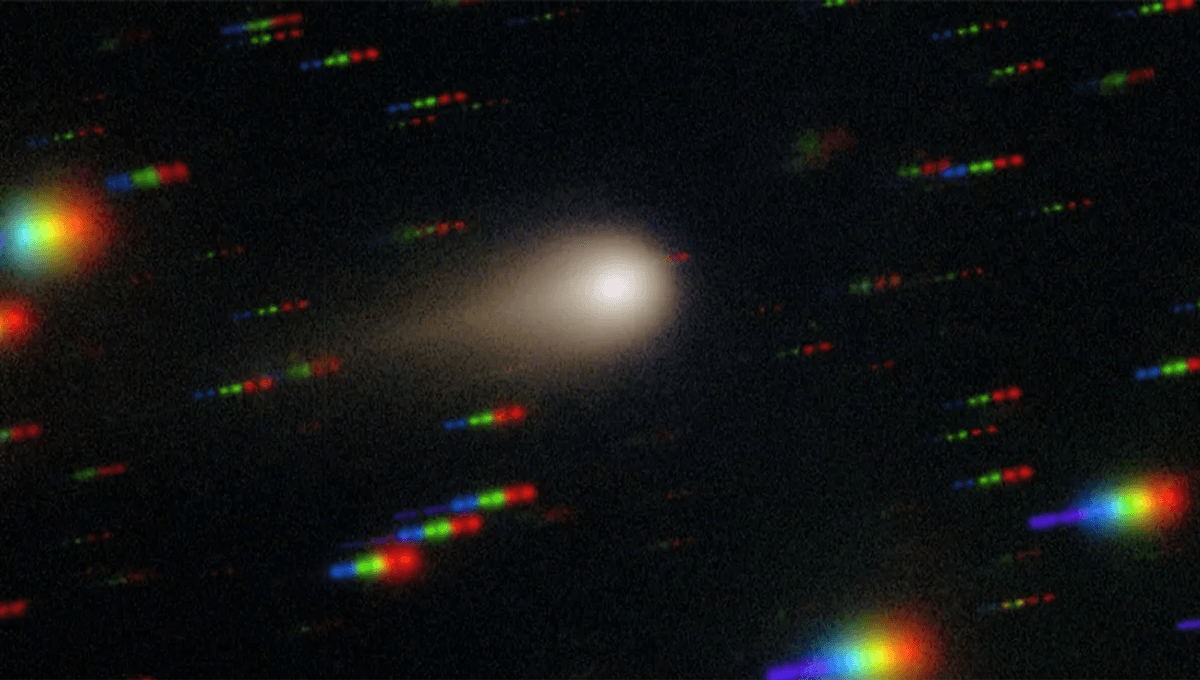
Harvard astronomer and origin of the unnecessary "alien spacecraft" hypothesis has admitted that interstellar comet 3I/ATLAS is "most likely natural" as it heads away from the Earth.
The rest of this article is behind a paywall. Please sign in or subscribe to access the full content. On July 1, 2025, the Asteroid Terrestrial-impact Last Alert System detected an object traveling through our Solar System on an escape trajectory. Traveling at 54 kilometers (33 miles) per second, it is the fastest interstellar object we have recorded so far, though admittedly this is only the third such object we have observed. It's an interesting comet, and in our brief window of observations before it leaves us once more we have learned a lot from it. For recent example, we have found key molecules for life upon it, and determined that it may be a time capsule from an earlier age of the universe, and a different part of our galaxy. But, much to the annoyance of some scientists, our interstellar visitor has been the subject of a lot of speculation and nonsense. While some degree of "IS IT ALIENS?" is to be expected on social media from unqualified spectators, one source that has certainly been providing fuel for the bin fire is a theoretical physicist at Harvard: Professor Avi Loeb. On July 16, Loeb, Adam Hibberd, and Adam Crowl put out a paper that Loeb described as "largely a pedagogical exercise" (or teaching exercise), which proposed that the object could be a hostile alien spacecraft as outlined in the "Dark Forest" hypothesis. In short (though you should read the book on which it is based, you will not regret it), given the finite resources in the universe, any lifeform may want to pre-emptively attack any other form of life, before it becomes a threat to their own civilization. According to the paper, the object could be here for that purpose. "3I/ATLAS achieves perihelion on the opposite side of the Sun relative to Earth. This could be intentional to avoid detailed observations from Earth-based telescopes when the object is brightest or when gadgets are sent to Earth from that hidden vantage point," Loeb wrote in an accompanying blog post. "The optimal point for a reverse Solar Oberth maneuver to become bound to the Sun is at perihelion," he added. "It is this optimal breaking point for 3I/ATLAS that is obscured from our view by the Sun." Perihelion, the comet's closest approach to the Sun, came and went, and no maneuver took place. In August he listed a lack of tail as a noteworthy and anomalous feature of the object. "When I argued in an essay on July 20, 2025 that the prematurely claimed elongation in the images of 3I/ATLAS might be an artifact resulting from the motion of the object, I was attacked by bloggers who insisted that it represents evidence for a cometary tail. Now that the dust has settled, literally speaking, we can ask again: could 3I/ATLAS be something other than a comet?" he wrote, adding "the more data we collect, the more difficult it would be for scientists to shove anomalies of 3I/ATLAS under the carpet of traditional thinking. We are used to finding icy rocks which exhibit familiar cometary tails in the Solar System, but an encounter with objects from interstellar space is a blind date on astronomical scales." Lo and behold, we have since seen the comet develop a tail, and anti-tail, which he has also since listed as anomalous. "It’s true that not many comets do this but it’s hardly unique," astronomer Jason Wright writes of the anti-tail 'anomaly'. "He also falsely claims he’s the first to explain why this might happen naturally, when in fact this has been understood for 50 years." These sorts of claims, not only proposed by Loeb, are not without consequence. If you have looked at Reddit, or other areas of the Internet since the comet's discovery, people have been highly anxious about a comet that is passing through our Solar System harmlessly. "I am having a really hard time dealing with the anxiety of 3I/ATLAS," one Reddit user wrote, for example. "I heard tonight or tomorrow we will begin to get more data that can confirm or refute alien origin. If it is aliens, I fear we see full societal collapse and panic. I have a relatively happy life and I am worried about this being a truly apocalyptic scenario." These kinds of comments have become especially prevalent as the comet made its closest approach to Earth, passing by – again, harmlessly – at a distance of 270 million kilometers (168 million miles). If it was sent to spy on Earth or destroy it, as many on the Internet seem to think, it didn't get a very good view. Since the closest approach on December 19, Loeb has spoken to News Nation about it. Rather than talking about the "anomalies", he stressed that the comet is likely a natural object. “So far, so good," he told the outlet. “3I/ATLAS did not maneuver or display any unusual activity when it came closest to Earth.” “At this point, given all the data that we have, I would agree that it’s most likely natural," he added, "but there are still a lot of things we don’t understand about it." This isn't the first time that Loeb has said that the object is most likely natural. He created the "Loeb scale" to rank such objects, running from 0 (the object is confirmed to be natural) to 10 (confirmed to be technological). The highest he has ranked this object is 4, which, from a public perspective, still sounds quite high considering we have never once detected an alien spacecraft. A look at the online discourse shows that while that may not have been Loeb's intention, many who cite his work do appear to believe that the comet is a spacecraft. Now, as the comet heads away from Earth and towards Jupiter before leaving our Solar System, Loeb appears to be winding down the speculation of alien spacecraft. Having passed Earth, the window of opportunity for speculation that it might be anything other than a natural object is closing. "Of course, any release of smaller objects near Jupiter, and the detection of artificial lights or unexpected maneuvers, might also constitute a technological signature," he writes on his blog. "But in the absence of a clear technological signature, I will revise my Loeb Scale rank downward." This is not the first time that Loeb has suggested an interstellar object may in fact be an alien artifact – he made similar claims about our first visitor, 1I/'Oumuamua, and he has been likened to "the boy who cried wolf". That could be a problem if we really were to find evidence of alien civilizations. “If and when we do find extraterrestrials – and I think there’s a real chance that we might detect some sort of life, intelligent or not, in the next decade or two – we’re going to have a ‘boy who cried wolf’ problem,” University of Toronto astronomer Bryan Gaensler explained to the Atlantic. “The people who find real evidence of this are probably not going to get the credit they deserve, because we’ve heard this all before.” To be fair to Loeb, 3I/ATLAS has been a pedagogical exercise, though in learning not to assume an object is aliens until we have had a good look at it. The overwhelming odds suggest that all those we've encountered so far are natural, just like 3I/ATLAS is. Something to bear in mind when we discover our fourth interstellar visitor, before the Internet works its way into a panic.



 English
 Arabic
 French
 Spanish
 Portuguese
 Turkish
 Dutch
Dutch
 Italiano
 Russian
 Romaian
 Portuguese (Brazil)
 Greek
Greek