10 Reasons the U.S. Won the Space Race - History Collection
5. Open Scientific Exchange
U.S. openness in space research contrasted sharply with Soviet secrecy during the Space Race era.
The United States’ commitment to transparency and international scientific cooperation during the Space Race stood in stark contrast to the Soviet Union’s secrecy. While the U.S. openly shared research findings and mission data, fostering global collaboration, the Soviets often withheld information about their space endeavors. For instance, the Soviet Union’s Luna 2 mission, which impacted the Moon in 1959, was initially shrouded in secrecy, with details emerging only years later. This openness not only enhanced the prestige of U.S. space achievements but also facilitated the peaceful exploration and use of outer space (aas.org).
6. Educational Investment
Federal investment through the NDEA of 1958 strengthens STEM education for national security and innovation.
The United States’ commitment to educational investment, particularly through initiatives like the National Defense Education Act (NDEA) of 1958, significantly bolstered STEM education. The NDEA allocated substantial federal funds to improve education in science, mathematics, and foreign languages—disciplines deemed essential for national security. These funds supported curriculum development, laboratory equipment, and instructional materials to elevate the quality of education in these fields. Additionally, the NDEA established a federally backed student loan program, providing low-interest loans to students pursuing degrees in science, technology, engineering, and mathematics. This initiative reduced financial barriers and encouraged more students to enter critical fields. Furthermore, the act emphasized teacher preparation and professional development, directing federal funds toward training educators to teach advanced subjects effectively. This focus improved the overall quality of instruction and student outcomes. Overall, the NDEA’s educational investments cultivated a generation of skilled scientists and engineers, fueling the United States’ space efforts and technological advancements (britannica.com).
7. Public Support and National Pride
U.S. transparency and international collaboration in the Space Race contrasted sharply with Soviet secrecy.
The United States’ commitment to transparency and international scientific cooperation during the Space Race stood in stark contrast to the Soviet Union’s secrecy. While the U.S. openly shared research findings and mission data, fostering global collaboration, the Soviets often withheld information about their space endeavors. For instance, the Soviet Union’s Luna 2 mission, which impacted the Moon in 1959, was initially shrouded in secrecy, with details emerging only years later (NCBI). This openness not only enhanced the prestige of U.S. space achievements but also facilitated the peaceful exploration and use of outer space.
8. Successful Problem Solving and Crisis Response
NASA implements rigorous safety upgrades and design changes following the Apollo 1 tragedy, prioritizing crew protection…
NASA’s response to the Apollo 1 tragedy exemplified its commitment to learning from failures and implementing swift safety improvements, thereby enhancing mission reliability and crew confidence. Following the January 27, 1967, accident, NASA conducted a comprehensive investigation that led to significant design and procedural changes. The Command Module’s hatch was redesigned for rapid egress, and flammable materials were replaced with fire-resistant alternatives. Additionally, NASA established an independent Office of Flight Safety to oversee all aspects of design, manufacturing, testing, and flight from a safety standpoint (nasa.gov). These proactive measures underscored NASA’s dedication to safety and its ability to adapt and improve in the face of adversity.
9. Global Diplomacy and Soft Power
Apollo 11 Moon landing broadcast unites millions, showcasing U.S. technological leadership during the Cold War.
American achievements in space, broadcast worldwide, reinforced diplomatic influence and positioned the U.S. as a technological leader at the height of the Cold War. The Apollo 11 mission, culminating in the first Moon landing in 1969, was a significant demonstration of American technological prowess. The live broadcast of Neil Armstrong’s first steps on the lunar surface was viewed by an estimated 650 million people worldwide, about 18% of the global population at the time (congress.gov). This unprecedented global viewership not only showcased American innovation but also served as a powerful tool in public diplomacy. Following the mission, astronauts Neil Armstrong, Buzz Aldrin, and Michael Collins embarked on a 37-day, 24-country goodwill tour, known as the “Giant Leap” tour, promoting the Apollo program and American cultural interests abroad. These efforts enhanced the United States’ soft power, fostering international goodwill and reinforcing its position as a leader in space exploration during a critical period of geopolitical rivalry.
10. The Moon Landing
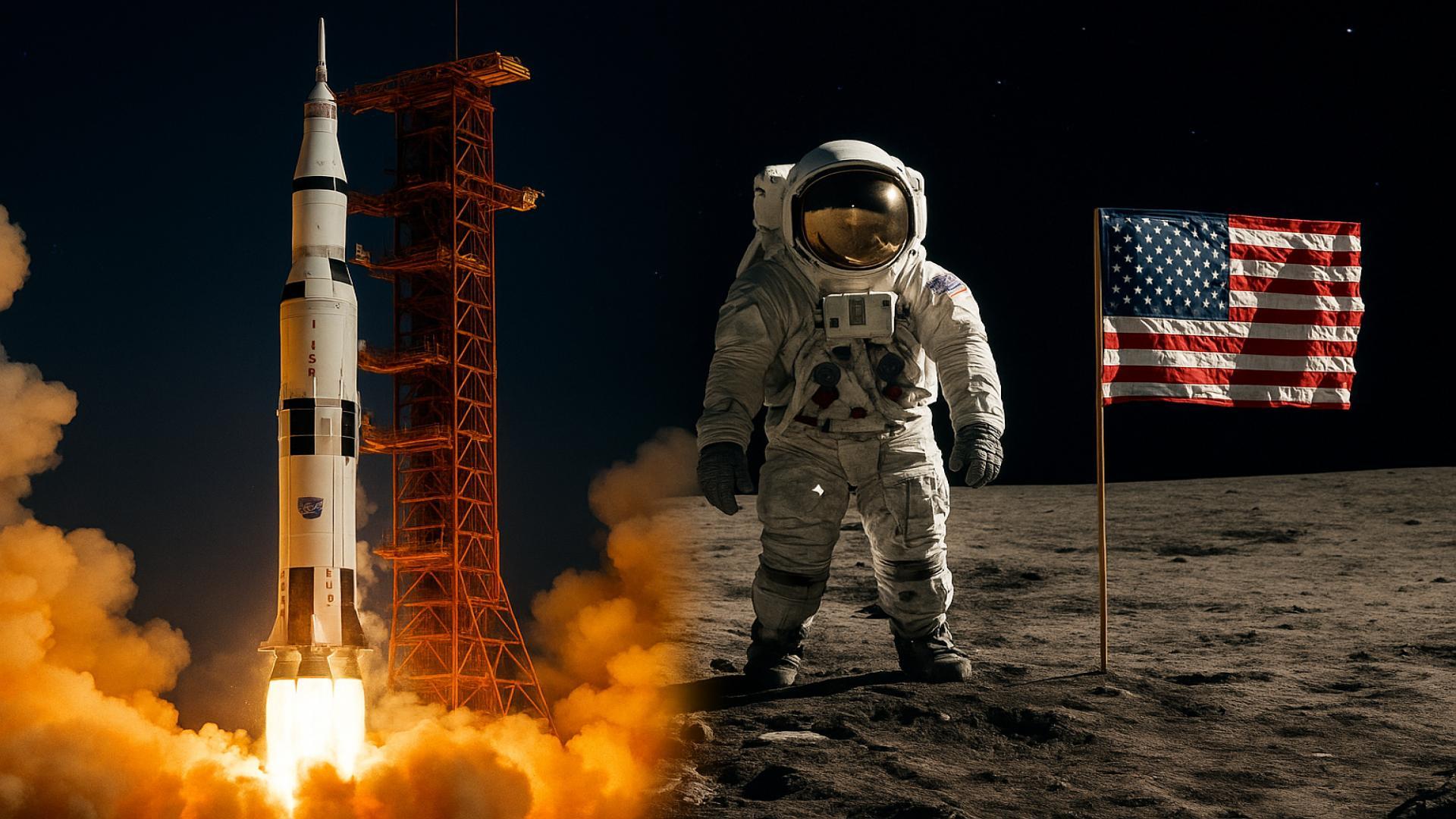
Apollo 11 astronauts achieve humanity’s first Moon landing, marking a historic milestone in space exploration.
The successful Apollo 11 mission, culminating in the first human landing on the Moon on July 20, 1969, (nasa.gov), stands as the crowning achievement of the Space Race. Astronauts Neil Armstrong and Buzz Aldrin descended to the lunar surface in the Lunar Module “Eagle,” while Michael Collins orbited above in the Command Module “Columbia.” Armstrong’s iconic words upon stepping onto the Moon—”That’s one small step for man, one giant leap for mankind”—resonated worldwide, symbolizing human ingenuity and determination (nasa.gov). The mission’s success showcased the United States’ technological prowess, strategic planning, and unwavering commitment to exploration, solidifying its victory in the Space Race and leaving an indelible mark on history.
Conclusion
Apollo 11’s triumph reflects American innovation, leadership, and enduring impact on global space exploration.
The United States’ victory in the Space Race was propelled by its superior economic resources, advanced technological innovations, strategic political leadership, and robust educational investments. These factors culminated in the historic Apollo 11 mission, which not only showcased American ingenuity but also left an enduring legacy in science, technology, and international relations. The advancements achieved during this era continue to influence modern space exploration and foster global collaboration in scientific endeavors. (gilderlehrman.org)





 English
 Arabic
 French
 Spanish
 Portuguese
 Deutsch
 Turkish
 Dutch
Dutch
 Italiano
 Russian
 Romaian
 Portuguese (Brazil)