


Space Astronomy Is Under Threat As New Paper "Raises Important Concerns" About Megaconstellations
Space Astronomy Is Under Threat As New Paper "Raises Important Concerns" About Megaconstellations
The number of satellites in space continues to rise due to the deployment of megaconstellations. For decades, humanity has sent about 200 satellites every year into space. You need just a couple of days to deploy the same number now. This unconstrained deployment comes with many serious concerns about future utilization of space, but also for Earth.
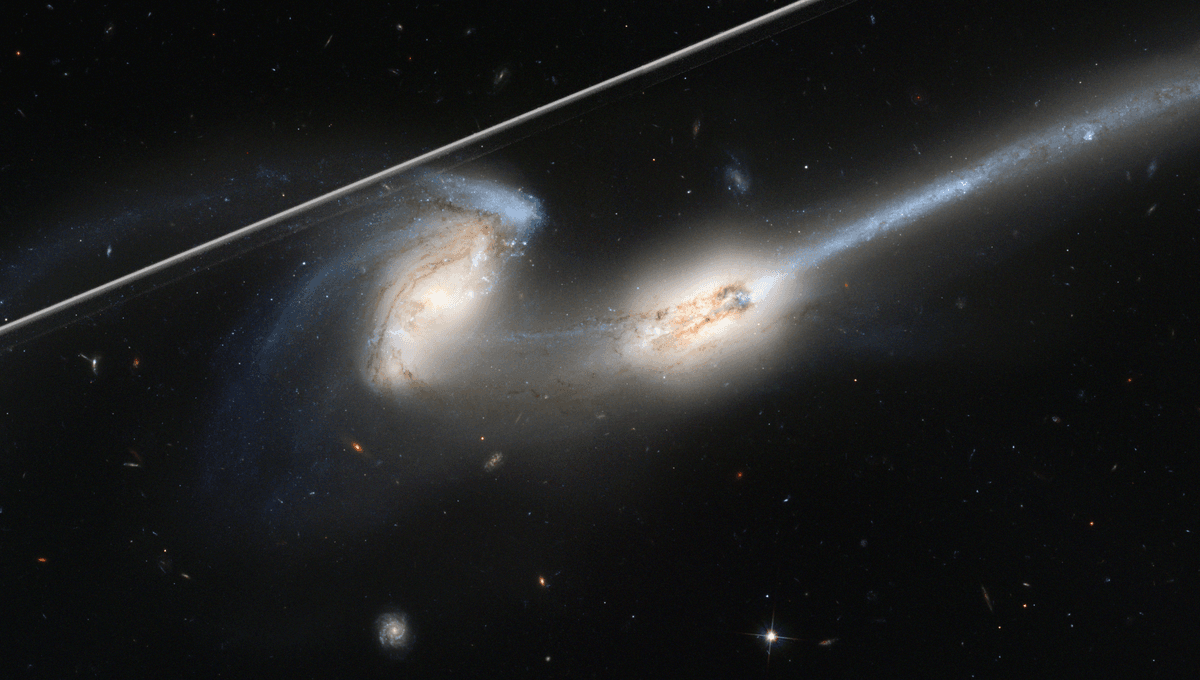
The rest of this article is behind a paywall. Please sign in or subscribe to access the full content. The crux is light pollution. The world is getting brighter, and the night is disappearing. This is partly due to LEDs, which are cheaper and more energy efficient – this has led to an increase in illumination even in places that do not require lighting to be on all night. But some of this extra light comes from satellites, bringing light pollution even to areas of the Earth like the middle of the oceans and deserts, which did not experience it before. Light pollution affects our health in a variety of ways, including being a risk factor in early onset dementia. The increasing number of satellites – such as the SpaceX megaconstellation Starlink, which makes up more than half of all the satellites in space – is also affecting astronomy. From the first deployment, we have seen how satellite streaks photobomb observatories around the globe, even putting at risk long-term campaigns like the Legacy Survey of Space and Time by the Vera Rubin Observatory. Now, it looks like not even space-based observatories are safe. New research, led by NASA Ames scientist Alejandro Borlaff, expects that by 2040, about 40 percent of all images from the Hubble telescope will be contaminated by internet satellite constellations. The value is even higher, reaching 96 percent, for new and upcoming telescopes such as ARRAKIHS, Xuntian, and SPHEREx, which has just completed an incredible 102-infrared-color map of the whole sky. “The recent Nature paper by Borlaff, Marcum and Howell raises important concerns about our ability to continue gathering astronomical data from space telescopes, particularly those in low-Earth orbit,” Dr John C. Barentine, co-founder of the Center for Space Environmentalism, told IFLScience. “Using existing observations and a model of the expected growth of the number of satellites in orbit around our planet, I think they show fairly convincingly that the interference these satellites may cause our space telescopes in the future is of significant concern.” There are almost 16,000 satellites in orbit at the moment. If every megaconstellation that has been planned gets built, we are looking at a fourfold, maybe even a fivefold, increase in the number of orbital objects, not only increasing light pollution globally, affecting astronomy on the ground and in space, but also increasing the risk of collisions between satellites. As the likelihood of exponential space debris generation through runway collision cascades rises, so too does the risk to current and future space telescopes. Dr John C. Barentine In just the first six months of the year, Starlink satellites performed 144,404 conjunction risk mitigation maneuvers. A collision could prove catastrophic as it might produce a cloud of debris that goes on colliding with other satellites, and so on. This is known as the Kessler syndrome, and it might make whole areas of orbital space not safe for use or passage. “[The paper] also underscores the threat that an increasingly crowded near-Earth space environment poses to the safety of space telescopes in lower orbits. As the likelihood of exponential space debris generation through runway collision cascades rises, so too does the risk to current and future space telescopes,” Dr Barentine told IFLScience. It might be surprising, but there is little in terms of regulation on what can go up in space, and it's all defined in the Outer Space Treaty, which was great in the 1960s when it was signed, but is in need of an update. Private companies and governments can place thousands, and maybe one day tens of thousands of satellites into space, without any pushback. “Much as in the case of satellite interference to ground-based astronomy, the world still lacks a strong international policy framework that can effectively control this problem. Because we do not know how to effectively mitigate the impact of satellites on astronomy conducted at any altitude, the most promising strategy is to limit the number of satellites launched in the future along and to require responsible de-orbiting of existing satellites when they reach the ends of their missions,” Dr Barentine told IFLScience. This doesn’t mean to stop space launches; it means that what we put into orbit ought to follow regulations. Unregulated areas seldom lead to a happy ending. Suggestions for better policies have already been put forward. “Some of the same technical strategies as those recommended by the IAU CPS can be made conditions of launch and operations licensing, as they may well benefit telescopes in space as much as those on the ground. And we need a stronger commitment from launching states to incorporate these ideas into their national space policies,” Dr Barentine told IFLScience. The study is published in the journal Nature.

 English
 Arabic
 French
 Spanish
 Portuguese
 Deutsch
 Turkish
 Dutch
Dutch
 Russian
 Romaian
 Portuguese (Brazil)
 Greek
Greek