


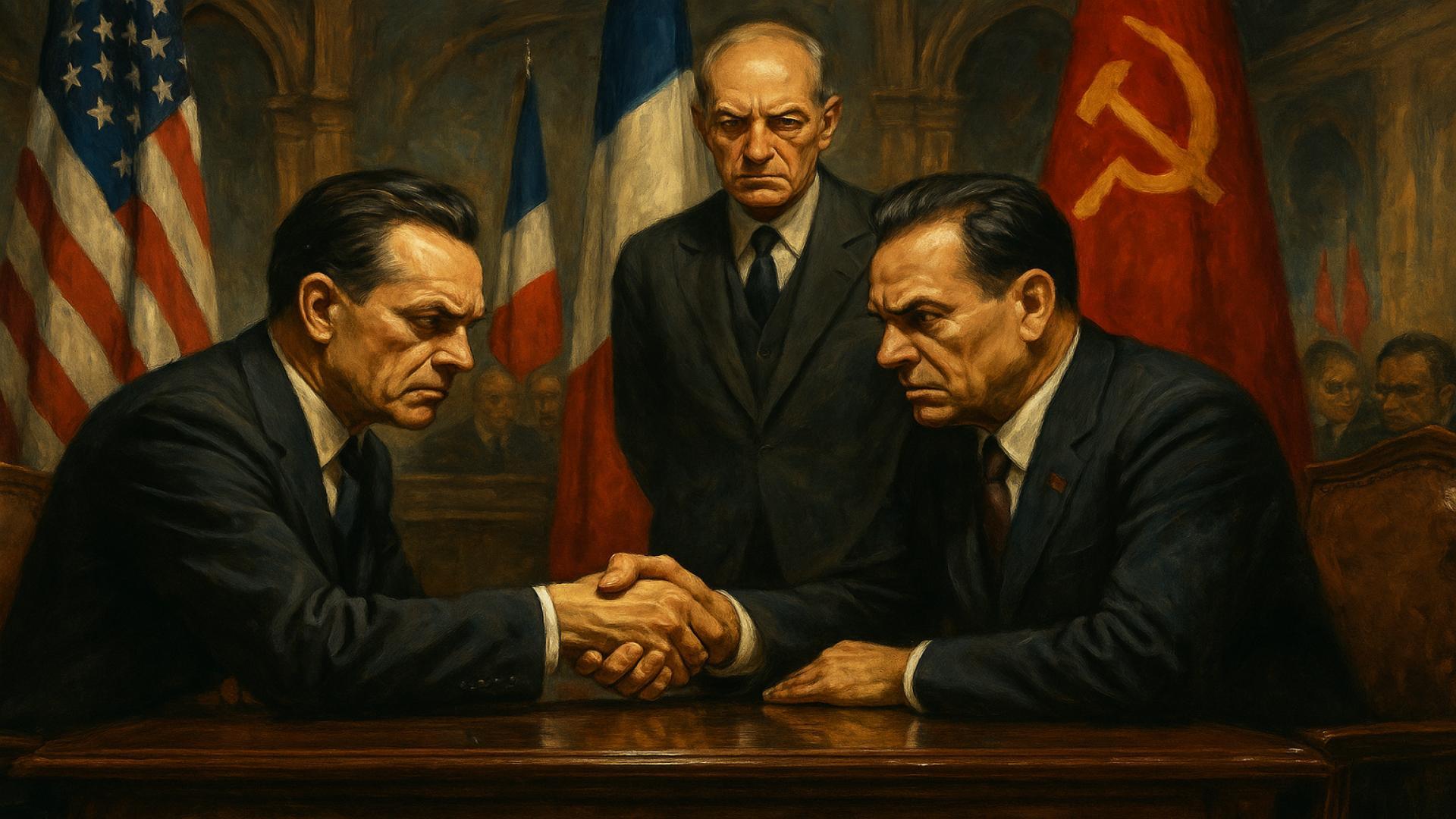
15 Times America Almost Went To War But Just Avoided It

0
12

15 Times America Almost Went To War But Just Avoided It - History Collection

4. The Zimmermann Telegram (1917)

15 Times America Almost Went To War But Just Avoided It
British interception of the Zimmermann Telegram exposes German plot to ally with Mexico against the U.S.

In January 1917, German Foreign Secretary Arthur Zimmermann sent a secret, coded message to the German ambassador in Mexico, proposing a military alliance against the United States. The telegram promised Mexico financial support and assistance in reclaiming territories lost during the Mexican-American War, including Texas, New Mexico, and Arizona. British intelligence intercepted and decrypted the message, revealing Germany’s intentions to incite conflict between the U.S. and Mexico. The British government presented the telegram to U.S. Ambassador Walter Hines Page on February 24, 1917. The revelation of the telegram’s contents caused outrage among the American public and significantly shifted public opinion toward supporting entry into World War I. On April 6, 1917, the United States Congress declared war on Germany, marking a pivotal moment in the nation’s history (archives.gov).

5. The Suez Crisis (1956)

15 Times America Almost Went To War But Just Avoided It
Suez Crisis of 1956: Nasser’s nationalization sparks international conflict and U.S.-led diplomatic intervention.

In July 1956, Egyptian President Gamal Abdel Nasser nationalized the Suez Canal, previously operated by a British-French company. In response, Britain, France, and Israel initiated military action against Egypt. The United States, under President Dwight D. Eisenhower, opposed the invasion, urging a ceasefire and diplomatic resolution. This intervention highlighted the U.S.’s commitment to preventing further colonial conflicts and reasserted its influence in the Middle East (history.state.gov).

6. The Berlin Blockade (1948-1949)

15 Times America Almost Went To War But Just Avoided It
Allied planes deliver vital supplies to West Berlin during the 1948-49 Soviet blockade.

In June 1948, the Soviet Union initiated the Berlin Blockade, cutting off all land and water routes to West Berlin in an attempt to force the Western Allies out of the city. In response, the United States and Britain organized the Berlin Airlift, supplying the city with essential goods via air for nearly a year. This operation successfully circumvented the blockade without resorting to military conflict, reinforcing the U.S. commitment to Europe and setting the tone for Cold War diplomacy (history.com).

7. The Korean Armistice Talks (1953)

15 Times America Almost Went To War But Just Avoided It
Armistice negotiations in 1953 halt Korean War, establishing the Demilitarized Zone and shaping diplomacy.

By 1953, the Korean War had reached a stalemate, with heavy casualties and no clear victor. The threat of nuclear escalation prompted both sides to seek an end to the conflict. Through backchannel diplomacy and formal armistice negotiations, an agreement was reached on July 27, 1953, effectively halting the fighting and establishing the Korean Demilitarized Zone. This armistice shaped future U.S.-Asia relations and set the stage for ongoing diplomatic efforts in the region (history.army.mil).

8. The U-2 Incident (1960)

15 Times America Almost Went To War But Just Avoided It
U-2 spy plane downed over Soviet territory, igniting Cold War tensions before Paris Summit.

On May 1, 1960, during the Cold War, a U.S. Lockheed U-2 spy plane piloted by Francis Gary Powers was shot down over the Soviet Union’s Sverdlovsk region. The incident occurred just days before a major summit in Paris, leading to a significant diplomatic crisis. The U.S. initially denied the mission’s purpose, but the Soviets presented evidence, including the pilot’s capture, forcing an admission. This event severely strained U.S.-Soviet relations and led to the collapse of the Paris Summit (history.com).

9. The Cuban Missile Crisis (1962)

15 Times America Almost Went To War But Just Avoided It
President Kennedy and advisors strategize during the Cuban Missile Crisis, averting nuclear confrontation with diplomacy…

In October 1962, the United States discovered that the Soviet Union had installed nuclear missiles in Cuba, just 90 miles off the coast of Florida. President John F. Kennedy convened his advisors to determine a response, leading to a naval “quarantine” of Cuba to prevent further Soviet shipments. After tense negotiations, Soviet Premier Nikita Khrushchev agreed to dismantle and remove the missiles in exchange for a U.S. public declaration not to invade Cuba and a secret agreement to remove U.S. missiles from Turkey. This 13-day standoff is widely considered the closest the Cold War came to escalating into a full-scale nuclear war (jfklibrary.org).

10. The Pueblo Incident (1968)

15 Times America Almost Went To War But Just Avoided It
USS Pueblo intercepted by North Korean forces in 1968, sparking international tensions and crew detainment.

On January 23, 1968, the USS Pueblo, a U.S. Navy intelligence vessel, was intercepted and captured by North Korean naval forces in international waters off the coast of North Korea. The North Koreans accused the ship of intruding into their territorial waters, a claim the U.S. government denied, asserting that the Pueblo was operating in international waters. During the capture, one crew member was killed, and the remaining 82 crew members were detained and subjected to harsh conditions, including beatings and sleep deprivation. The incident led to heightened tensions between the United States and North Korea, with the U.S. military mobilizing forces in the region. After 11 months of intense negotiations, the crew was released on December 23, 1968, but the ship itself remains in North Korean possession to this day. This event underscored the volatility of Cold War hotspots and the potential for conflict escalation (history.navy.mil).

11. The Yom Kippur War (1973)

15 Times America Almost Went To War But Just Avoided It
U.S. military airlift aids Israel during the 1973 Yom Kippur War, intensifying Cold War tensions.

In October 1973, Egypt and Syria launched a surprise attack on Israel during Yom Kippur, aiming to reclaim territories lost in the 1967 Six-Day War. The Soviet Union supported the Arab states with military supplies, while the United States initiated Operation Nickel Grass, a strategic airlift delivering approximately 22,325 tons of military aid to Israel. This U.S. support was crucial in enabling Israel to repel the offensive. The conflict brought the superpowers to the brink of direct confrontation, highlighting the delicate balance of Cold War diplomacy (en.wikipedia.org).

12. The Able Archer 83 Exercise (1983)

15 Times America Almost Went To War But Just Avoided It
NATO’s Able Archer 83 exercise heightens Cold War tensions, prompting Soviet nuclear alert readiness.

In November 1983, NATO conducted the Able Archer 83 exercise, simulating a period of heightened nuclear tensions between NATO and the Warsaw Pact. The exercise introduced new elements, including unique encrypted communications and radio silence, which led Soviet intelligence to misinterpret it as a potential prelude to a nuclear first strike. In response, the Soviet Union readied its nuclear forces, placing air units in East Germany and Poland on high alert. The crisis was defused when U.S. Lieutenant General Leonard H. Perroots advised against escalating the situation, and the exercise concluded without incident. This event underscored the delicate balance of Cold War diplomacy and the potential for misinterpretation leading to conflict (bbc.com).

13. The Taiwan Strait Crisis (1995-1996)

15 Times America Almost Went To War But Just Avoided It
Chinese missile tests near Taiwan in 1995 prompt U.S. naval response, heightening regional tensions.

In 1995, the People’s Republic of China (PRC) conducted missile tests near Taiwan, aiming to intimidate the Taiwanese electorate ahead of the 1996 presidential election. The United States responded by deploying naval forces to the region, demonstrating its commitment to Taiwan’s security. Through careful diplomacy, both nations avoided direct conflict, though regional tensions remained high. For a comprehensive analysis, refer to the Council on Foreign Relations’ overview of China-Taiwan relations (cfr.org).

14. The Kargil Conflict (1999)

15 Times America Almost Went To War But Just Avoided It
U.S. diplomatic intervention during the 1999 Kargil conflict averts escalation, strengthening U.S.-India relations.

In May 1999, Pakistani forces infiltrated the Kargil district along the Line of Control (LoC) in Jammu and Kashmir, leading to intense military confrontations with India. The conflict raised concerns about potential escalation between two nuclear-armed nations. The United States, under President Bill Clinton, played a pivotal role in urging Pakistan to withdraw its forces, thereby preventing a broader war. This intervention marked a significant shift in U.S.-India relations, fostering closer ties in the subsequent years. For an in-depth analysis, refer to the Brookings Institution’s overview of the Kargil conflict (brookings.edu).

15. The Downing of Iran Air Flight 655 (1988)

15 Times America Almost Went To War But Just Avoided It
USS Vincennes incident: Iran Air Flight 655 shot down, 290 lives lost, conflict narrowly avoided.

On July 3, 1988, the U.S. Navy cruiser USS Vincennes shot down Iran Air Flight 655 over the Strait of Hormuz, mistaking it for a hostile aircraft. The incident resulted in the deaths of all 290 people on board. Iran considered military retaliation, but through back-channel negotiations and reparations, a broader conflict was averted. For more details, see the BBC News article (bbc.com).

Conclusion

15 Times America Almost Went To War But Just Avoided It
Tense standoffs underscore the crucial role of leadership and diplomacy in averting international conflict.

These edge-of-war incidents highlight the thin line between conflict and peace, shaped by leadership, diplomacy, and sometimes sheer luck. Studying these episodes underscores the importance of measured decision-making in international affairs (hks.harvard.edu).

Rechercher
Catégories
Lire la suite
Home & Garden
These Old-Fashioned Southern Stewed Potatoes Taste Like Home
These Old-Fashioned Southern Stewed Potatoes Taste Like Home In under an hour, you can be...
Par Test Blogger9 2025-11-18 00:00:54 0 466
Home & Garden
8 Things You Should Never Ever Clean with Steel Wool
8 Things You Should Never Ever Clean with Steel Wool Steel wool is an effective tool for...
Par Test Blogger9 2025-06-20 12:00:39 0 2KB
Autre
Airsoft Guns Market Share: Growth, Value, Size, Scope, and Analysis
"Global Executive Summary Airsoft Guns Market: Size, Share, and Forecast CAGR Value Data...
Par Shweta Kadam 2025-11-27 08:00:24 0 411
Jeux
This may just be the biggest week ever if you're an Ark fan, and not only because Ark 2 has got a new launch window
This may just be the biggest week ever if you're an Ark fan, and not only because Ark 2 has got a...
Par Test Blogger6 2025-12-19 17:00:30 0 79
Jeux
Asus' golden RTX 5080 card is now in the US, but with no gold and a stupid price
Asus' golden RTX 5080 card is now in the US, but with no gold and a stupid price As an Amazon...
Par Test Blogger6 2025-08-26 17:00:17 0 1KB