


Not Everything On The Moon Is Gray – What Are These "Amazing" Orange Glass Beads?
Not Everything On The Moon Is Gray – What Are These "Amazing" Orange Glass Beads?
The Moon is certainly not a colorful world. Forget the crimson hue of Mars or the blue of Neptune. Our natural satellite is instead in grayscale, a magnificent desolation that only changes color in eclipses. However, there are pockets of color on the Moon, and some of them tell us of dramatic events in the distant lunar past.
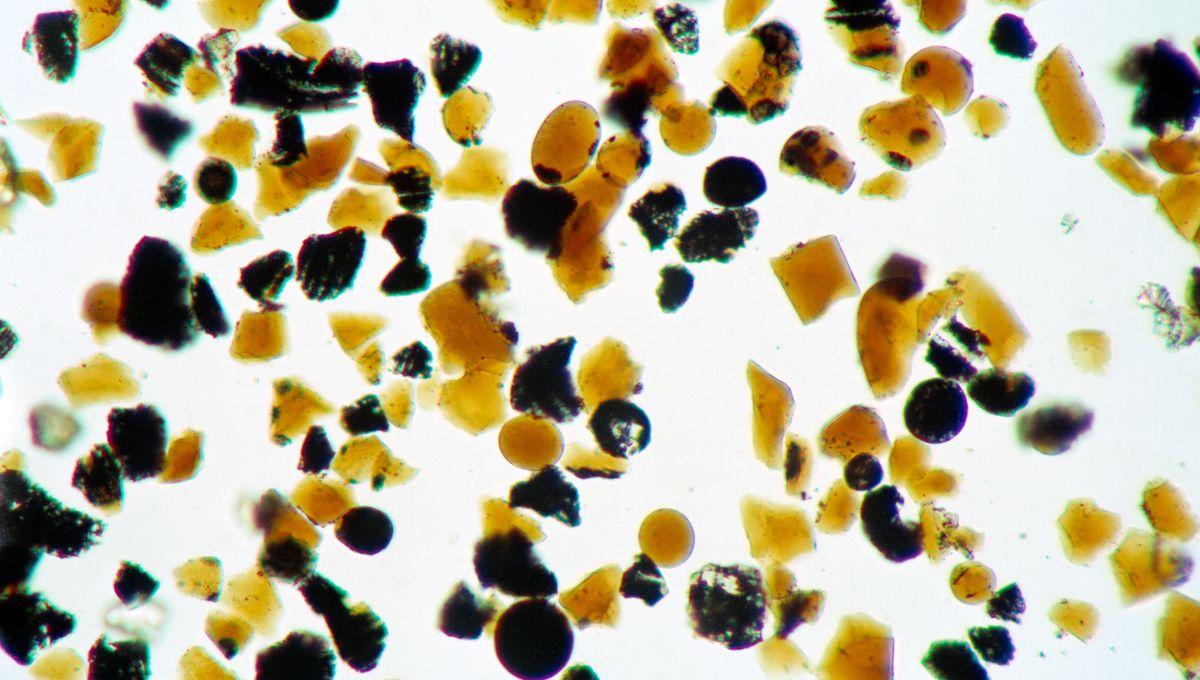
Apollo astronauts brought back 2,196 samples of lunar rocks for a total of 382 kilograms (842 pounds). Within those rocks, scientists have found beads about one millimeter across. Some of them are black while others are bright orange. Their color, shape, and chemical composition are unlike anything found on our planet, and that is due to their formation. "They're some of the most amazing extraterrestrial samples we have," Professor Ryan Ogliore, from Washington University in St. Louis, said in a statement. "The beads are tiny, pristine capsules of the lunar interior." The beads are believed to have formed from violent eruptions on the surface of the Moon that took place between 3.3 and 3.6 billion years ago. They would have arisen from the erupted lava being flung away from the surface. The Moon has barely any air, but the eruption had enough gases that the lava would interact with them in specific ways, creating black or orange beads as they were falling back to the ground. "The very existence of these beads tells us the moon had explosive eruptions, something like the fire fountains you can see in Hawaii today," Ogliore explained. Crucial to this finding was looking at the mineral deposits found on the surface of the beads. It was a challenging task and required multiple techniques, such as atom probe tomography, scanning electron microscopy, transmission electron microscopy, and energy dispersive X-ray spectroscopy, all under conditions to make sure that the samples were not reacting to Earth’s atmosphere. "Even with the advanced techniques we used, these were very difficult measurements to make," Ogliore stated. "We've had these samples for 50 years, but we now have the technology to fully understand them. Many of these instruments would have been unimaginable when the beads were first collected." The beads tell the story of evolving volcanism on the Moon, adding more evidence to the complex active world that our now monochromatic Moon used to be. The study is published in the journal Icarus.

 English
 Arabic
 French
 Spanish
 Portuguese
 Deutsch
 Dutch
Dutch
 Italiano
 Russian
 Romaian
 Portuguese (Brazil)
 Greek
Greek