


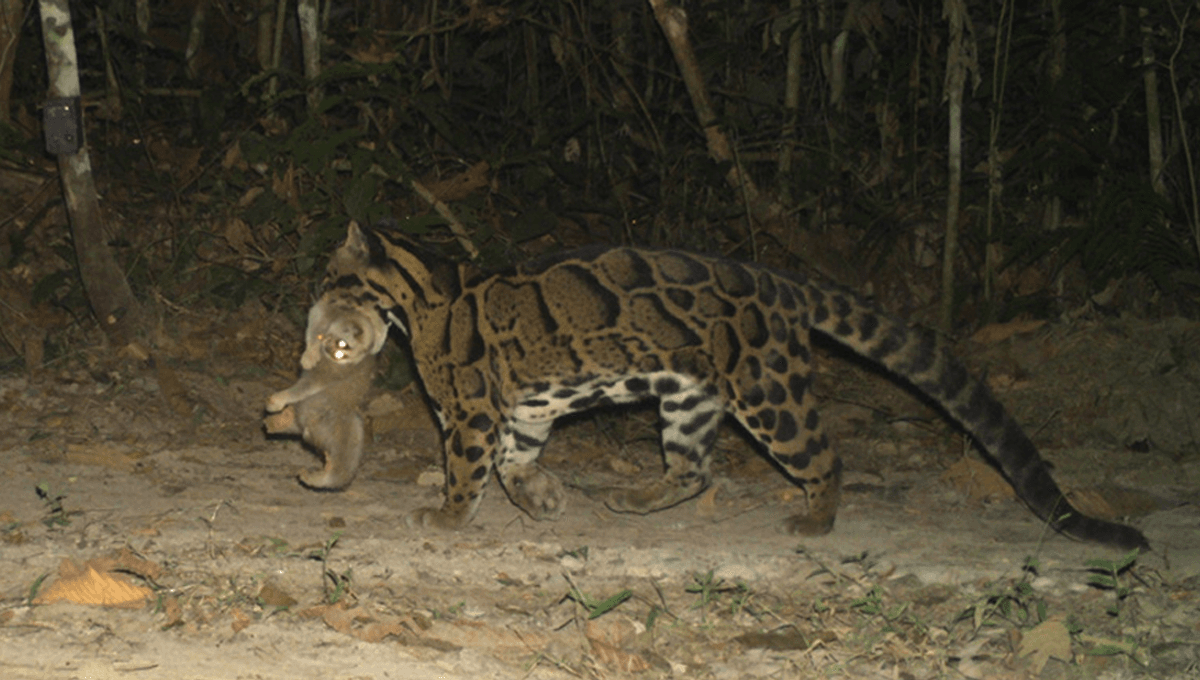


Camera traps are an invaluable resource when it comes to conservation; they can help scientists see "ghosts" in the dark, rediscover lost species, and build up a picture of how different members of a habitat are using the space. Camera traps can also provide a sneaky secret window into the lives of these creatures, revealing who, or what, they like to snack on.
On December 7, 2024, a clouded leopard (Neofelis nebulosa) was papped by a camera trap while strolling down a broad forest path. In its jaws, the leopard carried a Bengal slow loris by the nape of its neck. The camera was set up in the Dehing Patkai National Park in the Assam region of India. “This finding made through camera trapping contributes to our understanding of predatory behaviour and diet, highlighting the significance of conservation efforts for both species,” Bilal Habib, paper author, told Mongabay India. Clouded leopards are listed as Vulnerable by the IUCN and have a range across India, Nepal, China, and parts of Southeast Asia. They are a nocturnal species and are experts at climbing and hunting in trees; they even have specialized ankle joints to make this even easier. Meanwhile, Bengal slow lorises (Nycticebus bengalensis) are listed as Endangered and have an overlapping distribution with the clouded leopard. Similarly, they are nocturnal and spend a high proportion of their day in trees. They have known foraging routes, which are used repeatedly, and are not known for their speed. Given their nocturnal natures, both species are known to be elusive. The clouded leopard has a lack of information about its preferred prey habits but have been known to take on the greater slow loris in Thailand thanks to scat studies. Other research suggests that they have a wide range of prey including ungulates, primates, rodents, birds, and even pangolins. The camera trap that took the photograph was part of a larger network of 95 cameras that were set up to study five of the eight wild cat species that live within the national park. With data from projects like these, scientists and researchers can come up with effective conservation plans that can benefit these species and protect them from threats like illegal hunting and habitat loss. The study is published in the Journal of Wildlife Science.


 English
 Arabic
 French
 Portuguese
 Deutsch
 Turkish
 Dutch
Dutch
 Italiano
 Russian
 Romaian
 Portuguese (Brazil)
 Greek
Greek