


Global ANCA Vasculitis Drug Market Strategic Analysis and Industry Forecast
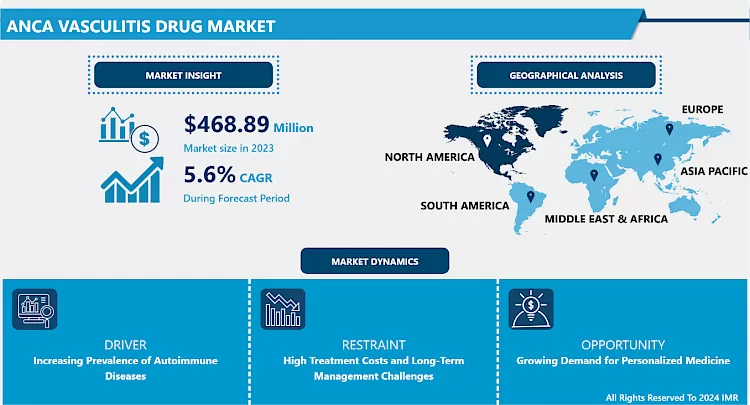
The Global ANCA Vasculitis Drug Market Size Was Valued at USD 468.89 Million in 2023 and is Projected to Reach USD 765.68 Million by 2032, Growing at a CAGR of 5.6% From 2024-2032.
Anti-neutrophil cytoplasmic antibody (ANCA)-associated vasculitis represents a group of rare, severe autoimmune diseases characterized by the inflammation and destruction of small-to-medium blood vessels. The ANCA Vasculitis Drug market focuses on the research, development, and commercialization of targeted therapeutic interventions designed to achieve rapid disease remission and prevent life-threatening organ damage. These medications, ranging from traditional immunosuppressants to cutting-edge biologics, are essential for managing complex conditions such as Granulomatosis with Polyangiitis (GPA) and Microscopic Polyangiitis (MPA).
The primary advantage of modern ANCA vasculitis drugs over traditional therapies lies in the development of "steroid-sparing" agents. For decades, high-dose corticosteroids were the standard of care, often resulting in debilitating side effects for patients. Modern therapeutics, specifically monoclonal antibodies and C5a receptor inhibitors, offer a more precise immunological approach that reduces the systemic toxic burden. Major industries and healthcare settings utilizing these drugs include specialized immunology clinics, nephrology departments, and hospital pharmacies. The rising prevalence of autoimmune disorders and significant improvements in diagnostic serology are the primary drivers of market expansion.
👉 To request a sample report:
https://introspectivemarketresearch.com/request/18543
Market Segmentation
The ANCA Vasculitis Drug Market is segmented into Drug Class, Disease Type, and Distribution Channel. By Drug Class, the market is categorized into (Biologics, Corticosteroids, Immunosuppressants, Complement Inhibitors). By Disease Type, the market is categorized into (Granulomatosis with Polyangiitis (GPA), Microscopic Polyangiitis (MPA), Eosinophilic Granulomatosis with Polyangiitis (EGPA)). By Distribution Channel, the market is categorized into (Hospital Pharmacies, Retail Pharmacies, Online Pharmacies).
Growth Driver
The principal growth driver for the ANCA Vasculitis Drug Market is the breakthrough in orphan drug development and the subsequent approval of targeted biologic therapies. Because ANCA-associated vasculitis is a rare disease, regulatory bodies like the FDA and EMA have provided incentives for pharmaceutical companies to develop "breakthrough" therapies. The introduction of B-cell depleting agents has fundamentally shifted the treatment paradigm, offering patients higher remission rates with fewer relapses compared to older cytotoxic treatments. This clinical shift toward specialized, high-value biologics, supported by favorable reimbursement policies for orphan drugs, is fueling consistent market value growth.
Market Opportunity
A major market opportunity lies in the advancement of oral small-molecule inhibitors that target specific inflammatory pathways, such as the complement system. While many current gold-standard treatments require intravenous infusions in a hospital setting, there is a significant unmet need for potent, oral alternatives that can be administered at home. Developing stable, oral formulations of complement inhibitors presents a high-growth niche, as they offer the potential to completely replace corticosteroids in induction and maintenance phases. Furthermore, the expansion of precision medicine through the use of genetic profiling to predict patient response to specific biologics offers a lucrative avenue for personalized therapeutic solutions.
Detailed Segmentation
Title: ANCA Vasculitis Drug Market Market, Segmentation The ANCA Vasculitis Drug Market is segmented on the basis of Drug Class, Disease Type, and Distribution Channel.
Drug Class
The Drug Class segment is further classified into Biologics, Corticosteroids, Immunosuppressants, and Complement Inhibitors. Among these, the Biologics sub-segment accounted for the highest market share in 2023. This dominance is driven by the widespread clinical success of monoclonal antibodies, which have become the preferred choice for both induction and maintenance of remission. Biologics provide a targeted mechanism of action that significantly reduces the risk of infection and long-term toxicity associated with broad-spectrum immunosuppressants. Their high efficacy in preventing relapses in GPA and MPA patients, combined with their premium pricing structure, ensures that Biologics remain the leading revenue generator in the global therapeutic landscape.
Disease Type
The Disease Type segment is further classified into Granulomatosis with Polyangiitis (GPA), Microscopic Polyangiitis (MPA), and Eosinophilic Granulomatosis with Polyangiitis (EGPA). Among these, the Granulomatosis with Polyangiitis (GPA) sub-segment accounted for the highest market share in 2023. GPA is the most prevalent form of the disease, requiring intensive and often lifelong pharmacological management to prevent respiratory and renal failure. The high volume of clinical trials focused specifically on GPA treatment protocols has led to a robust pipeline of approved drugs tailored to this condition. The necessity for chronic maintenance therapy in GPA patients creates a consistent demand for high-value specialty drugs, solidifying its position as the market's primary disease-focus area.
Some of The Leading or Active Market key Players Are-
Vifor Pharma (Switzerland) ChemoCentryx, Inc. (United States) Genentech, Inc. (United States) GlaxoSmithKline plc (United Kingdom) AstraZeneca (United Kingdom) Amgen Inc. (United States) Biogen Inc. (United States) Sanofi S.A. (France) Bristol-Myers Squibb Company (United States) Pfizer Inc. (United States) Takeda Pharmaceutical Company (Japan) AbbVie Inc. (United States) and other active players.
Key Industry Developments
In October 2023, Amgen Inc. successfully integrated the portfolio of ChemoCentryx, significantly expanding its footprint in the rare disease space with an FDA-approved oral C5a receptor inhibitor. This strategic move allows Amgen to offer a first-of-its-kind steroid-sparing treatment for GPA and MPA. The development represents a major shift in the market toward oral targeted therapies that simplify patient management and improve long-term outcomes.
In July 2024, GlaxoSmithKline received an expanded regulatory approval for its leading biologic in the treatment of pediatric patients with ANCA-associated vasculitis. This development addresses a critical unmet need in the smaller, highly specialized pediatric market. By providing a safe and effective biologic option for younger patients, GSK has strengthened its market position and expanded the reach of targeted immunology into the pediatric autoimmune sector.
Key Findings of the Study
· Dominant Segments: Biologics and Granulomatosis with Polyangiitis (GPA) therapy remain the largest market segments by revenue.
· Leading Regions: North America leads the market due to its advanced diagnostic infrastructure and strong adoption of high-cost orphan drugs.
· Key Growth Drivers: The shift toward targeted, steroid-sparing biologics and increased early-stage diagnostic accuracy are the primary catalysts.
· Market Trends: There is a significant industry focus on transitioning from intravenous to oral and subcutaneous drug delivery systems to enhance patient compliance.
🔍 𝐈𝐧-𝐃𝐞𝐩𝐭𝐡 𝐑𝐞𝐩𝐨𝐫𝐭:
https://introspectivemarketresearch.com/reports/anca-vasculitis-drug-market/
About Introspective Market Research
Introspective Market Research is a global provider of data-driven market intelligence and strategic advisory services. Our analysts and consultants deliver comprehensive reports, actionable insights and customized consulting to clients across chemicals & materials, healthcare, energy, environment, infrastructure, and advanced manufacturing sectors.
Media Contact:
Introspective Market Research.
Email: press@introspectivemarketresearch.com
Website: http://www.introspectivemarketresearch.com
Phone: +91-91753-37569

 English
 Arabic
 French
 Spanish
 Portuguese
 Deutsch
 Turkish
 Dutch
Dutch
 Italiano
 Russian
 Portuguese (Brazil)
 Greek
Greek