


Polar Bear Mom Adopts Cub – Only The 13th Known Case Of Adoption In 45 Years Of Study At Hudson Bay
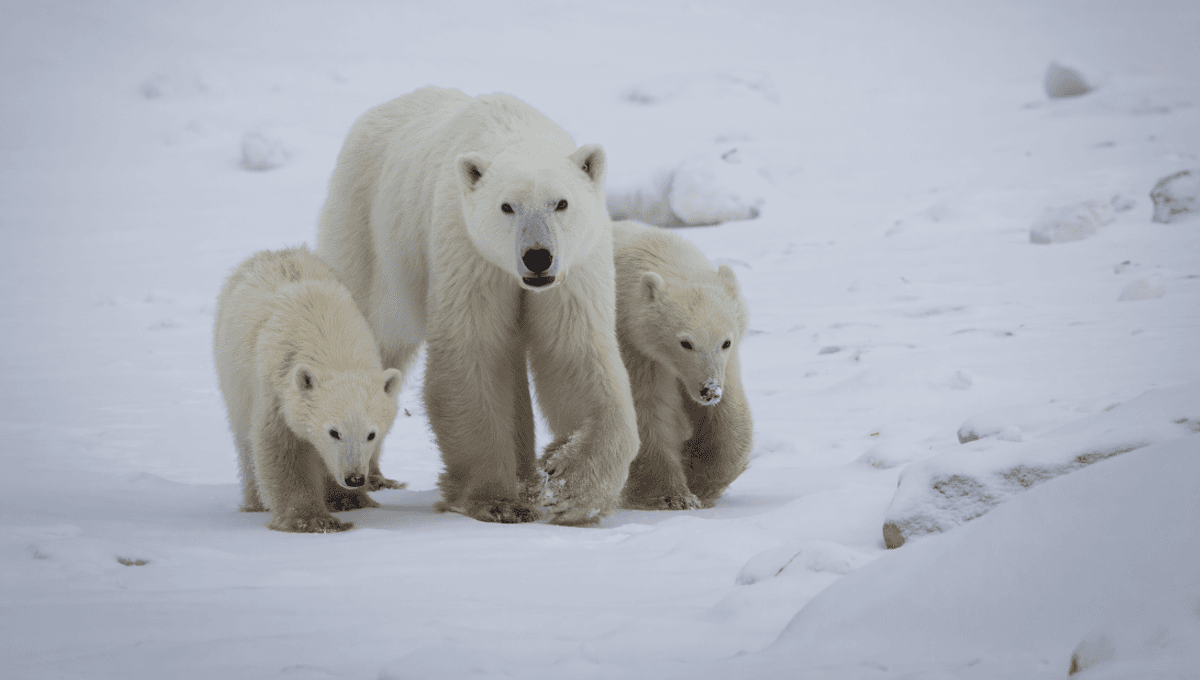
A Wild Polar Bear Has Adopted A Cub, Scientists Confirm – An Extraordinarily Rare (And Adorable) Behavior
A wild female polar bear in Canada’s Churchill, Manitoba, had been observed and captured on camera with an adopted cub that is not her own. Adoption among polar bears isn’t unheard of, but it is extremely rare, and it’s even rarer still for scientists to identify and film the adopted polar bear family.
The rest of this article is behind a paywall. Please sign in or subscribe to access the full content. The mother is a bear known as bear X33991, and she’s a part of the Western Hudson Bay subpopulation of polar bears in this part of the world. To date, this marks only the 13th known case of adoption among the 4,600 bears that live here, which have been studied for the last 45 years. When bear X33991 came out of her maternity den in spring 2025, she had just one cub that was tagged by scientists. You can understand their confusion, then, when she was spotted again in fall 2025 with two cubs in tow – one with a tag, and one without. It’s not known what happened to the adopted cub's biological mother. In some cases, the mothers of adopted cubs are found to be still alive. This is what’s known as “switching of litters”, where cubs go from one mother to another without being orphaned. Scientists are now analyzing genetic samples from the adopted cub to see if its mother is known to them. Raising a cub is energetically expensive for polar bear moms, which raises the question: why bother? It’s a particularly perplexing behavior for animals that are typically solitary, but they are fierce moms. “Female polar bears are really good moms and so they're just primed for looking after and caring for their offspring and you know we kind of think if there's a little cub that's bawling on the coast and has lost its mother these females just can't help themselves but to take them on and look after them so it's a really curious behavior and an interesting aspect of polar bear life history,” said Dr Evan Richardson, Polar Bear Research Scientist, Environment and Climate Change Canada, in a statement emailed to IFLScience. Whether this kind of adoption actually constitutes altruism is debatable, however. A 2015 study on polar bear adoption noted that while adaptive explanations – such as kin selection, reciprocal altruism, milk evacuation, or gaining parental experience – have been proposed, adoption may instead “simply be the result of error,” particularly when a female is hormonally or behaviorally primed, as Richardson said, to provide care while raising her own cub. Motivations aside, one thing we know for certain is that this adopted cub is very fortunate to have found itself a new family. “The survival rate for cubs to make it to adulthood is not great,” said Alysa McCall, Director of Conservation Outreach and Staff Scientist, Polar Bears International. “It's around 50 % give or take depending on the year. But we know that if a little cub has no mom, it has almost no chance.” “So, the fact that this cub got adopted and has a chance to learn lessons about being a bear and to be taken care of for a couple of years really does give it a shot at making it to adulthood.” Good luck, bear X33991! Accidental polar bear mom of the year.

 English
 Arabic
 French
 Portuguese
 Deutsch
 Turkish
 Dutch
Dutch
 Italiano
 Russian
 Romaian
 Portuguese (Brazil)
 Greek
Greek