


This year was all about AI. Next year? AI robots.
By

Timothy Beck Werth
Tech Editor
Timothy Beck Werth is the Tech Editor at Mashable, where he leads coverage and assignments for the Tech and Shopping verticals. Tim has over 15 years of experience as a journalist and editor, and he has particular experience covering and testing consumer technology, smart home gadgets, and men’s grooming and style products. Previously, he was the Managing Editor and then Site Director of SPY.com, a men's product review and lifestyle website. As a writer for GQ, he covered everything from bull-riding competitions to the best Legos for adults, and he’s also contributed to publications such as The Daily Beast, Gear Patrol, and The Awl.
on

Credit: Getty Images / China News Service
As Mashable's new tech editor, I get paid to stay on top of the latest tech trends, and I love my job. A lot happened in the tech world this year, but one technology dominated headlines more than any other — artificial intelligence. Companies like Google, OpenAI, and Anthropic made big advances in AI this year (though not as big as they might have hoped), both for better and worse. Not only that, but AI is now being integrated into virtually every tech product we own, even if you wish it wouldn't.
So, what are the 2026 tech trends I'm eyeing as we approach the new year? Yes, generative AI and large-language models will continue to take up a lot of oxygen in the tech world, even if — and maybe especially if — the AI bubble finally pops, like the Dot Com bubble before it.
Besides AI, you can look forward to exciting new foldable phones with more flexible displays. I also expect a lot of robots to enter the consumer market next year, as well as all the usual suspects from Apple, Samsung, Google, and Microsoft. Let's get out our crystal balls and smart AR/XR glasses and preview the tech trends to come in 2026.
Smart glasses and the return of the Google Glasshole
It's getting hard to remember what Mark Zuckerberg looked like before he started wearing Meta Ray-Ban smart glasses at all of his public appearances. Like a lot of Silicon Valley leaders, Zuck is all-in on smart glasses, and virtually every big tech company is working on its own version of Meta's Ray-Ban Display augmented-reality glasses. Samsung, Apple, and Google are all rumored or confirmed to be making smart glasses, and we also saw the launch of the Xreal One Pro AR glasses earlier this year.
I expect more smart AR glasses to launch next year, but even though Silicon Valley is convinced these gadgets are the future of personal computing, I'm not so sure. Zuck couldn't have been more wrong about the metaverse. Even people who need to wear glasses for vision correction often do so reluctantly, and there's a reason face-worn computers have so far failed to launch. On top of that, a lot of people just don't want every single interaction potentially recorded by a person wearing smart glasses with built-in cameras and microphones. The Google Glasshole was reviled for a reason.

Mark Zuckerberg wears Meta Ray-Ban Display AI glasses at the Meta Connect event. Credit: David Paul Morris/Bloomberg via Getty Images
This might be a generational divide. Young people raised on smartphones and social media may not share my discomfort with the surveillance culture that would follow widespread smart glasses adoption. But I think Silicon Valley is facing an uphill battle here.
Foldable phones will enter the mainstream
Foldable phones are no longer a novelty. They've been a reality of the smartphone market for years, and the early problems with these devices have mostly been ironed out. The Motorola Razr Ultra is a folding flip phone with a satisfying snap and killer battery life, and the new Galaxy Z Fold 7 is insanely thin. Yet the foldable market has been waiting for a latecomer to join the party — Apple.

Forget about the folding phone; get ready for the tri-folding phone. Credit: Joe Maldonado / Mashable
I expect the iPhone Fold to finally make its debut in 2026, and if anything can push foldables into the mainstream, it's Apple. These phones are also getting much better in general, and 2025 was the year I was finally convinced these devices are ready for primetime. If 2025 was the year of the ultra-thin phone (and it was), then expect 2026 to be the year of foldable phones, especially with both the iPhone Fold and Samsung's upcoming Galaxy TriFold coming soon.
AI will keep improving, but true AGI will remain out of reach
AGI, or artificial general intelligence, is the holy grail of the AI industry. AGI refers to a hypothetical AI system that has the full intellectual capabilities of a human. Put another way, it would be capable of performing most jobs without supervision. That's the end goal, and the reason why billions of dollars — trillions by some estimates — are being invested into unsustainable AI companies.
A lot of AI skeptics would like to believe that AI boosters are con artists and hucksters, and that AI chatbots are just a flash in the pan like NFTs. But the truth is, many of the people who work at companies like OpenAI have an almost religious faith that true AGI is just over the horizon. They're true believers. Yet these same AI companies no longer seem to be making the exponential advances in intelligence and computing power that suggest AGI is imminent. OpenAI spent years cooking GPT-5, but when it was released this year, it was widely seen as a disappointment.
I have no doubt that Google, OpenAI, Anthropic, Deepseek, and other companies will continue to improve their models. But I also see no concrete evidence that AGI is close, and AI experts like Gary Marcus question whether large-language models are even capable of that level of intelligence, no matter how many data centers you build.
This Tweet is currently unavailable. It might be loading or has been removed.
So, in 2026, expect AGI to exist in the realm of science fiction, not science fact — though not for lack of effort or funding.
Apple will be in rebuilding mode

iPhone 17 Pro Max phones on display at Apple HQ earlier this year. Credit: CNET
Apple released a lot of new products this year. In September, we saw the usual iPhone launch event, which delivered the newest iPhone generation, new AirPods Pro, and an ultra-thin phone called the iPhone Air. Soon after, the company released a new MacBook Pro, iPad Pro, and Vision Pro with the M5 chip.
But despite all these releases, I can't help but feel that Apple is on the back foot in 2025. The iPhone Air made no impression on the market. The new M5 devices are almost identical to last year's models. The most exciting phones of the year came not from Apple but from Samsung and Chinese companies like OnePlus and Xiaomi. Just check out the new Xiaomi 17 Pro Max, which boasts Leica cameras and a rear display.
Mashable Light Speed
This Tweet is currently unavailable. It might be loading or has been removed.
While I personally liked Liquid Glass and iOS 26, a lot of design-heads hate it, and it's much more of a makeover than a true innovation. The company is still playing catch-up to its rivals with foldable phones and AI technology. The company is also shedding executives in droves. And I could keep going.
Yes, Apple will likely release a foldable in 2026, and the AI-powered Siri might make its grand debut, but I think the company is in a rebuilding phase at the moment. Lately, Apple hasn't quite seemed like its old, sexy self.
More humanoid robots will go on sale

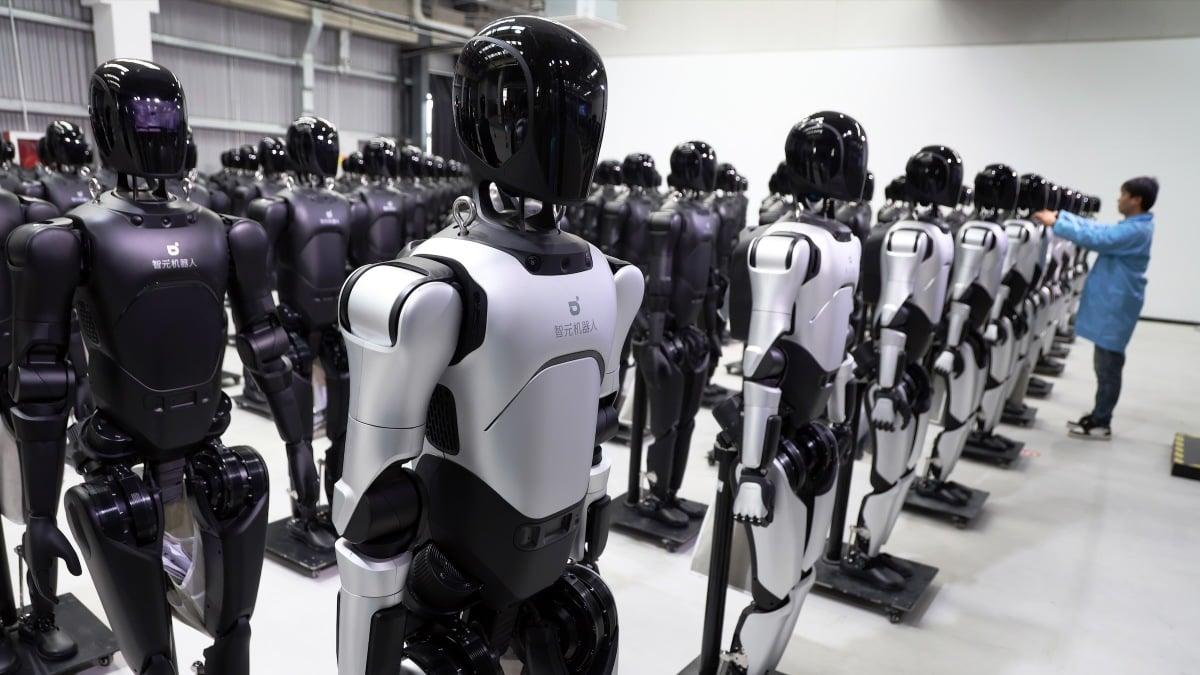
An engineer inspects humanoid robots at the AgiBot factory in China. Credit: Tang Yanjun/China News Service/VCG via Getty Images
We saw a lot of viral videos featuring humanoid robots this year, from a popcorn-serving Optimus bot at the Tesla diner to the Westworld-like Origin M1 from Chinese robotics company AheadForm. I still believe that the human body is a terrible blueprint for robots (just look to Moravec's Paradox), but something about anthropomorphized robots just hits different.
This year, a company called 1X opened up pre-orders for NEO, a humanoid household helper bot. Tesla may also start selling its Optimus robot next year (emphasis on may), and other companies are racing to get humanoid robots to market.
AI robots will be a major trend to watch
This is more of an offshoot of the previous trend, but I expect AI-powered robots to make waves in 2026. By leveraging the latest large-language models and computer vision technology, robotics companies will be able to make robots that respond more naturally to human input. Imagine robots that can mirror your facial expressions or hold a conversation with you. Don't expect these more advanced robots to appear in your home just yet, but at events like CES 2026, I expect to see some really cool new bots next year.
Physical AI companions for kids and lonely adults

The Fourier GR-3 companion robot by Fourier-Robotics on display in Shanghai. Credit: Hector RETAMAL / AFP via Getty Images
Virtual AI companions were a major trend this year. Sometimes, disturbingly so. This was the year we learned just how many people have developed emotional reliance on AI chatbots, whether in the form of ChatGPT or fictional companions in apps like Character.ai. Many experts we talked to this year warned that AI companions can be dangerous for young people, in particular. But that's not what I'm talking about here.
We saw the first real wave of AI-powered toys in 2025, some of which lacked proper safety guardrails. But we already know of at least one new AI companion debuting at CES 2026, and both AI and robotics companies across the world are designing physical companion bots that can interact with you, talk to you, and, in theory, comfort you.
This Tweet is currently unavailable. It might be loading or has been removed.
If it sounds like I'm talking about sex robots, I promise that's not what I mean. However, in the same way that AGI is the holy grail of the AI industry, I strongly suspect that functional sex robots are the holy grail for many robotics engineers and their investors.
The era of iterative improvements will continue
Here's a trend I'm not excited about, because it's literally impossible to get excited about it. All the major consumer tech launches of 2025 were a painful reminder that we're living in an era of iterative improvements. As Big Tech companies stick to highly competitive annual release schedules, we keep getting new phones, tablets, smartwatches, and laptops that make only very marginal improvements over last year's models. Yes, the Apple Watch Ultra 3 has a longer battery life, but you get 99% of the same features with the Ultra 2.

The Sony XM5 and XM6 headphones have very similar specs. Credit: Mark Stetson / Mashable
This trend also affects headphones, earbuds, and TVs, which seem to be about as good as they're going to get. We're fast approaching the point where the human eye can't even detect the improvements in display technology. Or, take the long-awaited Sony XM6 noise-cancelling headphones, which were years in the making. I praised these Sony headphones in my review, but they're pretty much the same headphones as the XM5s. They have improved active noise cancellation, but also a much higher price tag.
And speaking of higher price tags...
Laptops and smartphones will get even more expensive
All signs point to big price increases in the laptop market next year, and you can thank the AI industry. Samsung is reportedly doubling the price of DDR5 memory drives (this is the RAM in your laptop, essentially). So, any laptops that use these Samsung components will likely be more expensive. Framework recently raised prices on these exact components by 50 percent. HP, Dell, and Lenovo are all warning of imminent price increases. And that's on top of inflation-related price adjustments from earlier this year.
We're living in fun times, aren't we?
This Tweet is currently unavailable. It might be loading or has been removed.
In fact, we're in the midst of a worldwide memory shortage, as AI data centers hoover up computing components also needed for smartphones and laptops.
AI commercials will become much more common
This Tweet is currently unavailable. It might be loading or has been removed.
As I've written before, even the smallest whiff of AI in movie-making is enough to send many artists into a rage. Whenever a filmmaker (or studio marketing department) utilizes generative AI, even for minor background details, creative professionals revolt. I share their concerns. No one wants to have their job taken by a robot — especially if that robot has been trained on your work without permission or payment.
Yet for all the backlash from creatives, I'm not convinced Hollywood or Madison Avenue really cares. We've already seen major companies like McDonald's, the NFL, and Coca-Cola release AI commercials in 2025. AI videos and "actors" are now common sights in YouTube ads. And I suspect a lot more commercials and advertisements are already using AI than people realize.
As companies like Google and LumaAI continue to improve their cinematic AI video models, expect both more AI slop and more professional AI video production. I'm not saying it's a good thing, but I think AI in movies and advertising is a train that can't be stopped.
This article reflects the opinions of the author.
Disclosure: Ziff Davis, Mashable’s parent company, in April filed a lawsuit against OpenAI, alleging it infringed Ziff Davis copyrights in training and operating its AI systems.

Timothy Beck Werth is the Tech Editor at Mashable, where he leads coverage and assignments for the Tech and Shopping verticals. Tim has over 15 years of experience as a journalist and editor, and he has particular experience covering and testing consumer technology, smart home gadgets, and men’s grooming and style products. Previously, he was the Managing Editor and then Site Director of SPY.com, a men's product review and lifestyle website. As a writer for GQ, he covered everything from bull-riding competitions to the best Legos for adults, and he’s also contributed to publications such as The Daily Beast, Gear Patrol, and The Awl.
Tim studied print journalism at the University of Southern California. He currently splits his time between Brooklyn, NY and Charleston, SC. He's currently working on his second novel, a science-fiction book.


 English
 Arabic
 French
 Spanish
 Portuguese
 Deutsch
 Turkish
 Dutch
Dutch
 Italiano
 Romaian
 Portuguese (Brazil)
 Greek
Greek