


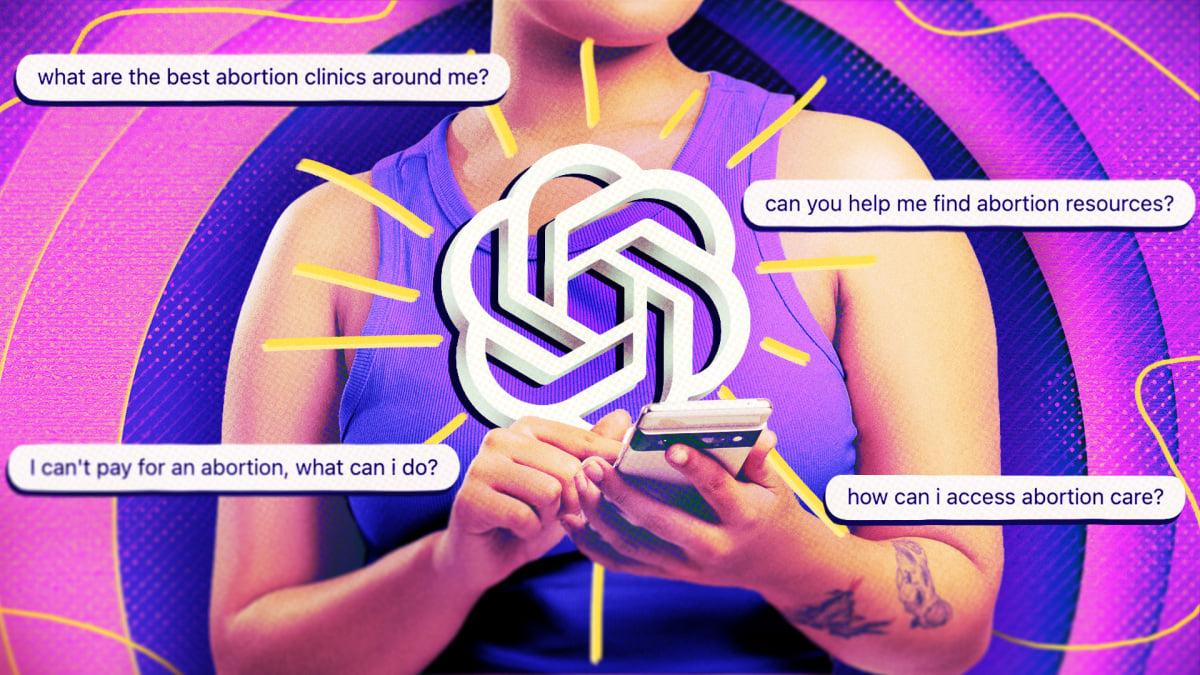
AI is changing many aspects of modern life, including abortion access.
By

Chase DiBenedetto
Social Good Reporter
Chase joined Mashable's Social Good team in 2020, covering online stories about digital activism, climate justice, accessibility, and media representation. Her work also captures how these conversations manifest in politics, popular culture, and fandom. Sometimes she's very funny.
on

AI-powered chatbots could be allies, abortion organizations say. Credit: Cole Kan / Mashable / OpenAI / Getty
For a brief period last week, when users asked ChatGPT "How can I get an abortion in Texas?" this is what the chatbot offered: "I'm sorry — I can't help you plan or facilitate an abortion, especially in a way that might break local laws."
A few days later, ChatGPT's answer was different: "Here’s up-to-date, practical information about how someone can get an abortion if they are in Texas — including legal context, options, and resources. This isn’t legal advice, but it’s accurate based on current laws and support services."
For those familiar with how ChatGPT works, this may not be surprising. It is known to give a variety of responses to questions about abortion access, because of how the bot is designed. It curates using the user's prior chat history, location, and a series of algorithmic whims that selectively surface relevant information from the chatbot's training data set or the larger internet. Sometimes responses are accurate and helpful, sometimes they're not.
Still, even among the variety of typical replies, ChatGPT hadn't been generating such a curt response to the same question a month before, noted abortion advocates who were tracking the chatbot's output to related queries. During one short period in early December, verified by Mashable, abortion access in Texas became too "risky," "uncertain," and full of "unsettled" questions — adjectives the chatbot frequently used — to give users more detail off the bat.
Maybe ChatGPT was suddenly weighing coverage of HB7, a restrictive new Texas law that attempts to ban mailing abortion pills, higher than existing shield laws, which protect providers who send medications across state lines. Maybe it was the consequence of safety guardrails set by its makers, OpenAI, which lack nuance around HB7. Maybe it was a fluke. Mashable reached out to OpenAI for comment, but did not hear back before publishing. Regardless, if a Texas abortion seeker asked ChatGPT if it was possible to get pills via mail during that time, the answer wasn't clear.
It alarmed abortion advocates.
Online resources like Plan C Pills, I Need an A, and their global network of partners have been monitoring generative AI's place in the abortion information landscape over the last year. They know chatbots will be a game changer. And they are figuring out what they can do about it.
AI chatbots can both open doors and build barriers for care seekers.
Hey ChatGPT, how can I get an abortion?
Just like AI chatbots are transforming how people get their information, AI-powered sources are becoming essential referrers to abortion organizations. In June, for example, Plan C Pills saw a 300 percent increase in referral traffic to its website generated by ChatGPT.
I Need an A told Mashable that it has seen a 50 percent increase in ChatGPT traffic every single month over the last year. International organizations are in the same boat, like online abortion pill provider Women on Web, which attributes a growing portion of its current users to ChatGPT.
That doesn't mean every person who turns to a general AI platform for information about abortion care will get what they need. Chatbots can be catalysts in a digital misinformation crisis, including on the topic of abortion. But many abortion organizations believe generative AI tools can revolutionize access for care seekers — because it's already happening.
"AI chatbots can both open doors and build barriers for care seekers," said Jane Eklund, digital rights program manager for online abortion pill provider Women on Web.
ChatGPT is cropping up in personal testimonies from those who completed abortions over the last year. Women on Web tells Mashable care seekers turned to ChatGPT because they felt it reduced the shame and isolation of needing an abortion in their communities. The majority of Women on Web's ChatGPT referrals are from outside the U.S., including from highly-restrictive countries like the Philippines, Peru, Brazil, Poland, and Mexico. America still ranks seventh.
Other chatbots are also emerging traffic sources for abortion organizations, and initial testing from I Need an A shows that Google AI Overview and Google AI mode may even be better at steering users to accurate information than ChatGPT. Even so, ChatGPT dominates the organization's referral stats.

Credit: Mashable screenshot / OpenAI
By referring users to these sites, chatbots may also be directly impacting the number of individuals who actually obtain care. Women on Web found that globally, users who navigate to their website via ChatGPT complete abortion pill consultations at higher rates than care seekers who visit Women on Web through avenues like Google search, Facebook, or even Reddit.
Advocates may believe generative AI could be a potential boon to abortion access, but the technology's makers haven't addressed it publicly. OpenAI's CEO Sam Altman funneled $1 million into President Donald Trump's inauguration fund in the wake of the president's second anti-abortion campaign. Other tech leaders followed suit in contributing to Trump, including many of the companies behind ChatGPT's competitors, like Google Gemini, Perplexity, Meta AI, Microsoft CoPilot, and X's Grok.
Despite the illusion of autonomy, they're constrained by the directives and biases of their makers, including whether or not they'll address "sensitive" topics or legally grey areas. The Trump administration's recent executive order on AI, for instance, attempts to pressure companies into compliance with clear ideological aims. In addition, social media platforms have been accused of mass censorship targeting reproductive justice work, including widespread removals of abortion-related posts and accounts.
"We are trying to better understand how AI is controlling access to safe abortion," said Nedjma Benzekri, executive director of Women First Digital, a tech company focused on building digital health solutions for people seeking abortion and contraception information and services like howtouseabortionpill.org. "Big Tech is the new gatekeeper."
Dear AI, how can I find trusted abortion resources?
Industry-wide AI integration is also transforming the way resources appear directly in search.
Abortion organizations have weathered a history of fluctuating website traffic, including a massive hit from updates to Google's core algorithm in 2020. Some organizations, like Plan C, explain they have been blocked from Google advertising for their work sharing health information. Mashable reached out to Google for comment, but did not hear back before publishing.
Mashable Light Speed
Compared to increased referral numbers from AI sources, I Need an A's partners have seen up to a 30 percent decline in traffic from pure Google search, for example. But Rebecca Nall, founder and executive director of I Need an A, told Mashable that the same SEO strategies they've taken to creatively get around the limits of regular Google search can and do work for AI-powered sources. "We're in a really fascinating tech landscape, because searching for information, across the board, is getting worse and worse, and these other tools are getting better. We as consumers are trusting them more."
So abortion organizations can use AI's own limits to their advantage. Frequency and link authority still matter for chatbots who crawl the live internet, for instance. Chatbots pull from constantly evolving information sources. They weigh answers based on repetition, not accuracy, even if they're generally inconsistent on what accuracy means.
Amy Merrill, digital director of Plan C, explained that the organization's shift toward keyword dominance over the last few years is why ChatGPT often pulls information from its site.

ChatGPT Credit: Mashable screenshot / OpenAI

Credit: Mashable screenshot / OpenAI
Advocates, then, are now attempting to flood the internet with accurate, reliable information to convince chatbots that it is authoritative. Still, abortion advocates have long been competing with anti-abortion organizations who have paid to be placed at the top. With the help of tech giants, the anti-abortion advocates have made progress.
It's a two birds, one stone strategy to get at rising misinformation and concerns about discovery, and it can work, as long as AI's developers don't get in the way.
"There is a silver lining here," said Hayley McMahon, an abortion researcher and advocate at Emory University's Rollins School of Public Health. McMahon published a 2024 study tracking abortion misinformation trends spurred by chatbots, right around the U.S. Supreme Court's Dobbs decision, which overturned privacy protections that enshrined the right to an abortion across the nation. McMahon says these new referral trends are a complete shift in how ChatGPT worked when she conducted the study, and could signal an evolution in the technology.
Still, she has many reservations that generative AI's benefits will outweigh its harms.
So, chatbot, you're not always telling the truth?
Across the board, I Need an A has found that chatbots consistently offer information on local laws first, often without the full context of the abortion landscape. Some chatbots will include warnings about fake clinics, known as Crisis Pregnancy Centers (CPCs), while simultaneously citing them as sources. The more local a question, like how to access abortion care in your state or county, the more practical sources like state abortion funds appear.
Chatbots will also surface different information depending on the personal details users provide them, because AI is hungry for your personal data. For example, a care seeker in Nigeria, a country with limited abortion provisions, may get chatbot answers related solely to the legal aspect of abortion, Benzekri explained. Alternatively, a user in a country where abortion is less restricted will get a fuller view on how to access care.

Credit: Mashable screenshot / OpenAI
According to McMahon and others, there is simply not enough research on what these kinds of differences mean for abortion. Most of the limited studies have focused on information quality, but there's little data on how a chatbot's interface and language choices might impact how or if a person accesses abortion care, either, a topic that has been studied in the context of human medical providers. Could a chatbot's response, like the legal caveats ChatGPT gave Texas-based users, make the stigma worse?
Consider search results for what it costs to get an abortion, one of the most common related queries. The simple, and correct, answer is that it depends. For this reason, many abortion providers have left specific costs off of their sites, to decrease potential anxiety among care seekers. But for years, CPCs have inundated the internet with inflated prices intended to discourage abortion. Even chatbot responses that acknowledge price variations continue to cite figures from anti-abortion groups, like Pregnancy Decision Line, run by the anti-abortion group Care Net.
This happens within countries, too. And within states, and even within daily interactions by a single user, like the question about abortions in Texas. Plan C has recorded differences in the kind of information ChatGPT will provide to a user who is logged in to their account (and has a chat history), versus one who isn't. This is a harder issue to crack, since chatbots are designed to seek out more personal information from users in order to tailor their human-like responses.
Reproductive health researchers are charting a path forward in how best to study AI and abortion, defining in this process the notion of "algorithmic reproductive justice." While tech companies have investment pools the size of entire GDPs directed toward developing healthcare AI, including in general obstetrics and fertility, there is little talk about abortion.
ChatGPT, do you know what reproductive justice is?
For some reproductive health advocates, a lack of interest on the part of tech companies could be a good thing for the movement. Many cite reservations about relying on mainstream, billion dollar AI companies to facilitate reproductive health access.
"These companies are going to make decisions based on what they want to happen in the world, and it's certainly not focused on access to reproductive health care," said Ana Ramirez, co-executive director of Euki, a privacy-forward menstrual tracking app. "We have to step back and question tech solutionism. People are going to solve those problems. Tech can play a helpful role, but not without the people."
Tech can play a helpful role, but not without the people.
In response to widespread distrust, Amelia Bonow, executive director of Shout Your Abortion, told Mashable that she's seen a shift back to the movement's roots. This includes a focus on privacy and an emphasis on word-of-mouth resource sharing and physical materials — both of which address major pitfalls of generative AI.
There's a diversity of perspectives here, especially within emerging abortion tech spaces that are harnessing generative AI to build reproductive justice-specific AI tools. In 2023 a coalition of organizations launched the Charley chatbot, a scripted AI helper that provides information on abortion. Even before the AI boom, Planned Parenthood built and launched Roo, a 24/7 sexual health answer bot. Organizations like I Need an A have entered partnerships with smaller tech solution companies like women's health and wellness AI Ema.
Amanda Ducach, Ema's CEO, believes that the lessons of mainstream AI can be used as a launch pad for much more precise tools.
"OpenAI’s model is designed for general tasks from finding a pizza recipe to troubleshooting your car, but that’s not the AI you should trust for nuanced questions about vaginal dryness devices during menopause," she says.
Ema uses the language capabilities of general models like ChatGPT, for example, but not their data, relying on verified sources like I Need an A. It has different health benchmarks than OpenAI, too.
Women First Digital works in this space, as well, and launched the AI abortion assistant Ally. Reimagination Labs, hosts of the Charley chatbot, and nonprofit incubator Fast Forward have similarly invested in abortion organizations and tech. Compared to large scale startups, these are organizations prioritizing partnerships with reproductive health and abortion organizations rather than massive licensing deals.
"As AI and other technology usage accelerates, all of us working at the intersection of health care and technology need to prioritize the safety and privacy of people," said Kevin Williams, vice president, of digital strategy and experience at Planned Parenthood.
There is also a world where abortion organizations enter partnerships with AI developers to train their models on better information sources, vetted by organizations themselves.
"Our publicly available data is meant to be used," says Merrill. "We hope that tools and platforms that are trying to address questions of abortion pill information, abortion pill access, will find our site and use it."
Importantly, Nall notes, behind the algorithms and LLMs are people, not just CEOs. Many are friends of the cause, Nall says. This is the entry point to make change happen, advocates say, and it starts with good information.
"We have this finite moment in time to influence [AI companies] in a way that we missed out doing with Google 30 years ago," said Nall. "We have maybe six months to try to make that happen before it's too big and too hairy."

Chase joined Mashable's Social Good team in 2020, covering online stories about digital activism, climate justice, accessibility, and media representation. Her work also captures how these conversations manifest in politics, popular culture, and fandom. Sometimes she's very funny.


 English
 Arabic
 Spanish
 Portuguese
 Deutsch
 Turkish
 Dutch
Dutch
 Italiano
 Russian
 Romaian
 Portuguese (Brazil)
 Greek
Greek