


First-Ever Footage of A Squid Disguising Itself On Seafloor 4,100 Meters Below Surface
Watch An Unknown Species Of Squid Perform A Bizarre Mud-Burying Behavior Not Seen Before In The Deep Sea
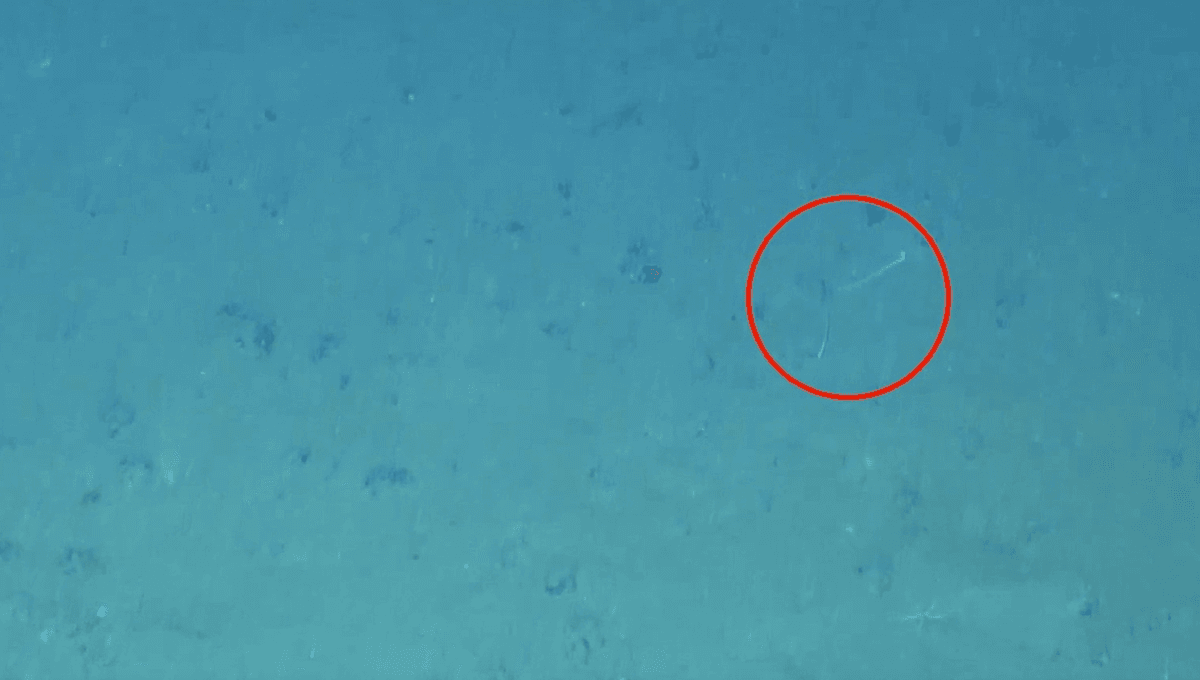
At 4,100 meters (13,450 feet) beneath the ocean’s surface, scientists witnessed a never-before-seen behavior in a deep-sea cephalopod: an unknown species of whiplash squid burying its head into the muddy seabed with its tentacles rigidly poking out like chopsticks.
The rest of this article is behind a paywall. Please sign in or subscribe to access the full content. The researchers can only speculate on the purpose of this mysterious behavior in an undescribed species, but they believe it might have something to do with camouflage, allowing the squid to blend in with common seafloor objects like sponge stalks or worm tubes to avoid the prying eyes of predators. Alternatively, the buried squid could be setting a trap, luring unsuspecting crustaceans close enough to snatch as prey. This kind of stealth isn’t entirely surprising for a cephalopod. Octopuses and cuttlefish are renowned masters of disguise, shifting shape and color to avoid detection. Even some open-ocean squids exhibit similar behaviors. Still, this is the first time such head-burying has been documented in a deep-sea cephalopod. “This study unveils mud-covering, masquerade, and aggressive mimicry behaviors that were previously undocumented for deep-sea Cephalopoda," the study authors write in their study. “We hypothesize that this behavior constitutes a camouflage that combines masquerade and aggressive mimicry as biological substrate, which is also novel for this charismatic taxon." The behaviour was filmed using a remotely operated sub in the heart of the Pacific Ocean as part of the SMARTEX project, a scientific expedition to study how deep-sea mining might affect marine life. It’s focusing on the Clarion-Clipperton Zone, a deep-sea plain in the Northeastern Pacific that’s being eyed up for mining companies because of its abundance of rare minerals. The risks of this deep-sea mining are still being weighed up. Projects like SMARTEX aim to determine not only how such activities might impact surrounding ecosystems, but also how long recovery could take and how far-reaching the consequences may be. As this observation shows, scientists still know very little about how life operates in the abyss. However, far from being a barren wasteland of darkness and simplicity, it suggests this is a realm that’s brimming with complex life that we are yet to understand. The squid’s drive to hide also suggests that life here may be even more elusive and abundant than previously thought, hinting that we may have underestimated the richness of this ecosystem. “Our discovery also demonstrates how little we still know about the diversity, distribution, and life history of abyssal taxa, particularly in the Northeast Pacific, where most of our knowledge solely stems from seabed imagery surveys,” the study concludes. “Moreover, the ability to self-disguise helps explain the scarcity of squid sightings and suggests that current abundance and richness may be underestimated and that sedimentary structure could influence their distribution." The new study is published in the journal Ecology.

 English
 Arabic
 French
 Spanish
 Portuguese
 Deutsch
 Turkish
 Dutch
Dutch
 Italiano
 Russian
 Romaian
 Portuguese (Brazil)