


Bio-Hybrid Robots Made Of Dead Lobsters Are The Latest Breakthrough In "Necrobotics"
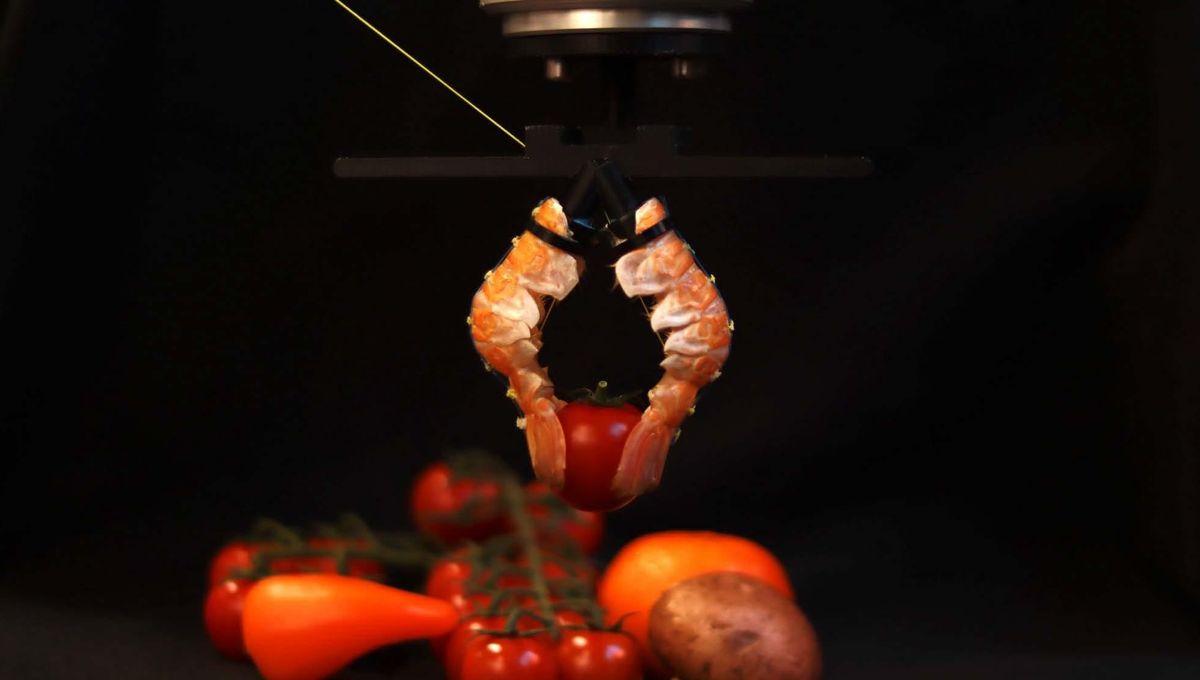
Watch Left-Over Seafood Turn Into A Surprisingly Nimble Robot
“Necrobotics” is a ghoulishly named field of research that uses the bodies of dead animals as robot parts. In the latest step toward creating the walking dead, researchers at EPFL in Switzerland have turned leftover crustacean tails into surprisingly effective robots.
The rest of this article is behind a paywall. Please sign in or subscribe to access the full content. The engineers began by collecting the exoskeletons of langoustine (small lobsters also known as scampi or Dublin Bay prawns) that had been destined for the dinner plate. Made of a highly mineralized and intricately structured material called chitin, the organic structures are ideal for robotics because they are tough, slow to biodegrade, and beautifully formed to make complex movements. “Exoskeletons combine mineralized shells with joint membranes, providing a balance of rigidity and flexibility that allows their segments to move independently. These features enable crustaceans’ rapid, high-torque movements in water, but they can also be very useful for robotics,” Josie Hughes, leader of EPFL’s CREATE Lab, said in a statement. Discarded exoskeletons have the added advantage of being a sustainable material. Instead of being crafted from a pricey, rare mineral, the robot is fashioned out of something that would have usually ended up in the trash – just be sure to give it a good wash before use. “By repurposing food waste, we propose a sustainable cyclic design process in which materials can be recycled and adapted for new tasks,” commented Hughes. The exoskeletons were fitted with specialized elastic components that acted like tendons, along with a motorized base that powered the movement. A finely tuned mechanism allowed the system to contract and relax, just like a real muscle, giving the robotic claw a surprisingly lifelike movement (despite being very dead). To demonstrate its potential, langoustine tails were transformed into a robotic gripper capable of picking up objects weighing up to 500 grams (1.1 pounds). It proved surprisingly nimble, able to grasp a variety of items, from a thin pen to a juicy tomato. Another “necrobot” was crafted into a swimming robot with two flapping “fins” that were able to propel through water at speeds of up to 11 centimeters per second (0.2 miles per hour). “To our knowledge, we are the first to propose a proof of concept to integrate food waste into a robotic system that combines sustainable design with reuse and recycling,” added Sareum Kim, first author and researcher at the CREATE Lab. The experiments suggested that this novel approach may be more effective – and certainly simpler to design – than conventional robotics made from metal and plastic. After all, why tinker with a “design” that natural selection has been fine-tuning for millions of years? “Although nature does not necessarily provide the optimal form, it still outperforms many artificial systems and offers valuable insights for designing functional machines based on elegant principles,” Hughes said. These are not the first animals to be resurrected as necrobots. Back in 2022, researchers at Rice University transformed curled-up dead spiders into robotic grippers – and it’s just as creepy as you'd hope. The study is published in the journal Advanced Science.

 English
 Arabic
 French
 Portuguese
 Deutsch
 Turkish
 Dutch
Dutch
 Italiano
 Russian
 Romaian
 Portuguese (Brazil)
 Greek
Greek