


Why Is The Head On Beer Often White, When Beer Itself Isn't?
Why Is The Head On Beer Often White, When Beer Itself Isn't?
If you've ever drunk a glass, schooner, or, more properly, pint of beer, at some point you may have wondered why the head of the beer appears so much lighter than the beer itself.
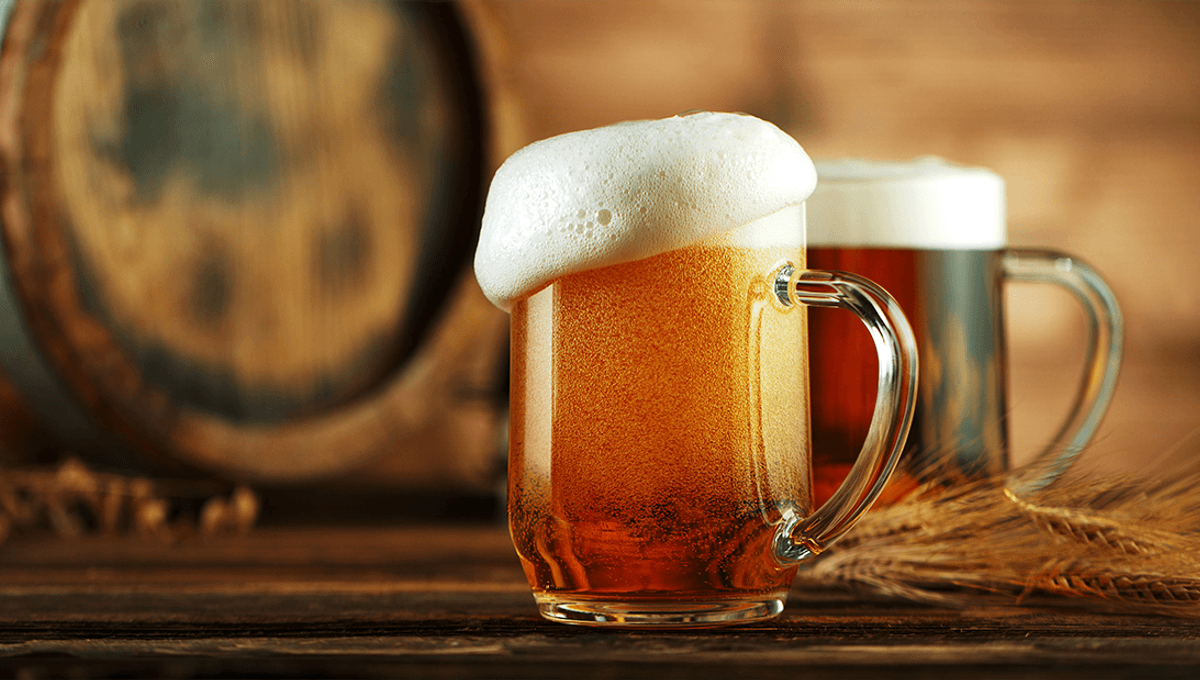
The rest of this article is behind a paywall. Please sign in or subscribe to access the full content. While beers vary and maltier, darker heads are possible, as a general rule the foam is lighter than the drink itself, and often looks white. This is despite the amber, or even dark brown/black appearance of the beer (or, to fend off the beer fanbase, stout, ales, pilsners, lagers etc etc). So why is this? First up, what gives beer their usual colors? That is the result of caramelization, or the breaking down of sugars and reformation into complex compounds due to heating, and Maillard reactions. "Maillard reactions are what you get when you start linking amino acids to sugars, usually prompted by the introduction of heat," The Beer Connoisseur explains, adding that this is what gives beer its darkened color, and contributes to its flavor and aroma. "Since the reactions generally occur at lower temperatures (100-200°F, depending on the malt we’re developing), time becomes an important factor. Length and temperature of kilning can vary and create malts of the same color, but they may have different properties relevant to brewers." So now that we know how beer gets its color, how come the foam is (usually) white? That's down to the foam's make-up, and the way that light interacts with it. "When beer is poured, proteins and polyphenols interact to form the foam head. Proteins from the malt contribute to foam stability, while polyphenols derived from hops aid in foam formation," Yeast and Hops Haven explains. "The carbon dioxide released during fermentation also plays a crucial role in creating and maintaining the beer foam by getting trapped within the liquid and forming bubbles." The foam is made of gas trapped within the liquid film around it, akin to a soap bubble, or the foam in your bubble bath. When light hits an object, wavelengths of light are absorbed, and others are reflected back, depending on the color of the object. A red cap, for example, absorbs wavelengths of light from the violet/blue end of the spectrum, and reflects the trademark red into your eyes. When light hits a white object, the light is scattered in many, many different directions by the uneven surface (a diffuse reflection), and imperfections of texture you may not even be able to see. While the beer absorbs light of certain wavelengths quite well, resulting in your eyes perceiving it as a certain color (depending on the beer), bubbles of different sizes scatter the light in all directions, which our eyes perceive as white. "Our eyes, which have three color cone cell receptors, report to the brain that each color receptor is completely saturated with significant colors being received at all visible wavelengths," NASA explains. "Our brains then integrate these signals into a perceived white color." That isn't to say that foam is pure white (we would never say that, for fear of The Emails), but it does give the foam a much lighter appearance than the beer itself. "The bubbles in a glass of beer act like tightly packed disco balls reflecting the light in many directions. Ray tracing of multiple bubble foam shows how within only a few bubbles, the light is completely redirected and effectively blocked by the foam," Brewing with Breiss explains. "Light travels through some of the beer in between bubbles and eventually exits the foam. This light will take on the color of the base beer, but because of how little beer it has interacted with, it will be much lighter than the beer in the glass." This effect is especially pronounced in nitrogenated beers like Guinness. "The smaller and denser the bubbles, the more effectively they block and reflect light, contributing to a whiter appearance of the foam," Yeast and Hops Haven explains. "Nitrogenated beers, known for their fine and dense bubbles, tend to exhibit almost white foam due to the efficient light-blocking properties of the smaller bubbles." Something to think about when you enjoy your next glass.

 English
 Arabic
 French
 Spanish
 Portuguese
 Deutsch
 Turkish
 Dutch
Dutch
 Russian
 Romaian
 Portuguese (Brazil)
 Greek
Greek