


JWST Finds Earliest Supernova Yet, From When The Universe Was Just 730 Million Years Old
JWST Finds Earliest Supernova Yet, From When The Universe Was Just 730 Million Years Old
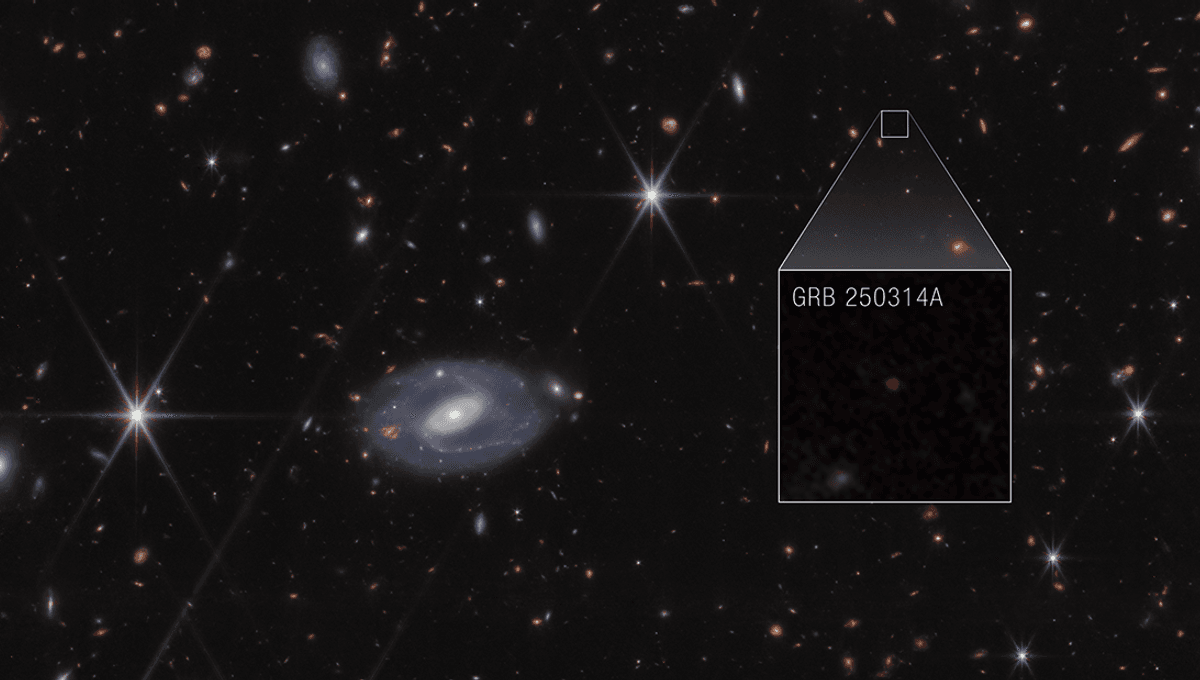
Astronomers using the JWST have traced the source of a long-duration gamma-ray burst back to a supernova that exploded around 13.07 billion years in the universe's past. The explosion is now the earliest known supernova event that we have seen, taking place when the universe was just 730 million years old.
The rest of this article is behind a paywall. Please sign in or subscribe to access the full content. On March 14, 2025, the Space-based multi-band astronomical Variable Objects Monitor (SVOM) telescope satellite detected a "super bright flash" of light lasting around 10 seconds, making it a long gamma-ray burst (LGRB). "Astronomers separate GRBs into two main classes: short (where the initial burst of gamma rays lasts less than two seconds) and long events (lasting two seconds or longer)," NASA explains. "Long bursts are linked to the explosive deaths of massive stars. When a high-mass star runs out of nuclear fuel, its core collapses and then rebounds, driving a shock wave outward through the star. Astronomers see this explosion as a supernova. The core may form a either a neutron star or a black hole." Using the Nordic Optical Telescope, the team soon found an infrared (IR) afterglow, while the Very Large Telescope (VLT) in Chile found that it had a redshift of around 7.3. That's high-redshift (where the light has been shifted into the redder end of the spectrum, due to the expansion of the universe), indicating that they were looking at an object in the very early universe. "Given the rarity of these high-redshift events and the faintness of such sources, the scientific outcome is strongly dependent on the responsiveness of the follow-up activities," the first of two papers on this supernova event explains. As such, the team quickly gained time using the JWST, the largest and most powerful infrared telescope humanity has built thus far, in order to view it better. But thanks to the expansion of the universe, the event appears slower from our perspective, as the light is stretched out by the time it reaches us, and the team used the JWST to observe the supernova when it was expected to be at its brightest. "We obtained observations with JWST/NIRCAM on 1 July 2025," paper two explains, "an epoch ∼110 days post-burst (or 13 days in the rest frame)." Using observations from the JWST and other telescopes, the teams estimate that it took place just 730 million years after the "Big Bang" banged. "There are only a handful of gamma-ray bursts in the last 50 years that have been detected in the first billion years of the universe,” Andrew Levan, the lead author of paper two and a professor at Radboud University in Nijmegen, Netherlands, and the University of Warwick in the United Kingdom, said in a statement. "This particular event is very rare and very exciting." Artist impression of the earliest supernova ever observed. Image credit: NASA, ESA, CSA, STScI, Leah Hustak (STScI) Due to the distances in time and space involved, we cannot learn a huge amount from it, and further observations of other supernovas in the early universe will be key to increasing our understanding. But what is a little puzzling about the supernova is how normal it looks. Conditions in the early universe are expected to differ from conditions in the current age of the cosmos, with stars expected to contain fewer heavy elements (supernovas are one way heavier elements are formed) and living shorter lives. But the supernova observed looked pretty normal (for a massive star undergoing collapse and forming a black hole or neutron star, of course). “We went in with open minds,” Nial Tanvir, a co-author and a professor at the University of Leicester in the United Kingdom, added. “And lo and behold, Webb showed that this supernova looks exactly like modern supernovae.” The team hopes to learn more about galaxies in the early universe, using the JWST to capture the afterglow of gamma-ray bursts. "That glow will help Webb see more and give us a ‘fingerprint’ of the galaxy," Levan added. We will learn more of these events, but for now it's pretty cool to know that astronomers have found the earliest supernova observed in the universe. So far, at least. Papers one and two are both published published in Astronomy & Astrophysics.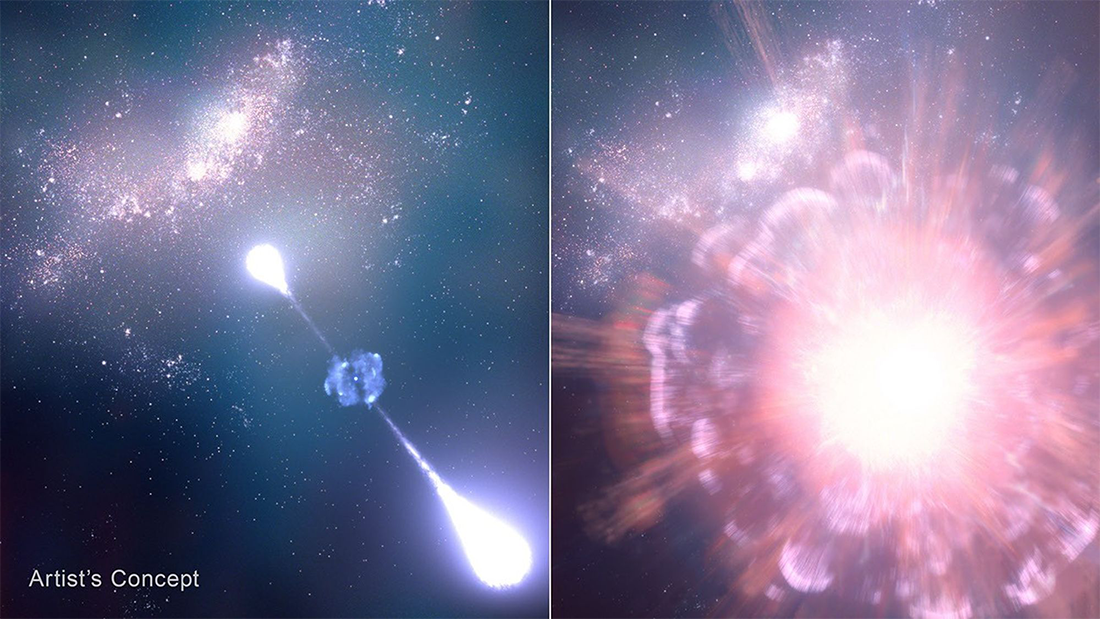

 English
 Arabic
 French
 Spanish
 Portuguese
 Deutsch
 Turkish
 Dutch
Dutch
 Italiano
 Russian
 Romaian
 Greek
Greek