


The Global LTCC and HTCC Market Size Was Valued at USD 1.1 Billion in 2023 and is Projected to Reach USD 1.56 Billion by 2032
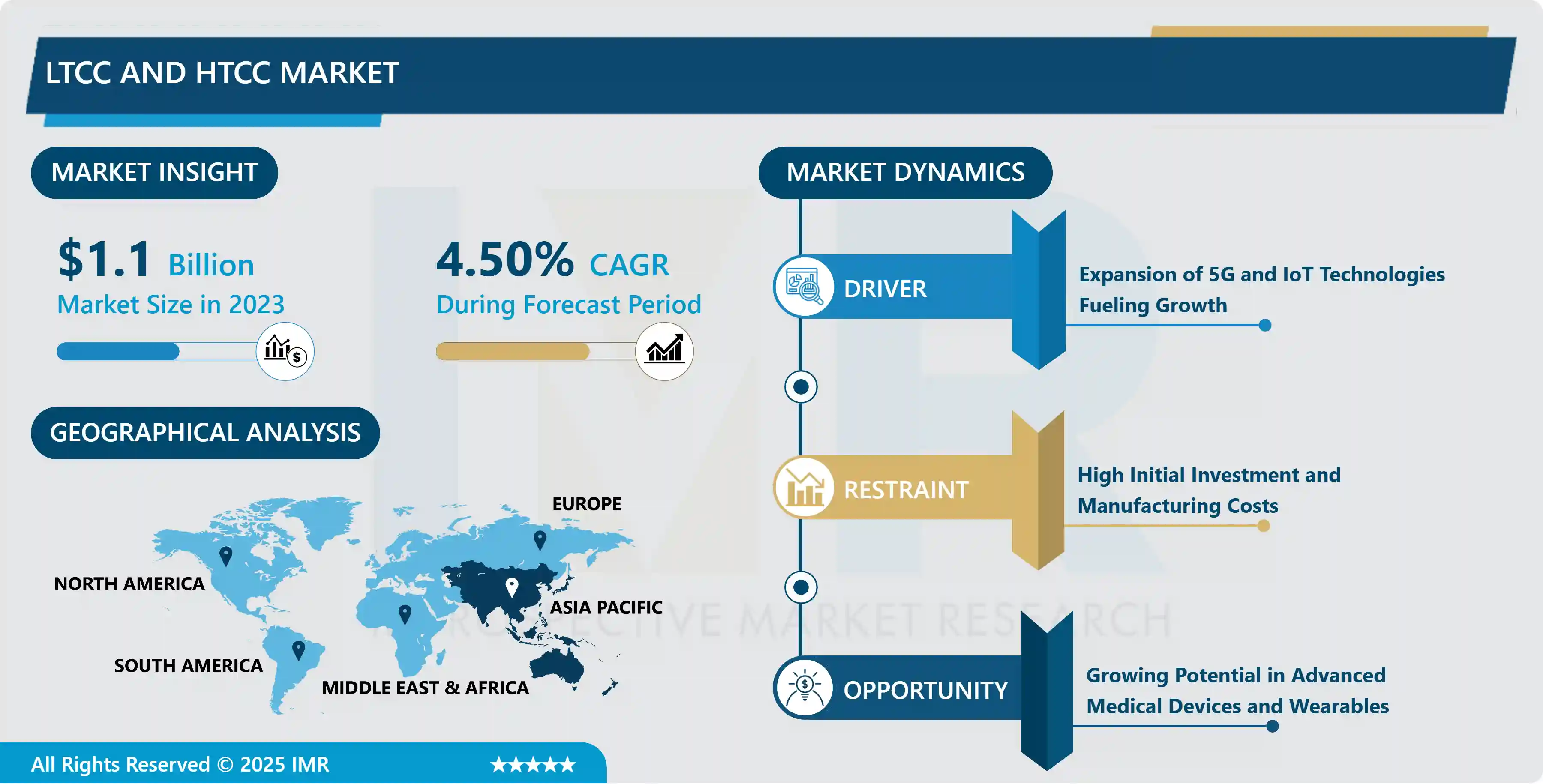
The Global LTCC and HTCC Market Size Was Valued at USD 1.1 Billion in 2023 and is Projected to Reach USD 1.56 Billion by 2032, Growing at a CAGR of 4.50%.
Low-Temperature Co-fired Ceramic (LTCC) and High-Temperature Co-fired Ceramic (HTCC) are advanced multilayer ceramic technologies used to manufacture compact, high-performance electronic components and substrates. These technologies involve stacking multiple layers of ceramic tape interspersed with conductive metal paste patterns, which are then co-fired to create a single, monolithic, and hermetically sealed structure. This fabrication method allows for the efficient integration of complex circuitry, passive components (such as resistors and capacitors), and entire antenna structures into a single, robust ceramic module, crucial for modern electronics.
The primary advantage of LTCC and HTCC over traditional Printed Circuit Board (PCB) technology lies in their superior performance characteristics, including excellent stability at high frequencies, exceptional thermal management capabilities, and unmatched reliability in harsh operating conditions. While HTCC offers unmatched mechanical strength and high thermal conductivity (fired above 1500°C), LTCC (fired below 1000°C) allows for the use of high-conductivity metals like silver and gold, minimizing signal loss. These properties make them indispensable for applications requiring tight tolerance, thermal stability, significant miniaturization, and hermetic sealing. They are mainly deployed in high-power modules, radio frequency (RF) front-ends, and sophisticated sensor packages across major industrial sectors.
👉 To request a sample report:
https://introspectivemarketresearch.com/request/18298
Market Segmentation
The LTCC and HTCC Market is segmented into Product Type, Application, and Material. By Product Type, the market is categorized into (LTCC, HTCC). By Application, the market is categorized into (Communication/Telecom, Automotive Electronics, Consumer Electronics, Aerospace & Defense). By Material, the market is categorized into (Alumina, Glass-Ceramic, Others).
Growth Driver
The principal market driver is the relentless demand for component miniaturization and high-speed data transmission required by modern, sophisticated electronic devices. With the rapid proliferation of portable IoT sensors, complex medical wearables, and high-performance computing systems, manufacturers necessitate circuit substrates that offer substantially higher wiring density and superior component integration without increasing the physical size. LTCC and HTCC substrates fulfill this critical need by enabling complex three-dimensional circuit integration and the embedding of passive components, effectively reducing the overall footprint of electronic modules while simultaneously enhancing their operational speed, power handling, and overall functionality across all major application sectors.
Market Opportunity
A key market opportunity is the massive global deployment of 5G and future-generation communication networks. 5G infrastructure operates at increasingly higher frequencies (including mmWave), where signal losses in traditional PCB materials become prohibitive. LTCC substrates are ideally suited for these high-frequency applications, offering low dielectric loss and excellent co-firing capabilities essential for 5G antenna modules, sophisticated filters, and high-linearity power amplifiers in base stations. As the development of 6G accelerates and the need for thermally stable, high-reliability RF front-ends intensifies within the telecommunications industry, the LTCC segment, in particular, is poised for significant revenue expansion.
Detailed Segmentation
Title: LTCC and HTCC Market, Segmentation Line below: The LTCC and HTCC Market is segmented on the basis of Product Type, Application, and Material.
Product Type
The Product Type segment is further classified into LTCC and HTCC. Among these, the LTCC sub-segment accounted for the highest market share in 2023. LTCC is the preferred technology for many high-volume applications due to its lower processing temperature, which allows for the use of high-conductivity metals like gold and silver for interconnects, ensuring minimal signal loss at high frequencies. This superior electrical performance, coupled with a more cost-effective manufacturing process compared to HTCC, facilitates higher component integration and excellent performance. It is therefore widely adopted in cost-sensitive, high-volume markets such as consumer electronics and wireless communication modules where maintaining signal integrity is paramount, leading to its current market dominance.
Application
The Application segment is further classified into Communication/Telecom, Automotive Electronics, Consumer Electronics, and Aerospace & Defense. Among these, the Communication/Telecom sub-segment accounted for the highest market share in 2023. The Communication/Telecom segment commands the largest market share, directly fueled by the continuous evolution of wireless standards, most notably the transition to 5G and the growth of satellite communication. LTCC and HTCC devices are essential components across the communication ecosystem, from highly complex filtering systems and power amplifiers in base stations to miniaturized RF components in smartphones and IoT transceivers. Their inherent ability to handle high power, manage heat efficiently, and provide low signal distortion is critical for reliable network operation, positioning this sector as the largest consumer.
Some of The Leading or Active Market key Players Are-
Kyocera Corporation (Japan) Murata Manufacturing Co., Ltd. (Japan) TDK Corporation (Japan) Samsung Electro-Mechanics (South Korea) Taiyo Yuden Co., Ltd. (Japan) Walsin Technology Corporation (Taiwan) Via Electronic GmbH (Germany) Vishay Intertechnology, Inc. (United States) NTK Technical Ceramics (Japan) TTM Technologies (United States) AdTech Ceramics (United States) Hitachi Metals (Japan) Northrop Grumman Corporation (United States) KOA Corporation (Japan) Airpax Corporation (United States) and other active players.
Key Industry Developments
In March 2024, Murata Manufacturing announced the mass production of a new ultra-compact LTCC filter for mmWave 5G applications. This development directly addressed the severe space constraints and stringent performance demands of next-generation 5G mobile devices. The new filter features a 50% smaller footprint and significantly lower insertion loss than previous models, enabling smartphone manufacturers to pack more features into smaller devices while improving overall battery life and high-frequency signal reliability.
In November 2023, Kyocera Corporation invested heavily in expanding its HTCC manufacturing capacity in response to growing automotive electrification demand. This strategic capacity expansion was specifically designed to capture the accelerating market for high-power, thermally robust ceramic modules required for Electric Vehicle (EV) battery management systems, invertors, and on-board chargers. The move underlines the indispensable role of HTCC technology in achieving high-reliability and high-temperature tolerance in critical automotive electronics.
Key Findings of the Study
· Dominant Segments: Low-Temperature Co-fired Ceramic (LTCC) product type and the Communication/Telecom application are the largest revenue contributors.
· Leading Regions: The Asia Pacific region (APAC) maintains market dominance due to its concentration of major electronics manufacturing hubs.
· Key Growth Drivers: The primary catalysts are the continuous push for component miniaturization and the critical need for substrates with superior high-frequency performance in modern devices.
· Market Trends: A notable trend is the increasing integration of embedded passive components and significant R&D in materials optimized specifically for 5G and 6G communication applications.
🔍 𝐈𝐧-𝐃𝐞𝐩𝐭𝐡 𝐑𝐞𝐩𝐨𝐫𝐭:
https://introspectivemarketresearch.com/reports/ltcc-and-htcc-market/
About Introspective Market Research
Introspective Market Research is a global provider of data-driven market intelligence and strategic advisory services. Our analysts and consultants deliver comprehensive reports, actionable insights and customized consulting to clients across chemicals & materials, healthcare, energy, environment, infrastructure, and advanced manufacturing sectors.
Media Contact:
Introspective Market Research.
Email: press@introspectivemarketresearch.com
Website: http://www.introspectivemarketresearch.com
Phone: +91-91753-37569

 English
 Arabic
 Spanish
 Portuguese
 Deutsch
 Turkish
 Dutch
Dutch
 Italiano
 Russian
 Romaian
 Portuguese (Brazil)
 Greek
Greek