


There’s Finally An Explanation For The Longest Known Gamma Ray Burst’s Appearance – But A Key Mystery Remains
There’s Finally An Explanation For The Longest Known Gamma Ray Burst’s Appearance – But A Key Mystery Remains
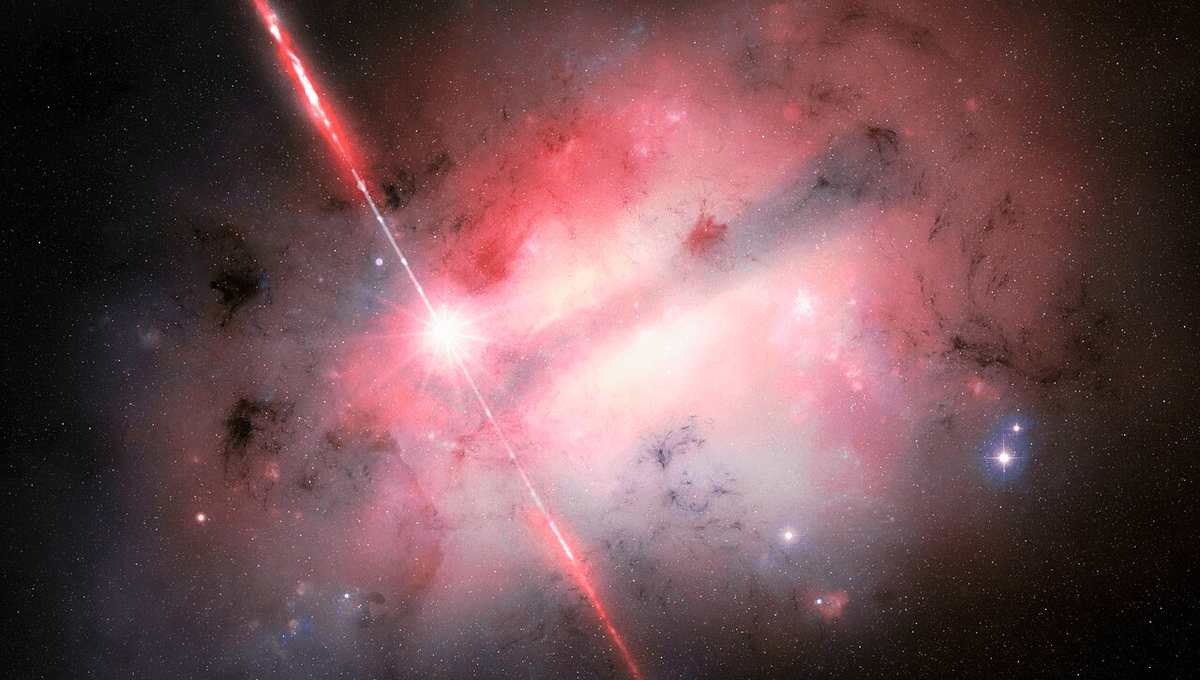
Telescopes operating up and down the electromagnetic spectrum have confirmed that the longest gamma ray burst (GRB) was produced by a jet of material traveling at close to the speed of light in a distant galaxy. The environment in which the jet was moving was particularly dusty, which obscured our view at visible wavelengths, but we don’t know if that’s relevant to its extreme length.
The rest of this article is behind a paywall. Please sign in or subscribe to access the full content. More than 15,000 GRBs have been detected in the 52 years since we gained the capacity to find them. Many of these last less than two seconds and come from within the Milky Way. Longer bursts come from other galaxies, but are still usually a matter of seconds or a few minutes. The GRB detected on July 2 this year, and known as 250702B, is an outlier, and astronomers are very keen to understand anything so unusual. Consisting of several sub-bursts, GRB 250702B was measured over seven hours. Moreover, an earlier X-ray detection of a failing afterglow suggests we probably saw the tail-end of something that lasted more than a day. The total energy emitted is thought to have been greater than any other event humanity has witnessed, including the much more powerful, but shorter, GRB dubbed the Brightest of All Time (BOAT). When something like this happens, telescopes drop what they are doing and pivot to observe it. “The ability to rapidly point the Blanco and Gemini telescopes on short notice is crucial to capturing transient events such as gamma-ray bursts,” said University of North Carolina graduate student and team lead Jonathan Carney in a statement. “Without this ability, we would be limited in our understanding of distant events in the dynamic night sky.” The actual view from seven billion light-years away is a bit less dramatic, even when combining the NSF Víctor M. Blanco 4-meter Telescope at Cerro Tololo Inter-American Observatory with the Giant Gemini North. Image credit: International Gemini Observatory/CTIO/NOIRLab/DOE/NSF/AURA Image processing: J. Miller (International Gemini Observatory/NSF NOIRLab), M. Zamani & D. de Martin (NSF NOIRLab) An analysis of several of these telescopes’ findings confirmed the event occurred at a distance of about 7 billion light-years. The area around the burst has been found to be very dusty. Carney and 33 co-authors think some event released a staggeringly powerful jet into this dusty material, which lay within two galaxies in the process of merging into a medium-sized galaxy. The dust could be local, the product of a scaled-up version of Betelgeuse’s sneeze, or because the event happened behind a denser version of one of the Milky Way’s dust lanes. This dust, along with some in our own galaxy, meant optical wavelengths were the one part of the spectrum in which GRB 250702B was invisible, but telescopes saw the original burst, or the afterglow, at other wavelengths. The context explains what we could and couldn’t see, but we don’t know if the unusual nature of the galaxy is relevant to the question everyone wants answered: What caused the GRB in the first place? The authors consider three scenarios to be the favorites: All of these have been proposed to explain the next longest GRBs, ones that, while substantially shorter than GRB 250702B, are still sufficiently distinct from most long GRBs as to represent a separate class. If GRB 250702B was caused by the same category of events as other ultra-long GRBs, then we don’t know what made it so much longer, but a better understanding of the context may help. If its cause was something completely different, then astronomers are at a loss to know what that could be. The study is published in The Astrophysical Journal Letters.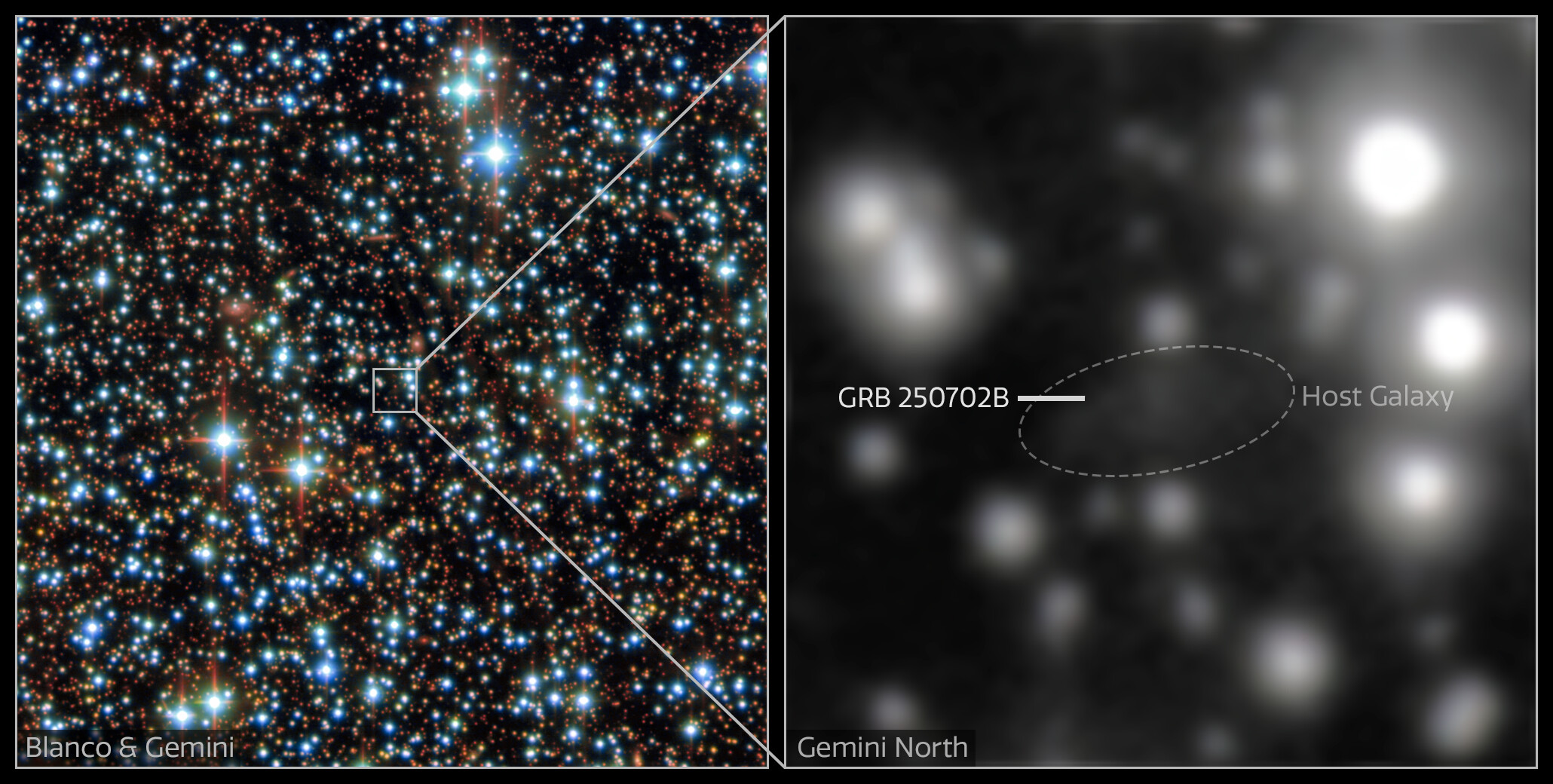

 English
 Arabic
 Spanish
 Portuguese
 Deutsch
 Turkish
 Dutch
Dutch
 Italiano
 Russian
 Romaian
 Portuguese (Brazil)
 Greek
Greek