


The Final Secret Of Self-Healing Roman Concrete May Have Been Cracked
The Final Secret Of Self-Healing Roman Concrete May Have Been Cracked
The Roman Empire was literally built on a special form of extra-tough, self-healing concrete that has managed to stay strong for thousands of years. Modern scientists have previously been puzzled about how they made this “magic” building material, but new discoveries from Pompeii are offering fresh clues.
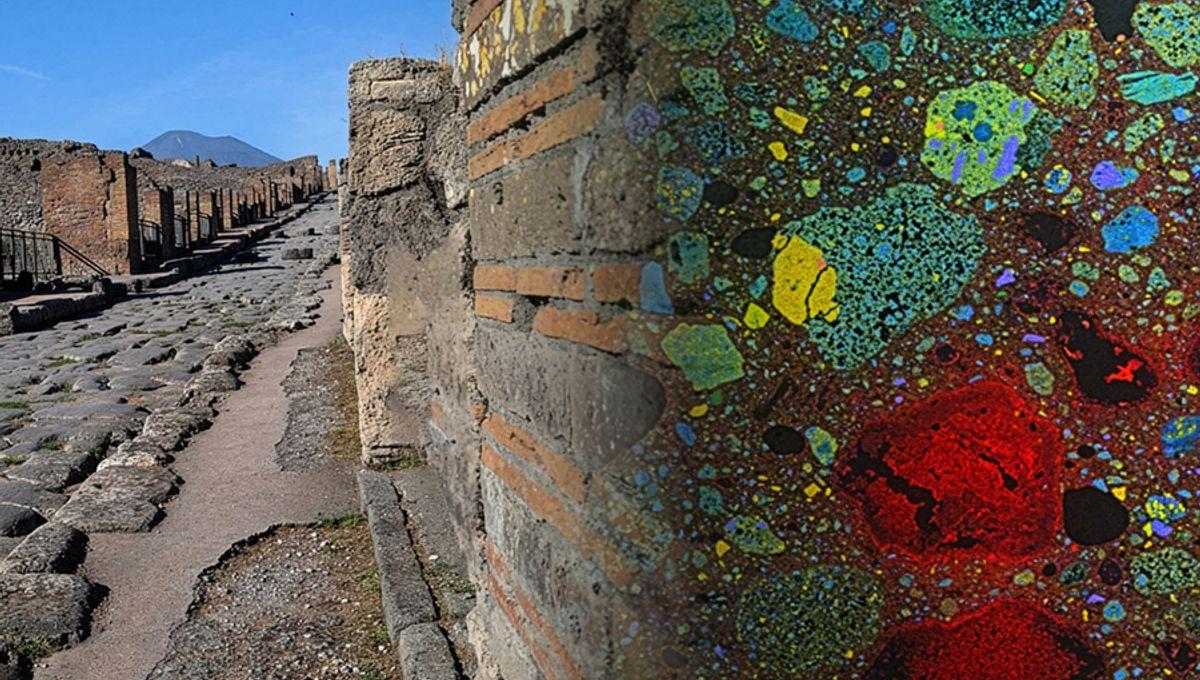
The rest of this article is behind a paywall. Please sign in or subscribe to access the full content. The findings come from the same team at MIT that described a potential recipe for Roman concrete in 2023. They primarily based this theory on a city wall in Priverno in southwest Italy, which was conquered by the Romans in the 4th century BCE. This is what they found: a key ingredient is pozzolan, a reactive volcanic powder that comes from the city of Pozzuoli, just outside Naples and near the infamous Mount Vesuvius. The researchers argued that this unusual material was mixed with fragments of lime and other dry materials. Finally, water is added to this dry mix, then it's heated in a process known as “hot mixing.” As the concrete sets, this method preserves pockets of highly reactive lime in the form of small, white grains. If cracks later form in the structure, these lime clasts can dissolve and recrystallize, filling in the gaps. This effectively gives Roman concrete the ability to self-heal – pretty smart for 2,000-year-old technology, to say the least. “Roman cement is durable, it heals itself, and it’s a dynamic system,” Admir Masic, study author and Associate Professor at MIT, said in a statement. “The way these pores in volcanic ingredients can be filled through recrystallization is a dream process we want to translate into our modern materials. We want materials that regenerate themselves.” In their new study, the MIT researchers have attempted to fix a crack in their own theory. The process they identified in 2023 was slightly different from the one described by Vitruvius, the Roman engineer who wrote the surviving work on architecture from classical antiquity, De architectura libri decem. In this ancient treatise, Vitruvius explained that the Romans added water to lime to create a paste-like material before mixing it with other ingredients, as opposed to mixing the dry material and then adding water. Weirdly, there’s no direct mention of the crucial “hot mixing” step. “Having a lot of respect for Vitruvius, it was difficult to suggest that his description may be inaccurate,” said Masic. “The writings of Vitruvius played a critical role in stimulating my interest in ancient Roman architecture, and the results from my research contradicted these important historical texts.” To learn more, Masic and the team looked at the archaeological remains of an ancient construction yard in Pompeii, the famous Roman town destroyed by a hellish volcanic eruption in 79 CE. The team took samples from this incredible site and conducted microstructural and chemical analyses on pre-mixed dry material piles, a partially built wall, completed buttresses and structural walls, and mortar repairs in an existing wall. They found that quicklime fragments had been pre-mixed with other ingredients in a dry raw material pile, indicating that the researchers' 2023 theory was correct. “Through these stable isotope studies, we could follow these critical carbonation reactions over time, allowing us to distinguish hot-mixed lime from the slaked lime originally described by Vitruvius,” Masic explained. “These results revealed that the Romans prepared their binding material by taking calcined limestone (quicklime), grinding them to a certain size, mixing it dry with volcanic ash, and then eventually adding water to create a cementing matrix.” This is unusual because Vitruvius doesn’t mention hot-mixing, plus it says water is added early into the mix. However, it doesn’t necessarily mean he was wrong. De architectura isn’t a tightly polished book in the modern sense, but rather a collection of notes and insights from Vitruvius that have been compiled by a bunch of writers and editors over the centuries. Masic believes that Vitruvius may have just been misinterpreted. Alternatively, he notes that De architectura does mention latent heat during the cement mixing process, which may be referring to hot-mixing. The study is published in the journal Nature Communications.

 Arabic
 French
 Spanish
 Portuguese
 Deutsch
 Turkish
 Dutch
Dutch
 Italiano
 Russian
 Romaian
 Portuguese (Brazil)
 Greek
Greek