


The Global Protein Engineering Market Size Was Valued at USD 2.7 Billion in 2023 and is Projected to Reach USD 10.5 Billion by 2032
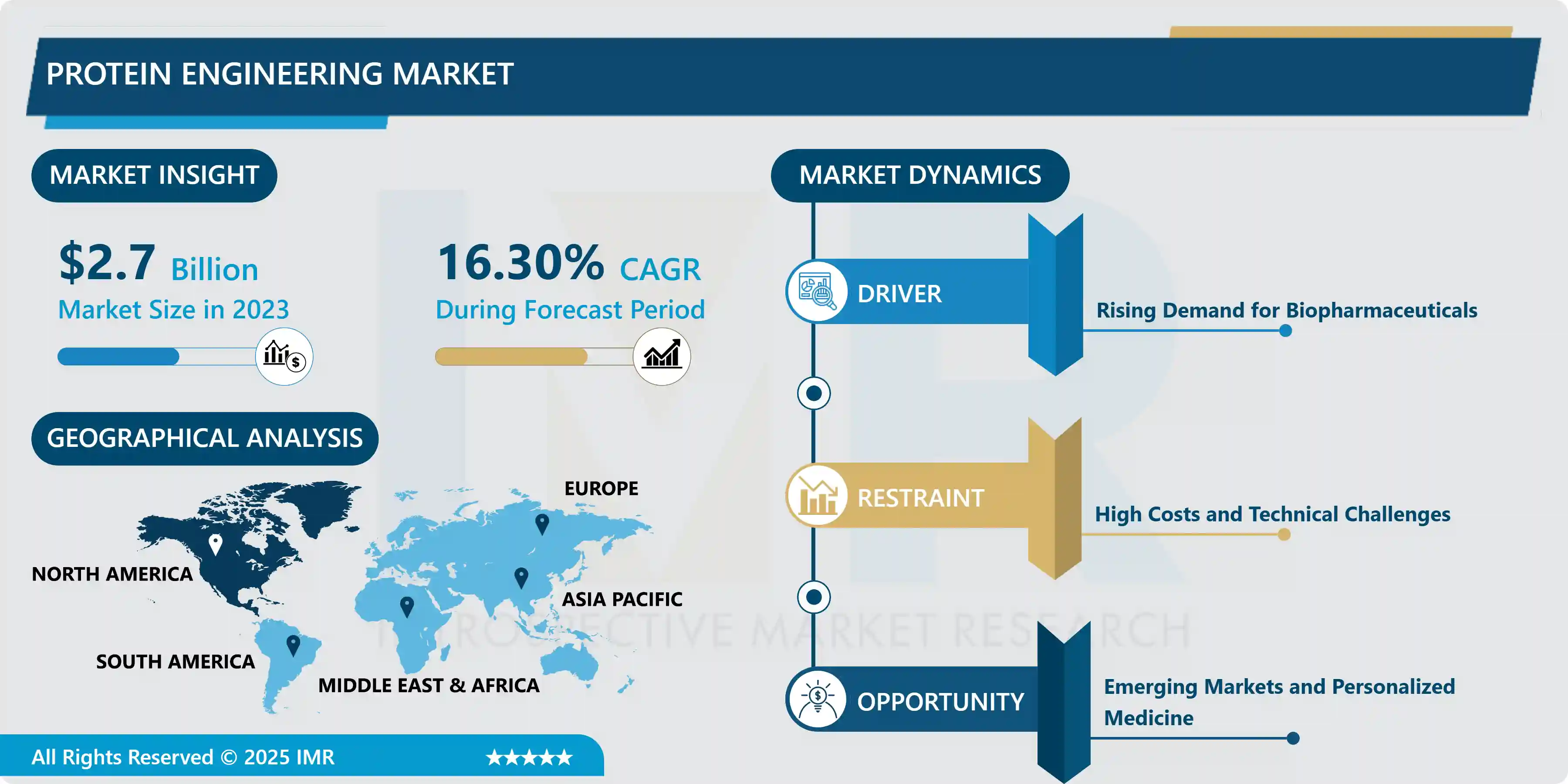
The Global Protein Engineering Market Size Was Valued at USD 2.7 Billion in 2023 and is Projected to Reach USD 10.5 Billion by 2032, Growing at a CAGR of 16.3%.
Protein engineering is a revolutionary field of biotechnology focused on developing useful or valuable proteins through modification of existing natural proteins or the creation of entirely synthetic ones. This discipline leverages advanced molecular biology and computational techniques to alter protein structure, resulting in enhanced properties such as increased stability, modified substrate specificity, or superior binding affinity. The resulting engineered proteins are fundamentally critical components in the rapidly expanding biopharmaceutical and industrial sectors.
These customized proteins offer immense advantages over their natural counterparts, chiefly by accelerating the discovery and optimization of novel therapeutics and industrial biocatalysts. For instance, engineered therapeutic antibodies can be designed for improved efficacy and reduced immunogenicity, leading to safer and more effective treatments for chronic diseases. The main uses of these technologies span major industries, including the development of biopharmaceuticals (therapeutic antibodies, recombinant vaccines), advanced diagnostics (highly specific detection assays), and industrial biotechnology (optimized enzymes for biofuels and food processing).
👉 To request a sample report:
https://introspectivemarketresearch.com/request/18063
Market Segmentation
The Protein Engineering Market is segmented into Technology, Product, and Application. By Technology, the market is categorized into (Directed Evolution, Rational Design, Hybrid Approaches). By Product, the market is categorized into (Engineered Proteins, Instruments, Services, Others). By Application, the market is categorized into (Therapeutics, Diagnostics, Industrial).
Growth Driver
The explosive growth in the development of next-generation biologics, particularly therapeutic monoclonal antibodies (mAbs) and novel fusion proteins, is the core factor driving the expansion of the Protein Engineering Market. Monoclonal antibodies represent one of the fastest-growing therapeutic classes, and protein engineering techniques are indispensable for optimizing these complex molecules. Engineering allows researchers to enhance characteristics such as antibody affinity for target antigens, reduce potential systemic toxicity, and increase the half-life of the drug in the body, making treatments more convenient and effective for patients. This relentless demand for better, more potent biologics ensures sustained high investment in protein engineering R&D.
Market Opportunity
A significant market opportunity lies in the burgeoning application of customized proteins for gene editing and cell therapy applications, specifically in advancing CRISPR technology. Protein engineering is used to enhance the efficiency and precision of CRISPR-associated enzymes (like Cas9), reducing off-target edits and expanding the range of delivery methods. Furthermore, engineering is critical for developing sophisticated chimeric antigen receptor (CAR) T-cells for cancer immunotherapy, allowing scientists to design receptors with better targeting capabilities and reduced risk of side effects. As these fields move from research to mainstream clinical use, the need for highly customized and effective engineered proteins will soar, creating a massive commercial runway.
Detailed Segmentation
Title: Protein Engineering Market, Segmentation Line below: The Protein Engineering Market is segmented on the basis of Technology, Product, and Application.
By Technology
The Technology segment is further classified into Directed Evolution, Rational Design, and Hybrid Approaches. Among these, the Directed Evolution sub-segment accounted for the highest market share in 2023. Directed Evolution is the dominant technology because it mimics the process of natural selection in a laboratory setting, enabling the rapid and efficient screening of millions of protein variants to identify those with superior characteristics (e.g., stability or activity). This high-throughput, trial-and-error methodology is particularly effective when the underlying structure-function relationship of the target protein is poorly understood. Its power lies in its ability to quickly generate vast libraries of functional proteins for both therapeutic and industrial applications.
By Product
The Product segment is further classified into Engineered Proteins, Instruments, Services, and Others. Among these, the Engineered Proteins sub-segment accounted for the highest market share in 2023. This sub-segment's leadership is directly linked to the high commercial value and massive sales of protein-based drugs, primarily therapeutic antibodies. Engineered proteins are the end product that drives clinical efficacy and revenue across the biopharmaceutical industry. The continuous need for more potent and safer biologic drugs, coupled with the increasing prevalence of chronic diseases requiring long-term treatment with biologics, solidifies the revenue-dominant position of this product category over instruments and services.
Some of The Leading or Active Market key Players Are-
Thermo Fisher Scientific Inc. (United States) Danaher Corporation (United States) Merck KGaA (Germany) Abcam plc (United Kingdom) GenScript Biotech Corporation (China) Waters Corporation (United States) Agilent Technologies, Inc. (United States) Bio-Rad Laboratories, Inc. (United States) Amgen Inc. (United States) Twist Bioscience (United States) Sartorius AG (Germany) Creative Enzymes (United States) Arzeda (United States) Codexis, Inc. (United States) Novozymes A/S (Denmark) and other active players.
Key Industry Developments
In May 2024, Twist Bioscience announced a collaboration with a leading pharmaceutical company to accelerate drug discovery using synthetic DNA libraries. This partnership leverages Twist's high-throughput silicon platform for generating massive, custom-designed gene fragments and protein variants. The primary goal is to drastically shorten the time required to discover and optimize novel therapeutic targets by utilizing synthetic biology to rapidly screen millions of potential protein candidates, accelerating the pipeline for next-generation medicines.
In February 2024, DeepMind’s AlphaFold was integrated into research workflows by several major biotech firms for structure-based rational design. This marked a significant adoption of AI/ML tools, allowing scientists to accurately predict the 3D structure of novel proteins based purely on their amino acid sequences. This integration enhances the precision of rational design approaches, reducing the need for extensive experimental lab work, lowering R&D costs, and enabling the engineering of proteins with highly targeted functions.
Key Findings of the Study
· Dominant Segments: Directed Evolution leads the Technology segment, while the Engineered Proteins product segment generates the highest revenue.
· Leading Regions: North America maintains market dominance due to high R&D spending and a strong biopharmaceutical industry presence.
· Key Growth Drivers: The surge in development and optimization of therapeutic biologics, particularly complex monoclonal antibodies.
· Market Trends: Increasing integration of Artificial Intelligence and Machine Learning (AI/ML) tools, like AlphaFold, to boost the efficiency of protein design.
🔍 𝐈𝐧-𝐃𝐞𝐩𝐭𝐡 𝐑𝐞𝐩𝐨𝐫𝐭:
https://introspectivemarketresearch.com/reports/protein-engineering-market/
About Introspective Market Research
Introspective Market Research is a global provider of data-driven market intelligence and strategic advisory services. Our analysts and consultants deliver comprehensive reports, actionable insights and customized consulting to clients across chemicals & materials, healthcare, energy, environment, infrastructure, and advanced manufacturing sectors.
Media Contact:
Introspective Market Research.
Email: press@introspectivemarketresearch.com
Website: http://www.introspectivemarketresearch.com
Phone: +91-91753-37569

 English
 Arabic
 Spanish
 Portuguese
 Deutsch
 Turkish
 Dutch
Dutch
 Italiano
 Russian
 Romaian
 Portuguese (Brazil)
 Greek
Greek