


Gravitational Lenses Confirm That Something Is Still Broken In The Universe
Gravitational Lenses Confirm That Something Is Still Broken In The Universe
Researchers have calculated one of the most precise estimates for the expansion rate of the universe today, and it turns out we still have a massive problem. This new value continues to strengthen the dilemma known as the Hubble tension. Different methods have produced distinct numbers for this one single value, and we just got a new one!
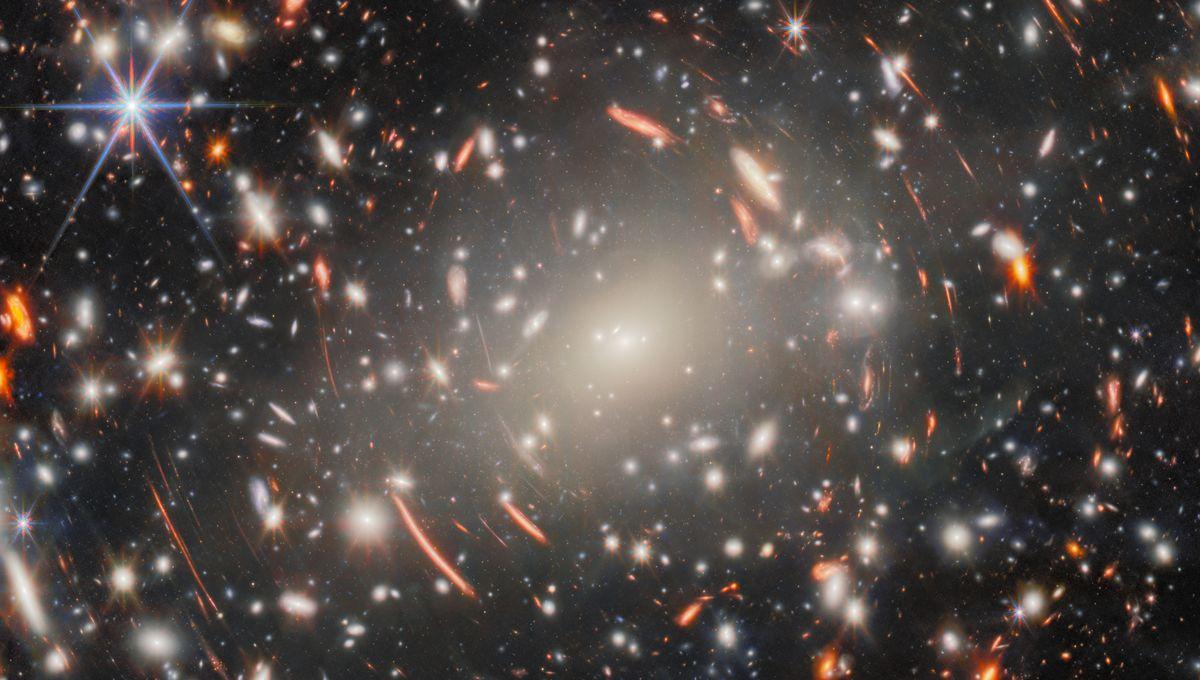
The rest of this article is behind a paywall. Please sign in or subscribe to access the full content. The universe is believed to be experiencing an accelerating expansion. The expansion rate, also known as the Hubble constant, can be obtained in multiple ways. One way is from the cosmic microwave background (CMB), the first light that moved freely in the cosmos. Another way is to measure the distance of galaxies and how quickly they appear to recede from us. These two approaches have reached, in the last decade, incredible precision. The problem is that the two numbers are not the same and the uncertainties do not overlap. Several alternatives exist and have been used to help resolve this issue. One of them, called time-delay cosmography, has just produced an interesting result, strengthening the case that things are not gelling together. The basis of this approach is gravitational lensing, the warping of space-time produced by massive galaxies. This warp act like a lens, so more distant objects have their light multiplied and magnified. Within these images there is hidden data about reality, and the team used some of the most advanced telescopes in the world – such as JWST, Keck, and the Very Large Telescope (VLT) – to find it. The Hubble tension is potentially the most important open issue in cosmology right now. Professor Tommaso Treu “When a light source is almost exactly behind a massive foreground galaxy (the lens or deflector), the observer can see multiple images of the source (as in the graphic). The images do not arrive all at the same time, because the light paths are different. We measured the delay between the images and from that we inferred the distances between us, the lens, and the source. By measuring distances one can reconstruct the expansion history of the universe, and ultimately the Hubble constant,” co-author professor Tommaso Treu, of the University of California, Los Angeles, told IFLScience. The observations of the CMB conducted by the European Space Agency’s Planck satellite place the value of the Hubble constant at 67.4 kilometers (42 miles) per second per megaparsec, with 1 megaparsec being 3.26 million light-years. This means that if two galaxies are 1 megaparsec apart, the expansion of the universe would make them look like they are moving away from each other at a speed of 67.4 kilometers per second. This was recently confirmed by a different CMB observatory that worked for about 20 years. Using Hubble and JWST data, researchers got instead a value of 72.8 kilometers (45.2 miles) per second per megaparsec. The uncertainties on each value are small, and they don’t overlap. The numbers, even in scientific terms, are different. The value from this time-delay cosmography is of 71.6 kilometers (44.5 miles) per second per megaparsec. The uncertainty on this value is of +3.9 and -3.3, making this value in agreement with the galaxy method, but not with the CMB. The precision of this value is currently lower than the other two methods, but the team has plans to strengthen it, by collecting more gravitational lenses with high quality data for each lens. “The kind of data we got with Keck/VLT/JWST are essential, as they tell us how stars move in the lens and thus they help us characterize the light paths. In fact, we have a Keck observing run coming up next week to do just that,” Professor Treu told IFLScience. Researchers using time-delay cosmography independently confirmed that the universe's current rate of expansion, known as the Hubble constant, does not match values predicted from measurements from the universe when it was much younger. Image credit: W. M. Keck Observatory/Adam Makarenko Solving the Hubble tension is fundamental to help us understand what the universe is like. It is possible that any or all measurements are underestimating their uncertainties, and these methods are actually in agreement. Or, we are facing a profound crisis and there is something fundamentally wrong with our model of the universe. “[T]he Hubble tension is potentially the most important open issue in cosmology right now, and multiple independent measurements are needed to be sure it's really a new phenomenon and not simply a measurement error. Time-delay cosmography is completely independent of all other methods and it is thus particularly valuable,” Professor Treu told IFLScience. The study is published in the journal Astronomy and Astrophysics.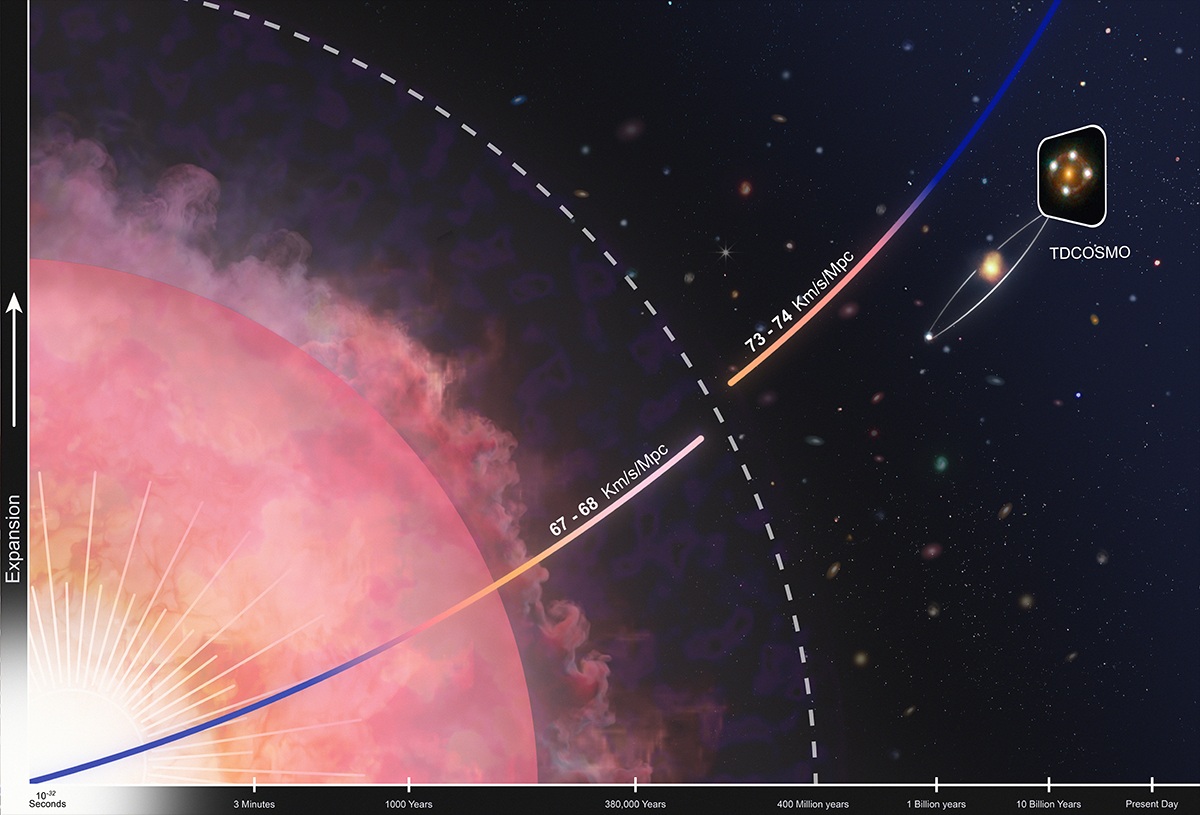

 English
 French
 Spanish
 Portuguese
 Deutsch
 Turkish
 Dutch
Dutch
 Italiano
 Russian
 Romaian
 Portuguese (Brazil)
 Greek
Greek