


Emperor Penguins Could Be Disappearing Faster Than Even Our Worst Fears
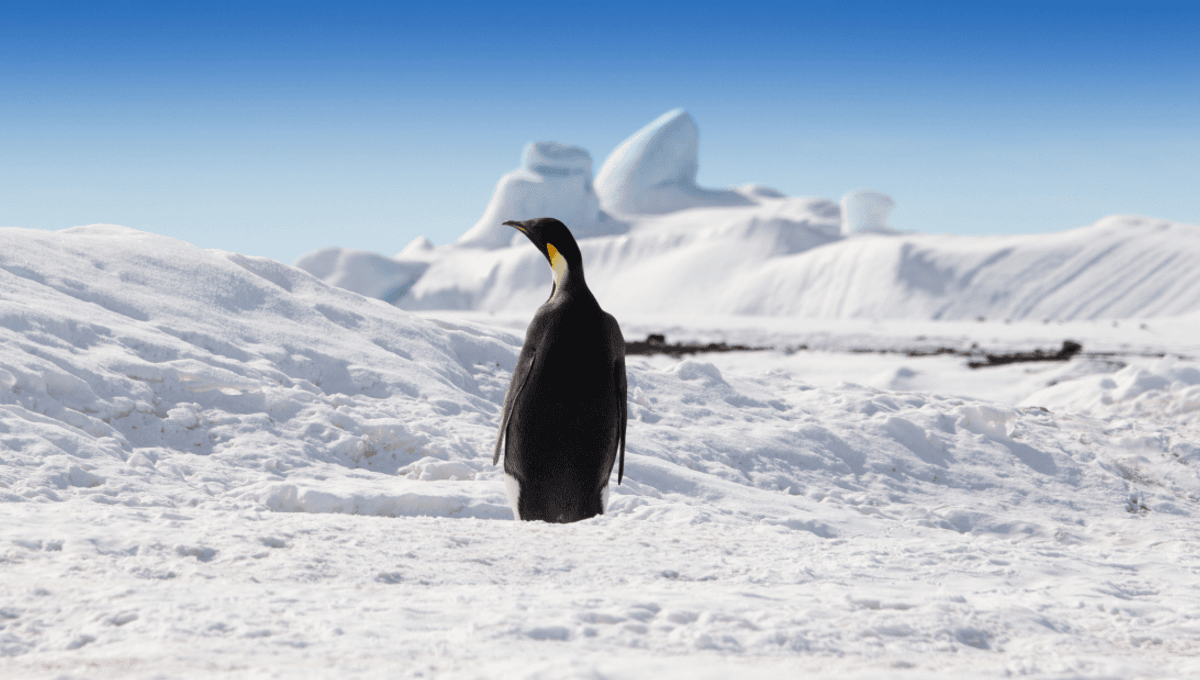
“The Decline Is Worse Than The Worst-Case Projections”: Emperor Penguin Numbers Slashed By A Quarter In 15 Years
The results of a new analysis into the decline of emperor penguins are in, and they aren’t good. Using satellite imagery, the British Antarctic Survey (BAS) says that their numbers appear to have dropped by 22 percent over a 15-year period, from 2009 to 2024. This decline is only based on one region of the penguins' total habitat in Antarctica, encompassing the Antarctic Peninsula, Weddell Sea, and Bellingshausen Sea, but it already paints a worrying picture for the species.
“There's quite a bit of uncertainty in this type of work and what we've seen in this new count isn't necessarily symbolic of the rest of the continent,” said Dr Peter Fretwell, who studies wildlife from space at BAS, in a statement, “but if it is - that's worrying because the decline is worse than the worst-case projections we have for emperors this century.” The last survey of this kind across Antarctica as a whole found a population drop of 9.5 percent in the decade leading up to 2018. While this new study only reports on a limited area, the survey still encompasses 30 percent of the global emperor penguin population. The surveying technique relies on estimating the number of individuals present in satellite imagery, which, while an imperfect approach, is the best approximation that scientists currently have for reviewing their habitats remotely. We are already acutely aware that the rapidly changing climate and subsequent sea ice loss are a critical development in the demise of emperor penguins. However, that the outcome already looks worse than even our most pessimistic estimates indicates that there may be more factors at play. Satellite imagery of the Halley Bay emperor penguin colony. Image credit: ©2025 Maxar Technologies “The fact that we're moving to a position faster than the computer models project means there must be other factors we need to understand in addition to loss of breeding habitat,” said Dr Phil Trathan, co-author and emeritus fellow at BAS. “The only way we'll see a turnaround for the population is if we stabilise greenhouse gas emissions. If we don't, we'll probably have relatively few emperor penguins left by the turn of this century.” Another poorly understood and emerging threat to the Antarctic ecosystem is trawling, a damaging fishing practice that’s now reached what should be the planet’s most pristine waters. Krill form the basis of the food chain here, eaten by penguins, whales, seals, and sea birds, but in 2024, around half a million tonnes of krill were hauled out of the ocean by humans. The effects? We just don’t know yet. “This is the scary thing, this is sort of a new frontier,” said Toby Nowlan, director of Ocean with Sir David Attenborough, to IFLScience. “What we do know is that the entire Southern Ocean and the Antarctic is reliant essentially on just a single species. Almost every animal down there, almost every penguin and whale and seal is reliant on krill. It's a very rare ecosystem that's so reliant on that foundational species.” ⓘ IFLScience is not responsible for content shared from external sites. “We also know that these krill cluster and concentrate in a few key areas, which is where the wildlife therefore go to feed. That is where these ships are going, these enormous ships, and we know that they are hoovering up vast amounts of krill, and this is the same food source as this wildlife.” They are basically taking the krill out of the mouths of the whales. Enric Sala “They are basically taking the krill out of the mouths of the whales,” added marine ecologist Enric Sala, Executive Producer and Scientific Advisor on Ocean, and National Geographic Explorer. “They are concentrating this effort in the Antarctic Peninsula, which is a critical area for marine life across Antarctica, and there are proposals by most nations of the world, except China and Russia, to protect key areas in the Antarctic Peninsula, so these areas can be safe from industrial exploitation.” “This is the last wilderness on Earth, really the last truly wild place, and we [could be about to see] the last wild place on Earth, which is the heritage of all of humanity, become prey of industrial exploitation for the benefit of a few.” The study is published in Communications Earth & Environment.

 English
 Arabic
 French
 Spanish
 Deutsch
 Turkish
 Dutch
Dutch
 Italiano
 Russian
 Romaian
 Portuguese (Brazil)
 Greek
Greek